

of an orogenic cycle, have been proposed (Zwart, 1967;
Pitcher 1979; Ernst, 2005; Frisch et al., 2011):
(i) Cordilleran-type or arc-type orogens are dominated by
I-type (derived from the melting of a igneous protolith)
andesitic volcanism and granodioritic batholiths.
These orogens are not formed by continent–continent
collision but rather developed during a geologically
long period of oceanic subduction beneath
a continental margin. Although these orogens may
experience a protracted history including collisions
(with
seamounts,
oceanic
plateaus,
or
microcontinents), abyssal sedimentary rocks, a suture
zone, and basement nappes are generally missing.
Above the downgoing oceanic plate, huge sedimentary sequences form thrust sheets of an accretionary
wedge. The distribution of metamorphic rocks in such
orogens can be described as paired metamorphic belts
parallels to the chain. Low pressure–high temperature
metamorphism occurs along the magmatic arc, while
high pressure–low temperature rocks are present as
part of a mélange incorporated to the accretionary
wedge.
(ii) Alpine-type orogens result from the collision of two
continents after subduction of an oceanic plate. Such
orogens form relatively narrow belts, which are dominated by thick nappe stacks involving basement of
different metamorphic pressure–temperature evolution. The nappes experience considerable deformation and large-scale overthrusting in the order of
100 km or more. Ophiolitic material marks the suture
zone between the initially separated continents, where
the separating oceanic plate has been consumed. Typically, one or more tectonic units record high-pressure
(blueschist and/or eclogite facies) or even ultrahighpressure metamorphism (>2.7 GPa). They are
extruded up to the surface above a major thrust and
below an apparent normal fault. Syn- and posttectonic plutons are dominated by S-type granites
(derived from the melting of a sedimentary protolith).
Anatomy of orogens: the critical parts
Although the processes involved in the formation of orogenic belts may vary significantly, there are several major
elements which are common to many of these belts
(Hatcher and Williams, 1986). The formation of these typical elements has been successfully modeled by analogue
and numerical experiments, through their ability to simulate shallow and deep processes occurring at different
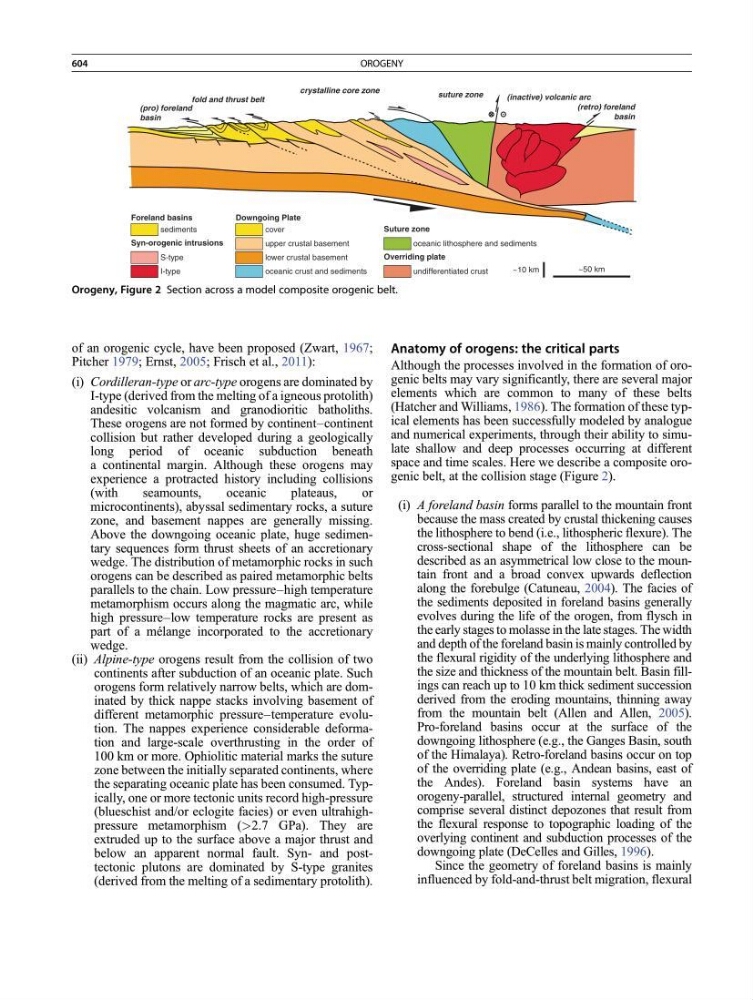
space and time scales. Here we describe a composite orogenic belt, at the collision stage (Figure 2).
(i) A foreland basin forms parallel to the mountain front
because the mass created by crustal thickening causes
the lithosphere to bend (i.e., lithospheric flexure). The
cross-sectional shape of the lithosphere can be
described as an asymmetrical low close to the mountain front and a broad convex upwards deflection
along the forebulge (Catuneau, 2004). The facies of
the sediments deposited in foreland basins generally
evolves during the life of the orogen, from flysch in
the early stages to molasse in the late stages. The width
and depth of the foreland basin is mainly controlled by
the flexural rigidity of the underlying lithosphere and
the size and thickness of the mountain belt. Basin fillings can reach up to 10 km thick sediment succession
derived from the eroding mountains, thinning away
from the mountain belt (Allen and Allen, 2005).
Pro-foreland basins occur at the surface of the
downgoing lithosphere (e.g., the Ganges Basin, south
of the Himalaya). Retro-foreland basins occur on top
of the overriding plate (e.g., Andean basins, east of
the Andes). Foreland basin systems have an
orogeny-parallel, structured internal geometry and
comprise several distinct depozones that result from
the flexural response to topographic loading of the
overlying continent and subduction processes of the
downgoing plate (DeCelles and Gilles, 1996).
Since the geometry of foreland basins is mainly
influenced by fold-and-thrust belt migration, flexural
~50 km
~10 km
(retro) foreland
basin
(pro) foreland
basin
fold and thrust belt
crystalline core zone
suture zone
(inactive) volcanic arc
sediments
Foreland basins
cover
upper crustal basement
lower crustal basement
oceanic crust and sediments
Suture zone
oceanic lithosphere and sediments
Overriding plate
S-type
I-type
Downgoing Plate
Syn-orogenic intrusions
undifferentiated crust
Orogeny, Figure 2 Section across a model composite orogenic belt.
604
OROGENY