

lithosphere onto the continental margin. Dehydration
of the downgoing oceanic plate leads to melting of
its overlying mantle wedge and induces the formation
of a volcanic arc in the overriding plate.
(iii) Continental subduction and collision of two continents eventually occurs, as the continental margin at
the other side of the previous oceanic basin arrives in
the subduction zone. Ongoing shortening induces
deformation, metamorphism, magmatism, and thickening of the crust. Surface uplift together with erosion of the rising orogenic belt results in deposition
of synorogenic sediments. Convergence may be
accommodated by lateral escape of crustal blocks
along continent-scale strike-slip faults.
(iv) Destruction of the orogen is accompanied by lithospheric extension, crustal thinning, development of
fault-bounded sedimentary basins, and intrusions of
large magmatic bodies. Once the crust has reached
a normal thickness, a new orogenic cycle can begin.
Although similar stages can be found in all Phanerozoic
orogenic belts, such a cycle is a very broad simplification,
which probably does not apply to all orogens in detail. In
fact, it is very unlikely that rifted continental margins
reassemble at the same location since in most continental
collisions the two colliding continents were never previously close together. It must also be noted that orogeny
and the orogenic cycle are here described in the framework of plate tectonics, the onset of which is debated
(sometimes in the Precambrian, Eriksson et al., 2004).
Other geodynamic processes than those described here
have probably controlled formation of mountain ranges
early in the Earth’s history.
Types of orogens
Based on the different tectonic, metamorphic, and magmatic evolutions of orogenic belts, two main different
types of orogens, which are in fact two different stages
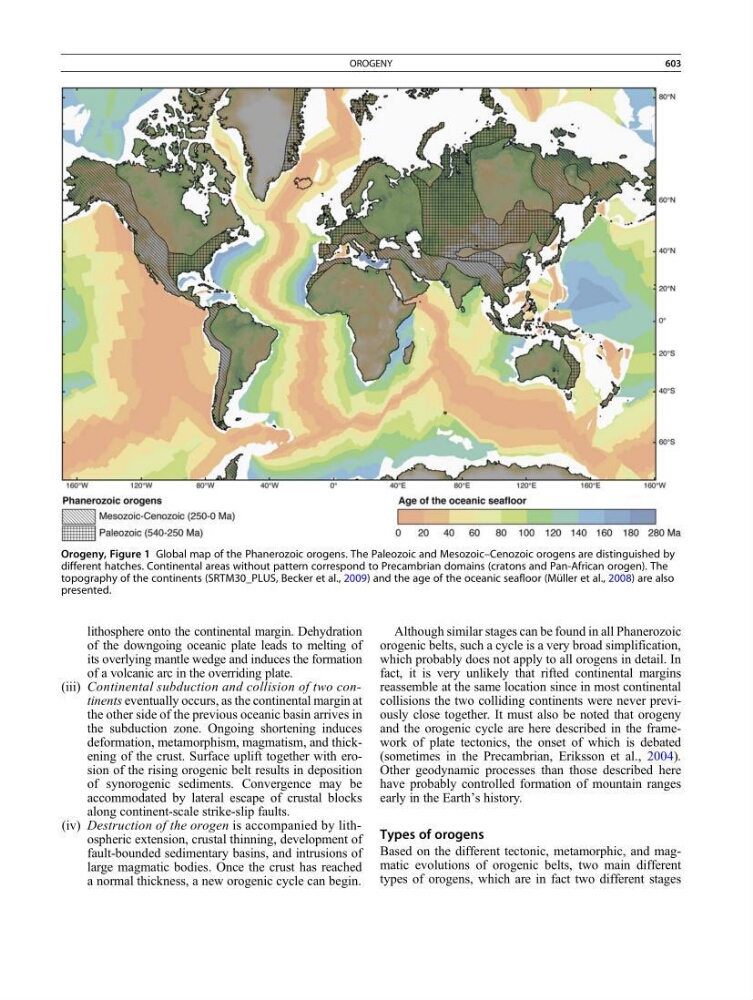
Orogeny, Figure 1 Global map of the Phanerozoic orogens. The Paleozoic and Mesozoic–Cenozoic orogens are distinguished by
different hatches. Continental areas without pattern correspond to Precambrian domains (cratons and Pan-African orogen). The
topography of the continents (SRTM30_PLUS, Becker et al., 2009) and the age of the oceanic seafloor (Mu ¨ ller et al., 2008) are also
presented.
OROGENY
603