

development. Field investigations in 1970 (Arrow), 1975
(Metula), 1976 (Urquiola, Argo Merchant), and 1978
(Amoco Cadiz, Ixtoc I) enabled geoscientists to begin
understanding the complex interactions between spilled
oil, shorelines, sediments, and coastal processes. Table 1
lists the major studies of oil/shoreline interactions and
serves as references to the observations described in the
following sections. Exxon Valdez studies have continued
for more than 20 years and provide the longest detailed
record of any oil spill to date (Wiens, 2013).
Spill interaction: sediment-dominated shorelines
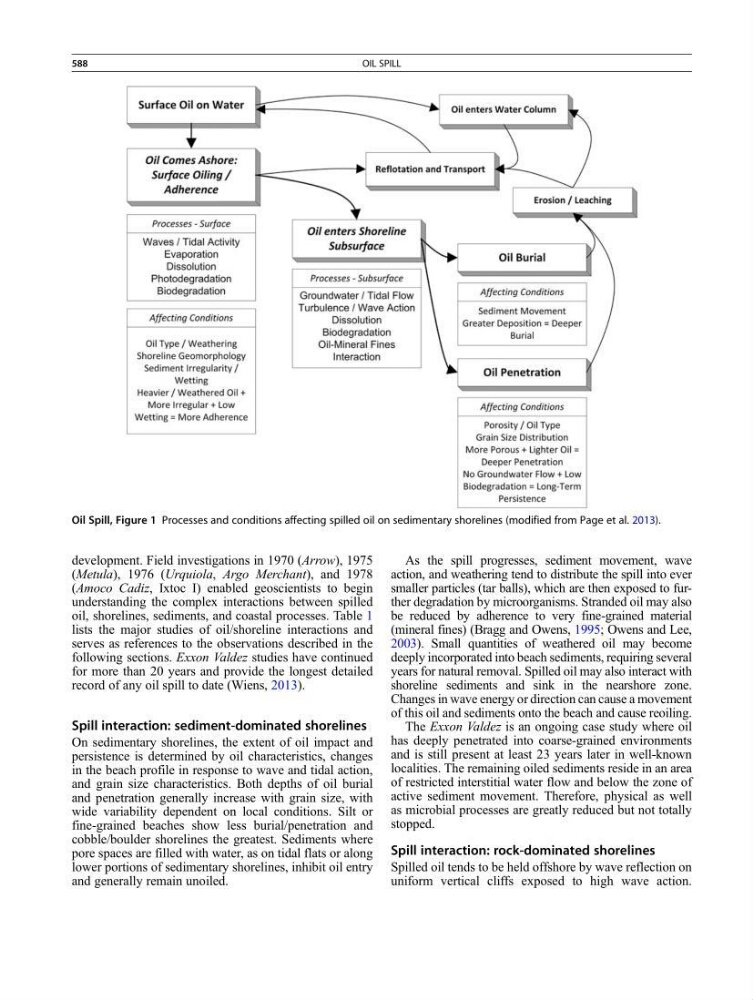
On sedimentary shorelines, the extent of oil impact and
persistence is determined by oil characteristics, changes
in the beach profile in response to wave and tidal action,
and grain size characteristics. Both depths of oil burial
and penetration generally increase with grain size, with
wide variability dependent on local conditions. Silt or
fine-grained beaches show less burial/penetration and
cobble/boulder shorelines the greatest. Sediments where
pore spaces are filled with water, as on tidal flats or along
lower portions of sedimentary shorelines, inhibit oil entry
and generally remain unoiled.
As the spill progresses, sediment movement, wave
action, and weathering tend to distribute the spill into ever
smaller particles (tar balls), which are then exposed to further degradation by microorganisms. Stranded oil may also
be reduced by adherence to very fine-grained material
(mineral fines) (Bragg and Owens, 1995; Owens and Lee,
2003). Small quantities of weathered oil may become
deeply incorporated into beach sediments, requiring several
years for natural removal. Spilled oil may also interact with
shoreline sediments and sink in the nearshore zone.
Changes in wave energy or direction can cause a movement
of this oil and sediments onto the beach and cause reoiling.
The Exxon Valdez is an ongoing case study where oil
has deeply penetrated into coarse-grained environments
and is still present at least 23 years later in well-known
localities. The remaining oiled sediments reside in an area
of restricted interstitial water flow and below the zone of
active sediment movement. Therefore, physical as well
as microbial processes are greatly reduced but not totally
stopped.
Spill interaction: rock-dominated shorelines
Spilled oil tends to be held offshore by wave reflection on
uniform vertical cliffs exposed to high wave action.
Oil Spill, Figure 1 Processes and conditions affecting spilled oil on sedimentary shorelines (modified from Page et al. 2013).
588
OIL SPILL