

Bibliography
Gattuso, J.-P., and Hansson, L., 2011. Ocean Acidification. Oxford:
Oxford University Press.
Hönisch, B., Ridgwell, A., Schmidt, D. N., Thomas, E., Gibbs, S. J.,
Sluijs, A., Zeebe, R., Kump, L., Martindale, R. C., Greene, S. E.,
Kiessling, W., Ries, J., Zachos, J. C., Royer, D. L., Barker, S.,
Marchitto, T. M., Jr., Moyer, R., Pelejero, C., Ziveri, P., Foster,
G. L., and Williams, B., 2012. The geological record of ocean
acidification. Science, 335, 1058–1063.
Raven, J., Caldeira, K., Elderfield, H., Hoegh-Guldberg, O., Liss, P.,
Riebesell, U., Shepherd, J., Turley, C., and Watson, A., 2005.
Ocean Acidification Due To Increasing Atmospheric Carbon
Dioxide. Royal Society Report, Policy Document 12/05,
London.
Wolf-Gladrow, D., Riebesell, U., Burkhardt, S., and Bijma, J., 1999.
Direct effects of CO 2 concentration on growth and isotopic composition of marine plankton. Tellus, 51B, 461–476.
OCEAN DRILLING
Kiyoshi Suyehiro
Integrated Ocean Drilling Program, Management
International, Tokyo, Japan
Definition
Ocean drilling broadly refers to science conducted by utilizing ocean drilling platforms (vessels) to retrieve material samples and measurements from boreholes drilled
beneath the seafloor in deep seawater not achieved by
other shallow sampling methods such as dredging, gravity
coring, or shallow piston coring (Figure 1).
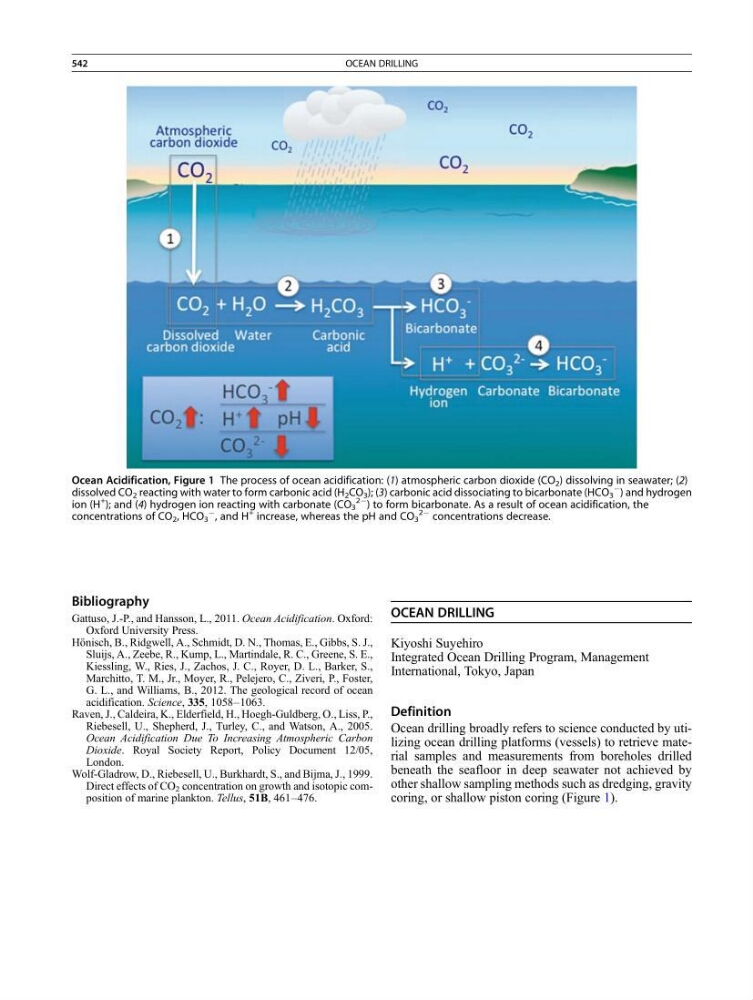
Ocean Acidification, Figure 1 The process of ocean acidification: (1) atmospheric carbon dioxide (CO 2 ) dissolving in seawater; (2)
dissolved CO 2 reacting with water to form carbonic acid (H 2 CO 3 ); (3) carbonic acid dissociating to bicarbonate (HCO 3
À
) and hydrogen
ion (H
+ ); and (4) hydrogen ion reacting with carbonate (CO 3
2À
) to form bicarbonate. As a result of ocean acidification, the
concentrations of CO 2 , HCO 3
À , and H
+ increase, whereas the pH and CO 3
2À concentrations decrease.
542
OCEAN DRILLING