

for these species richness changes or of other macroevolutionary parameters, such as coccolith size of individual species or entire assemblages, however, remain enigmatic
(Langer et al., 2006; Herrmann and Thierstein, 2012).
Summary and conclusions
Nannofossils and coccoliths are the microscopic remains
of single-celled planktonic algae that have lived in the
world’s oceans for about 230 Ma. Nannofossils are found
in many calcareous rocks and help geologists to tell the
age of these deposits and the environmental conditions at
that time.
Bibliography
Bown, P. R. (ed.), 1999. Calcareous Nannofossil Biostratigraphy.
Norwell: Kluwer. 315 p.
Bown, P. R., et al., 2004. Calcareous nannoplankton evolution and
diversity through time. In Thierstein, H. R., and Young, J. R.
(eds.), Coccolithophores – From Molecular Processes to Global
Impact. Berlin: Springer, pp. 481–508.
Hay, W. W. (ed.), 1974. Studies in Paleo-oceanography. SEPM
Special Publication, Vol. 20. 218 p.
Herrmann, S., and Thierstein, H. R., 2012. Cenozoic coccolith size
changes – evolutionary and/or ecological controls? Paleogeography Palaeoclimatology Palaeoecology, 333–334, 92–106.
Iglesias-Rodriguez, M. D., et al., 2008. Phytoplankton calcification
in a high-CO 2 world. Science, 320, 336–340.
Langer, G., et al., 2006. Species-specific responses of calcifying
algae to changing seawater carbonate chemistry. Geochemistry,
Geophysics, Geosystems, 7(9), 1–12.
Perch-Nielsen, K., 1989. Mesozoic and Cenozoic calcareous
nannofossils. In Bolli, H. M., et al. (eds.), Plankton Stratigraphy.
Cambridge: Cambridge University Press, Vol. 1, pp. 329–554.
Stoll, H. M., and Ziveri, P., 2004. Coccolithophorid-based geochemical paleoproxies. In Thierstein, H. R., and Young, J. R.
(eds.), Coccolithophores – From Molecular Processes to Global
Impact. Berlin: Springer, pp. 529–562.
Young, J. R., et al., 2003. A guide to extant coccolithophore taxonomy. Journal of Nannoplankton Research, Special Issue, 1, 125.
Cross-references
Biochronology, Biostratigraphy
Calcite Compensation Depth (CCD)
Deep-sea Sediments
Dinoflagellates
Marine Microfossils
Paleoceanographic Proxies
Paleoceanography
NITROGEN ISOTOPES IN THE SEA
Thomas Pedersen
School of Earth and Ocean Sciences, University of
Victoria, Victoria, BC, Canada
Definition
Nitrogen has two stable isotopes,
14
N and
15
N, comprising, respectively, 99.64 % and 0.36 % of the nitrogen
atoms on earth. The isotopes are fractionated one from
the other in a wide variety of biochemical processes in
the sea (see Sigman et al., 2009, for a comprehensive
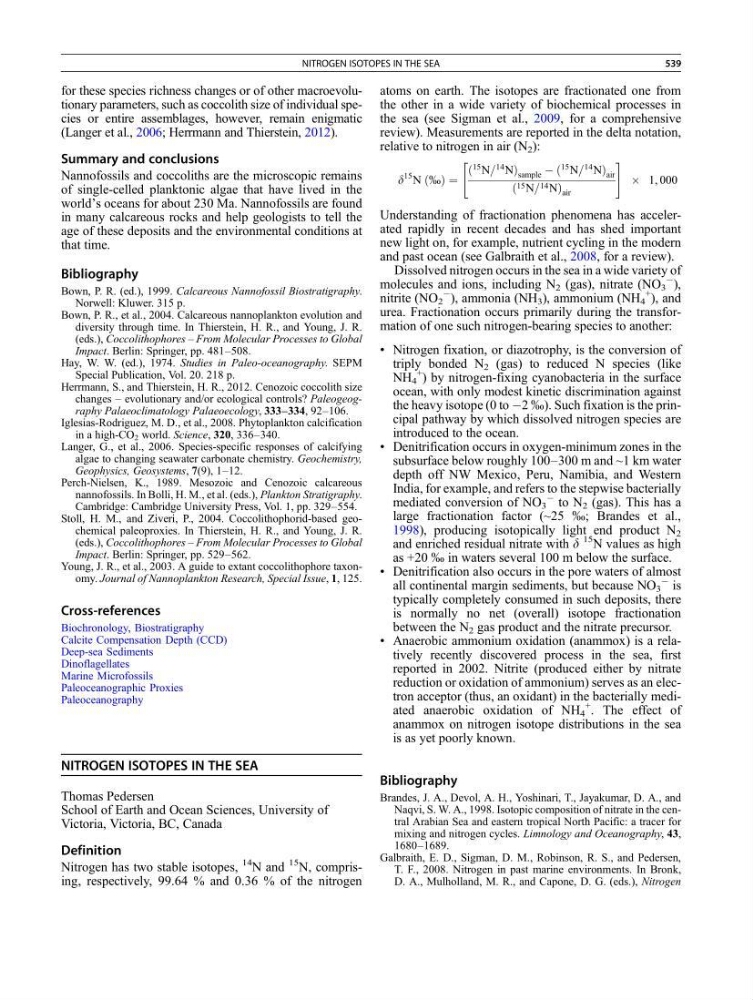
review). Measurements are reported in the delta notation,
relative to nitrogen in air (N 2 ):
d
15 N %
ð Þ ¼
15 N=
14 N
ð
Þ sample À
15 N=
14 N
ð
Þ air
15 N= 14 N
ð
Þ air
"
#
 1, 000
Understanding of fractionation phenomena has accelerated rapidly in recent decades and has shed important
new light on, for example, nutrient cycling in the modern
and past ocean (see Galbraith et al., 2008, for a review).
Dissolved nitrogen occurs in the sea in a wide variety of
molecules and ions, including N 2 (gas), nitrate (NO 3
À
),
nitrite (NO 2
À ), ammonia (NH 3 ), ammonium (NH 4
+ ), and
urea. Fractionation occurs primarily during the transformation of one such nitrogen-bearing species to another:
• Nitrogen fixation, or diazotrophy, is the conversion of
triply bonded N 2 (gas) to reduced N species (like
NH 4
+
) by nitrogen-fixing cyanobacteria in the surface
ocean, with only modest kinetic discrimination against
the heavy isotope (0 to À2 %). Such fixation is the principal pathway by which dissolved nitrogen species are
introduced to the ocean.
• Denitrification occurs in oxygen-minimum zones in the
subsurface below roughly 100–300 m and ~1 km water
depth off NW Mexico, Peru, Namibia, and Western
India, for example, and refers to the stepwise bacterially
mediated conversion of NO 3
À to N 2 (gas). This has a
large fractionation factor (~25 %; Brandes et al.,
1998), producing isotopically light end product N 2
and enriched residual nitrate with d
15
N values as high
as +20 % in waters several 100 m below the surface.
• Denitrification also occurs in the pore waters of almost
all continental margin sediments, but because NO 3
À is
typically completely consumed in such deposits, there
is normally no net (overall) isotope fractionation
between the N 2 gas product and the nitrate precursor.
• Anaerobic ammonium oxidation (anammox) is a relatively recently discovered process in the sea, first
reported in 2002. Nitrite (produced either by nitrate
reduction or oxidation of ammonium) serves as an electron acceptor (thus, an oxidant) in the bacterially mediated anaerobic oxidation of NH 4
+ . The effect of
anammox on nitrogen isotope distributions in the sea
is as yet poorly known.
Bibliography
Brandes, J. A., Devol, A. H., Yoshinari, T., Jayakumar, D. A., and
Naqvi, S. W. A., 1998. Isotopic composition of nitrate in the central Arabian Sea and eastern tropical North Pacific: a tracer for
mixing and nitrogen cycles. Limnology and Oceanography, 43,
1680–1689.
Galbraith, E. D., Sigman, D. M., Robinson, R. S., and Pedersen,
T. F., 2008. Nitrogen in past marine environments. In Bronk,
D. A., Mulholland, M. R., and Capone, D. G. (eds.), Nitrogen
NITROGEN ISOTOPES IN THE SEA
539