

for past global climate changes (e.g., Iglesias-Rodriguez
et al., 2008).
Evolution
About 250 coccolithophore species are known to live in
today’s ocean waters (Young et al., 2003), but coccoliths
of only about 50 of them are found in recent deep-sea sediments (Bown et al., 2004). The long-term species diversity
history shows a rather gradual increase from 230 Ma
(mid-Triassic) to an all-time high of about 140 species at
70 Ma (late Cretaceous), followed by a drastic reduction
at the K/T boundary (65 Ma) and numerous fluctuations
throughout the Cenozoic (Bown et al., 2004). The causes
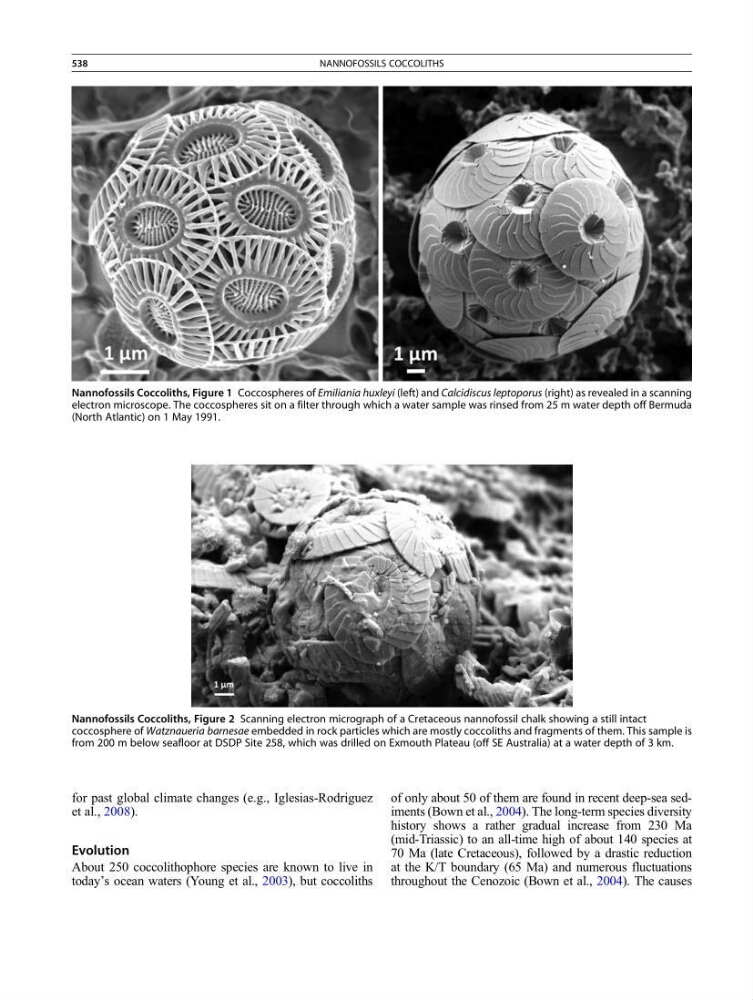
Nannofossils Coccoliths, Figure 1 Coccospheres of Emiliania huxleyi (left) and Calcidiscus leptoporus (right) as revealed in a scanning
electron microscope. The coccospheres sit on a filter through which a water sample was rinsed from 25 m water depth off Bermuda
(North Atlantic) on 1 May 1991.
Nannofossils Coccoliths, Figure 2 Scanning electron micrograph of a Cretaceous nannofossil chalk showing a still intact
coccosphere of Watznaueria barnesae embedded in rock particles which are mostly coccoliths and fragments of them. This sample is
from 200 m below seafloor at DSDP Site 258, which was drilled on Exmouth Plateau (off SE Australia) at a water depth of 3 km.
538
NANNOFOSSILS COCCOLITHS