

Collectively, the deep-sea trench, outer ridge, and
forearc basin comprise the forearc region. The distance
between the plate boundary and magmatic zone has
a width of between 100 and 250 km. This region is also
called the arc-trench gap, a magmatic gap that with very
few exceptions is void of magmatic activity. Low temperatures in the crust are caused by the coolness of the
subducting plate underneath; the low temperature gradient
prevents the formation of magma by melting or the rise of
magma from deeper sources.
The volcanic arc, with an average width of 100 km, is
the central part of the island arc or the active continental
margin system and is characterized by significant magmatic activity. Approximately 90 % of all active volcanoes
above the sea-level, most of which are in or around the
Pacific Ocean, are subduction-related volcanoes. The
zone of volcanism has a sharp boundary on the forearc
margin and a gradual one on the backarc margin
(Figure 3).
Island arcs are separated from adjacent continents by
a marine basin underlain by ocean crust, the backarc basin
(Figures 2 and 3). Active continental margins have
a backarc region that may have thinned continental crust
and/or a zone of compressional structures.
In principle the arcuate shape of island arcs is easy to
explain. Before a plate enters a subduction zone, it possesses a curvature according to the curvature of the Earth.
When it dives into the subduction zone, this curvature
inverts and convex becomes concave. Adjacent arcs commonly display a catenary-like pattern as observed in the
Western Pacific where one island arc drapes next to the
other. The radius of an arc is a function of the radius of
the Earth and the inclination angle of the subduction zone,
but is also influenced by structural features of the upper
plate. This becomes evident along continental margins
where the shape of the continent substantially controls
the shape of the plate boundary, e.g., along the continental
margin on the western edge of South America.
Morphological differences caused by Marianaand chile-type subduction
The western rim of the Pacific Plate is characterized by
lithosphere with ages greater than 100 Ma. Therefore,
spontaneous subduction driven by the density of the cool
oceanic lithosphere dominates (Mariana-type subduction). However, younger lithosphere typical of the eastern
margin of the Pacific, mostly less than 50 Ma old, as well
as that of the Philippine Sea Plate and the western Sunda
Arc is too buoyant to subduct spontaneously, but rather
is forced underneath the upper plate by compressional
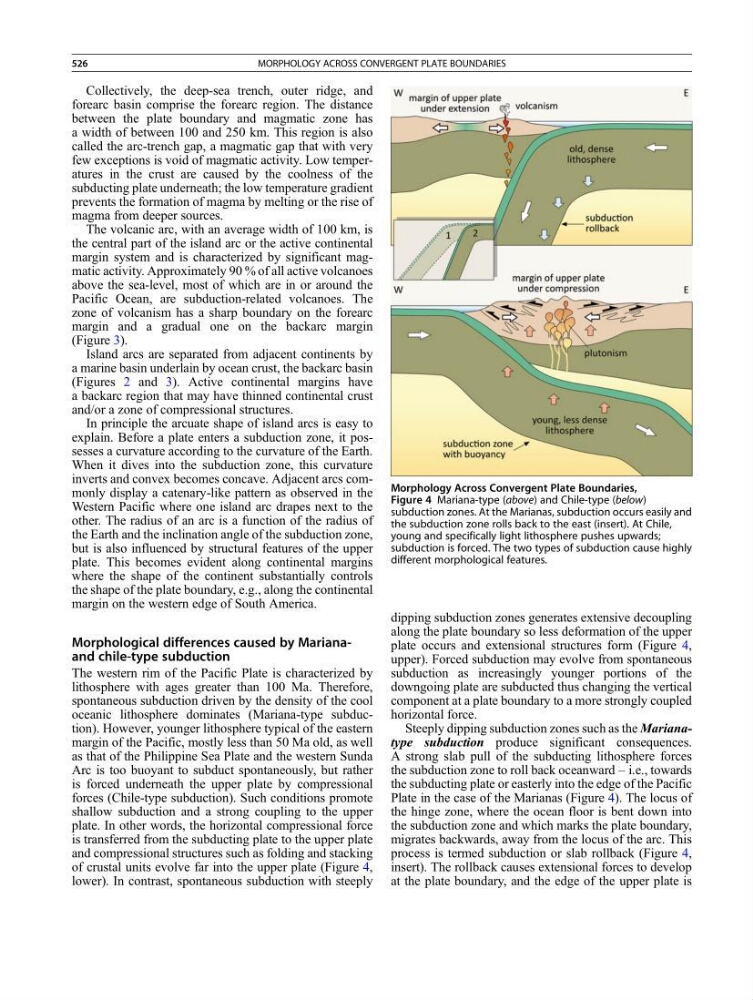
forces (Chile-type subduction). Such conditions promote
shallow subduction and a strong coupling to the upper
plate. In other words, the horizontal compressional force
is transferred from the subducting plate to the upper plate
and compressional structures such as folding and stacking
of crustal units evolve far into the upper plate (Figure 4,
lower). In contrast, spontaneous subduction with steeply
dipping subduction zones generates extensive decoupling
along the plate boundary so less deformation of the upper
plate occurs and extensional structures form (Figure 4,
upper). Forced subduction may evolve from spontaneous
subduction as increasingly younger portions of the
downgoing plate are subducted thus changing the vertical
component at a plate boundary to a more strongly coupled
horizontal force.
Steeply dipping subduction zones such as the Marianatype subduction produce significant consequences.
A strong slab pull of the subducting lithosphere forces
the subduction zone to roll back oceanward – i.e., towards
the subducting plate or easterly into the edge of the Pacific
Plate in the case of the Marianas (Figure 4). The locus of
the hinge zone, where the ocean floor is bent down into
the subduction zone and which marks the plate boundary,
migrates backwards, away from the locus of the arc. This
process is termed subduction or slab rollback (Figure 4,
insert). The rollback causes extensional forces to develop
at the plate boundary, and the edge of the upper plate is
Morphology Across Convergent Plate Boundaries,
Figure 4 Mariana-type (above) and Chile-type (below)
subduction zones. At the Marianas, subduction occurs easily and
the subduction zone rolls back to the east (insert). At Chile,
young and specifically light lithosphere pushes upwards;
subduction is forced. The two types of subduction cause highly
different morphological features.
526
MORPHOLOGY ACROSS CONVERGENT PLATE BOUNDARIES