

exhuming and uplifting footwall and record the exhumation history of the evolving core complex.
Core complexes also offer an opportunity to look into
the problem of absolute versus relative displacement
along tectonic faults. Shear-sense indicators in ductile
and brittle shear zones provide evidence for the relative
displacement of faults; they do not per se provide constraints as to the absolute motion of either hanging- or
footwall relative to the Earth surface. However, in a core
complex the metamorphic core usually has been juxtaposed against non-metamorphosed sediments in the hanging wall. This provides evidence for the absolute upward
motion of the footwall relative to the Earth surface. The
sediments of the hanging wall remained more or less stationary with respect to the Earth surface.
Forms of continental extension and thermal
stratification of continental crust
The metamorphic grade of high-grade rocks in the footwalls of exposed core complexes commonly shows that
the rocks formed under a high thermal gradient exceeding
30
C km
À1
. The high thermal gradient leads to a relatively hot and soft crust with a shallow brittle-ductile transition ( 10 km depths) and a relatively high-strength
contrast between the ductile lower crust and the brittle
upper crust.
It has been shown that the thermal state of the continental lithosphere and its rheological structure control the variation between flow in the ductile middle and lower crust
and localized deformation in the brittle upper crust and
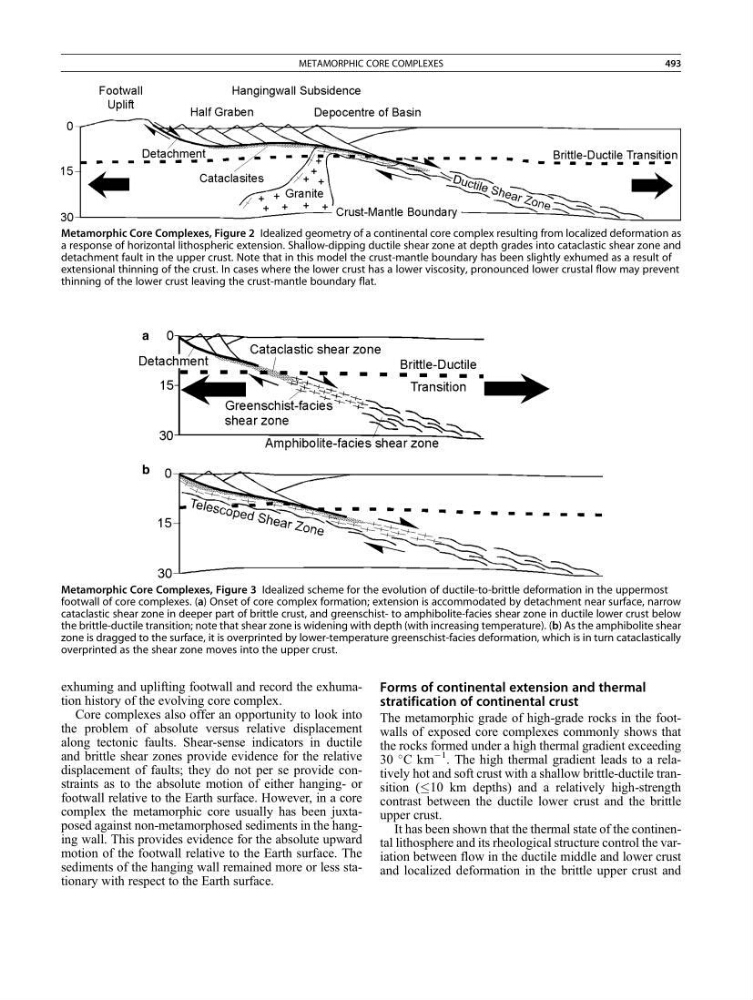
Metamorphic Core Complexes, Figure 2 Idealized geometry of a continental core complex resulting from localized deformation as
a response of horizontal lithospheric extension. Shallow-dipping ductile shear zone at depth grades into cataclastic shear zone and
detachment fault in the upper crust. Note that in this model the crust-mantle boundary has been slightly exhumed as a result of
extensional thinning of the crust. In cases where the lower crust has a lower viscosity, pronounced lower crustal flow may prevent
thinning of the lower crust leaving the crust-mantle boundary flat.
Metamorphic Core Complexes, Figure 3 Idealized scheme for the evolution of ductile-to-brittle deformation in the uppermost
footwall of core complexes. (a) Onset of core complex formation; extension is accommodated by detachment near surface, narrow
cataclastic shear zone in deeper part of brittle crust, and greenschist- to amphibolite-facies shear zone in ductile lower crust below
the brittle-ductile transition; note that shear zone is widening with depth (with increasing temperature). (b) As the amphibolite shear
zone is dragged to the surface, it is overprinted by lower-temperature greenschist-facies deformation, which is in turn cataclastically
overprinted as the shear zone moves into the upper crust.
METAMORPHIC CORE COMPLEXES
493