

originated in a low-angle orientation (Wernicke, 1981;
Lister and Davis, 1989; Cowan et al., 2003; Collettini
and Holdsworth, 2004; Axen, 2007). A low-angle origin
of the detachment faults readily explains the moderate variation in metamorphic grade along the crustal section
exposed in the footwalls of core complexes (Lister and
Davis, 1989).
The footwalls of core complexes are usually made up of
middle/lower crustal metamorphic rocks that may be
intruded by syn-extensional plutons (Figure 2). The
deeper parts of these plutons are frequently not or very
weakly deformed; toward the detachments, they are
overprinted by extension-related mylonites. In a number
of cases, it has been convincingly shown that high-grade
metamorphism and pluton emplacement are a consequence of core complex formation (Ring et al., 2010;
Schulte et al., 2014), whereas in some other cases,
temporal
relationships
between
metamorphism,
magmatism, and core complex formation remain elusive
(Reynolds, 1982).
In general, rocks in the footwalls of core complex
detachments show a distinct sequence of ductile deformation fabrics that were successively overprinted by brittle
structures toward the structurally higher part of the shear
zone underlying the detachment (Figure 3). In the simplest
case, high-temperature deformation structures may be preserved at the bottom of the shear zone. As the footwall is
dragged up toward the surface, deformation becomes
more localized, and lower-temperature deformation structures overprint earlier high-temperature structures in the
upper portions of the evolving shear zone and are successively overprinted by cataclastic deformation once the
footwall has reached the upper crust. The detachment
faults at the top of the ductile shear zone are basically
upper crustal manifestations of the shallow-dipping,
normal-slip shear zones (Reynolds, 1982; Davis, 1983).
This simple, idealized overprinting sequence is usually
not fully met because deformation is commonly heterogeneously distributed in nature.
The footwalls of metamorphic core complexes cool
very rapidly at rates exceeding 50–100
C Myr
À1 as they
are dragged up to the surface (Fitzgerald et al., 1993;
Brichau et al., 2006; Thomson and Ring, 2006). Commonly thermochronologic ages that record true cooling
through a certain closure temperature (e.g., fission-track
and (U-Th)/He ages) are identical with error for minerals
with different closure temperatures (Fitzgerald et al.,
1993; Foster and John, 1999; Brichau et al., 2007). These
cooling ages are also identical, or almost identical, to
deformation ages from the extensional mylonites
(Kumerics et al., 2005). Because most fault systems in
metamorphic core complex are low angle, the amount of
footwall exhumation is moderate (Deckert et al., 2002;
Ring et al., 2003).
The upper crustal rocks above the detachments are
often syn-extensional clastic sediments, which contain
detritus of the metamorphic core. Therefore, the sediments
provide evidence for syn-extensional exposure of the
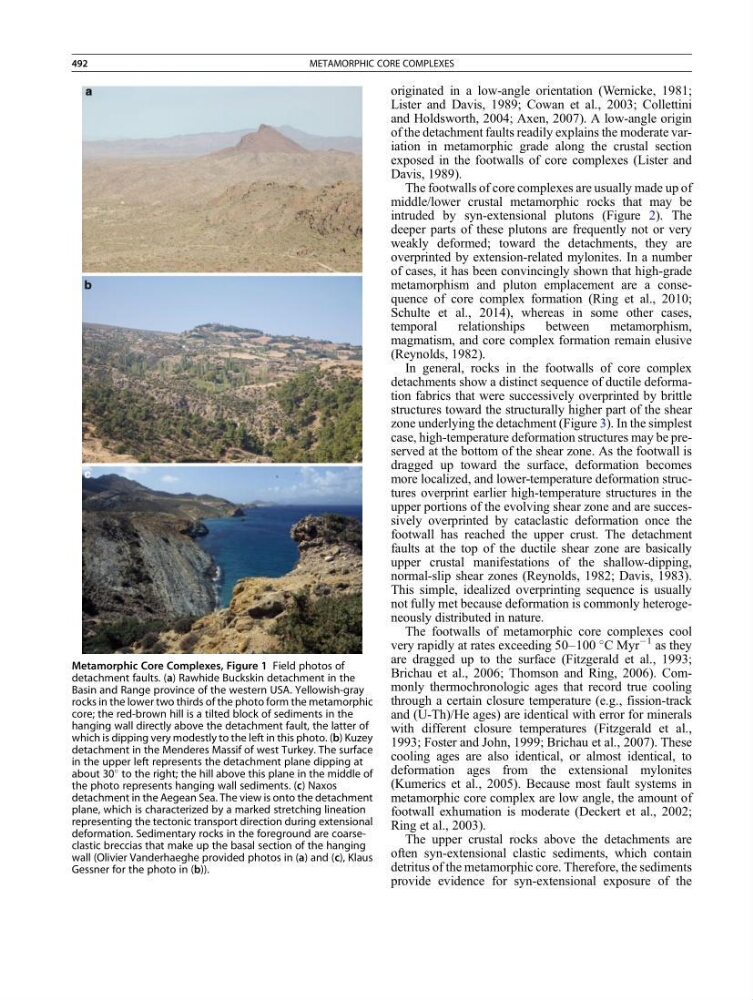
Metamorphic Core Complexes, Figure 1 Field photos of
detachment faults. (a) Rawhide Buckskin detachment in the
Basin and Range province of the western USA. Yellowish-gray
rocks in the lower two thirds of the photo form the metamorphic
core; the red-brown hill is a tilted block of sediments in the
hanging wall directly above the detachment fault, the latter of
which is dipping very modestly to the left in this photo. (b) Kuzey
detachment in the Menderes Massif of west Turkey. The surface
in the upper left represents the detachment plane dipping at
about 30
to the right; the hill above this plane in the middle of
the photo represents hanging wall sediments. (c) Naxos
detachment in the Aegean Sea. The view is onto the detachment
plane, which is characterized by a marked stretching lineation
representing the tectonic transport direction during extensional
deformation. Sedimentary rocks in the foreground are coarseclastic breccias that make up the basal section of the hanging
wall (Olivier Vanderhaeghe provided photos in (a) and (c), Klaus
Gessner for the photo in (b)).
492
METAMORPHIC CORE COMPLEXES