

continental crust beneath the basin reached a climax and
outpaced the rate of sedimentation (Escalona and Mann
2011). As the zone of deformation between the northern
South American continent and the obliquely colliding
Great Arc of the Caribbean moved progressively eastward, the tectonically controlled subsidence rate waned,
and the basin filled to sea-level with both marine and
nonmarine sediments (Figure 4). Presently the central
and eastern part of the foreland basin in Venezuela is filled
to sea-level and forms a broad, alluvial plain with the Orinoco delta at its eastern end adjacent to the Atlantic Ocean
(Figure 4).
Subduction-related basins: basins formed by
stretching
Subduction-related basins generally form by processes of
extension linked to the underlying, extensional process
of “slab rollback” or steepening of the subducting slab that
underlies the arc system. Extension produces back-arc
basins like the Grenada basin and forearc basins like the
Tobago basin that are fully marine in intraoceanic settings
as the Lesser Antilles arc shown in Figure 5 and discussed
by Aitken et al. (2011). Although occupying a much different tectonic setting, subduction-related basins form by
the same processes of stretching that are observed in
40°N
38°N
36°N
34°N
32°N
Depth to Basement,
Offshore (TWT)
Value
High : 6 s
High : 18000 ft.
High : 10000 ft.
Low : 3000 ft.
Low : 0 ft.
Low : 1 s
Thrust margin
Active faults
Value
Value
Depth to Basement,
Los Angeles basin (ft.)
Depth to Basement,
San Joaquin basin (ft).
125°W
120°W
115°W
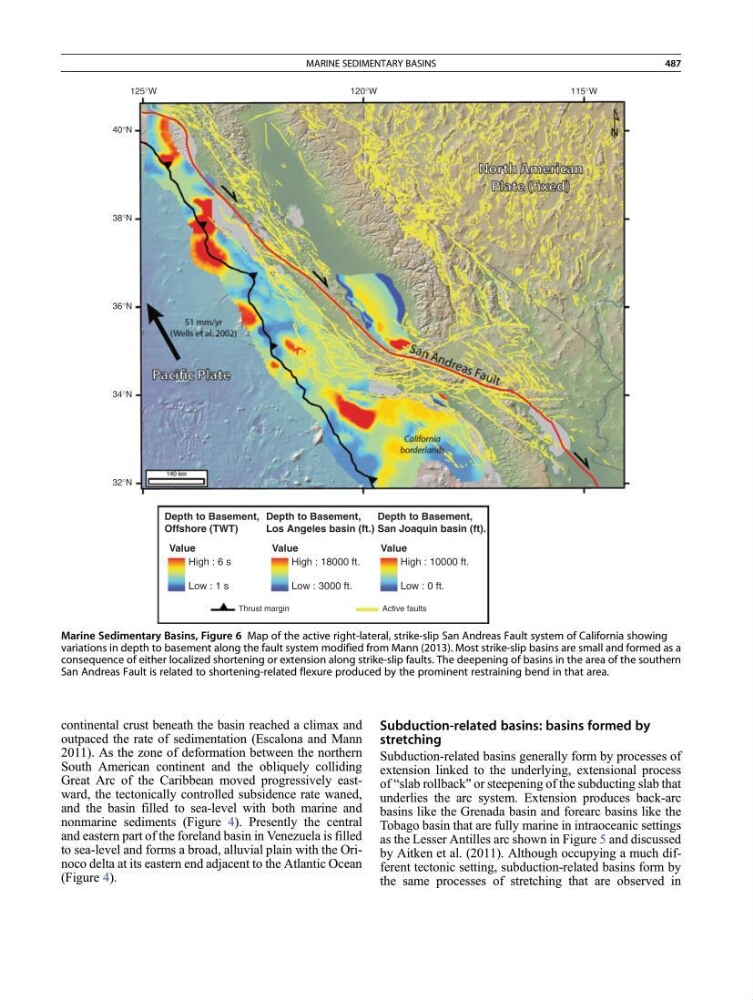
Marine Sedimentary Basins, Figure 6 Map of the active right-lateral, strike-slip San Andreas Fault system of California showing
variations in depth to basement along the fault system modified from Mann (2013). Most strike-slip basins are small and formed as a
consequence of either localized shortening or extension along strike-slip faults. The deepening of basins in the area of the southern
San Andreas Fault is related to shortening-related flexure produced by the prominent restraining bend in that area.
MARINE SEDIMENTARY BASINS
487