

(4.4–4.0 Ga), although preserved in younger rocks (Wilde
et al., 2001), is thought to demonstrate the existence of
some siliceous crust at the time, but does that have to be
continental crust, or could it be merely siliceous scum on
pre-plate tectonic crust? Small sections of felsic crust on
large rafts of mafic crust may have been too insignificant
volumetrically to prevent wholesale recycling of the crust
and its remixing into the mantle.
In terms of structures, plate tectonics results in linear
collisional belts of mountains and large strike-slip faults,
but taken alone these are indications of lateral crustal
movements, but not necessarily plate tectonics. Shelf sediments and rock associations typical of continental rifts are
rare until the late Archean, but one cannot expect these
before continental crust itself becomes abundant.
The best evidence for ocean crust takes the form of
ophiolites, which are rock packages consisting of basalts
and gabbros of the ocean crust underlying marine sediments and overlying ultramafic rocks of the uppermost
mantle. Opinions differ greatly as to the first appearance
of ophiolites; some scientists require the complete package to be present, whereas basalts with an oceanic geochemical signature suffice for others. The first relatively
complete ophiolites date from around 2.0 Ga (Scott et al.,
1991; Peltonen and Kontinen, 2004), whereas partial ones
are claimed for the earliest Archean (de Wit, 1998). Due to
the ephemeral nature of ocean crust, it is much more
poorly preserved than continental crust, and some sections
of mafic crust interpreted as ocean crust may be from the
pre-plate tectonic mafic crust. The eclogite xenoliths
already mentioned contain clear evidence of having been
at the surface and were later returned to the mantle – but
by which process? This may not be clear evidence for subduction in the modern plate tectonic style.
Most entries in Table 1 consider the subduction process, as this appears to be the best key to indicating that
plate tectonics functioned. All of these either suffer from
the preservation problem or are only indirect indictors.
The high-pressure, low-temperature metamorphism characteristic of modern subduction produces eclogites and
blueschists, and these ideally occur as part of paired metamorphic belts together with low-pressure, hightemperature metamorphism formed at the other side of
the subduction suture (Miyashiro, 1961). Blueschists are
not known from before 1 Ga (Stern, 2005). However, this
time limit addresses large occurrences that can be recognized in the field. Evidence is found for much earlier
high-pressure, low-temperature metamorphism as relict
features preserved on a microscopic scale in rocks that
have been re-equilibrated at lower pressures. These can
be used to show that the duality of thermal indicators
across subduction sutures can be recognized as far back
as 3.26 Ga (Moyen et al., 2006), but at this time the temperature difference between the two sides was considerably smaller than in Phanerozoic times. Before 3.26 Ga,
the pair of thermal indicators has not been found, and no
relicts for high-pressure, low-temperature metamorphism
are known (Brown, 2007; van Kranendonk, 2011).
The most widely used evidence for tectonic settings in
old rocks is indirect and concerns the recognition of trace
element geochemical signatures reminiscent of modern
plate tectonic environments such as island arcs, mid ocean
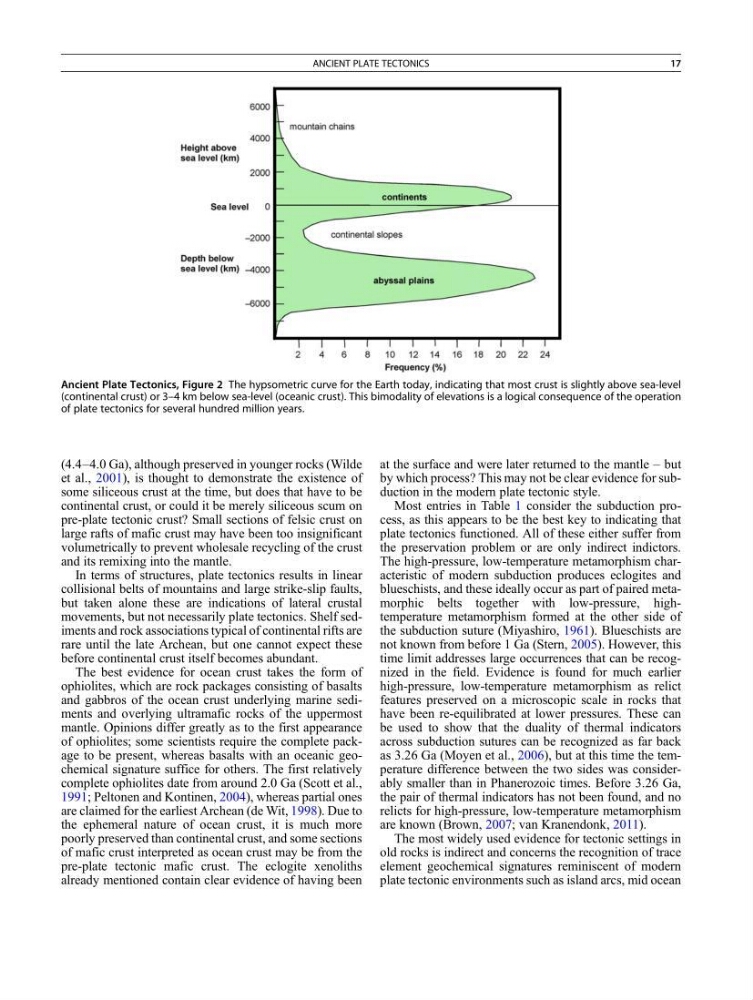
Ancient Plate Tectonics, Figure 2 The hypsometric curve for the Earth today, indicating that most crust is slightly above sea-level
(continental crust) or 3–4 km below sea-level (oceanic crust). This bimodality of elevations is a logical consequence of the operation
of plate tectonics for several hundred million years.
ANCIENT PLATE TECTONICS
17
et al., 2001), is thought to demonstrate the existence of
some siliceous crust at the time, but does that have to be
continental crust, or could it be merely siliceous scum on
pre-plate tectonic crust? Small sections of felsic crust on
large rafts of mafic crust may have been too insignificant
volumetrically to prevent wholesale recycling of the crust
and its remixing into the mantle.
In terms of structures, plate tectonics results in linear
collisional belts of mountains and large strike-slip faults,
but taken alone these are indications of lateral crustal
movements, but not necessarily plate tectonics. Shelf sediments and rock associations typical of continental rifts are
rare until the late Archean, but one cannot expect these
before continental crust itself becomes abundant.
The best evidence for ocean crust takes the form of
ophiolites, which are rock packages consisting of basalts
and gabbros of the ocean crust underlying marine sediments and overlying ultramafic rocks of the uppermost
mantle. Opinions differ greatly as to the first appearance
of ophiolites; some scientists require the complete package to be present, whereas basalts with an oceanic geochemical signature suffice for others. The first relatively
complete ophiolites date from around 2.0 Ga (Scott et al.,
1991; Peltonen and Kontinen, 2004), whereas partial ones
are claimed for the earliest Archean (de Wit, 1998). Due to
the ephemeral nature of ocean crust, it is much more
poorly preserved than continental crust, and some sections
of mafic crust interpreted as ocean crust may be from the
pre-plate tectonic mafic crust. The eclogite xenoliths
already mentioned contain clear evidence of having been
at the surface and were later returned to the mantle – but
by which process? This may not be clear evidence for subduction in the modern plate tectonic style.
Most entries in Table 1 consider the subduction process, as this appears to be the best key to indicating that
plate tectonics functioned. All of these either suffer from
the preservation problem or are only indirect indictors.
The high-pressure, low-temperature metamorphism characteristic of modern subduction produces eclogites and
blueschists, and these ideally occur as part of paired metamorphic belts together with low-pressure, hightemperature metamorphism formed at the other side of
the subduction suture (Miyashiro, 1961). Blueschists are
not known from before 1 Ga (Stern, 2005). However, this
time limit addresses large occurrences that can be recognized in the field. Evidence is found for much earlier
high-pressure, low-temperature metamorphism as relict
features preserved on a microscopic scale in rocks that
have been re-equilibrated at lower pressures. These can
be used to show that the duality of thermal indicators
across subduction sutures can be recognized as far back
as 3.26 Ga (Moyen et al., 2006), but at this time the temperature difference between the two sides was considerably smaller than in Phanerozoic times. Before 3.26 Ga,
the pair of thermal indicators has not been found, and no
relicts for high-pressure, low-temperature metamorphism
are known (Brown, 2007; van Kranendonk, 2011).
The most widely used evidence for tectonic settings in
old rocks is indirect and concerns the recognition of trace
element geochemical signatures reminiscent of modern
plate tectonic environments such as island arcs, mid ocean
Ancient Plate Tectonics, Figure 2 The hypsometric curve for the Earth today, indicating that most crust is slightly above sea-level
(continental crust) or 3–4 km below sea-level (oceanic crust). This bimodality of elevations is a logical consequence of the operation
of plate tectonics for several hundred million years.
ANCIENT PLATE TECTONICS
17