

the densities of rocks that constitute these layers
(Anderson, 1989).
However, few of the criteria for either continental drift
or plate tectonics can be successfully used for the Archean
or early Proterozoic, which according to Figure 1 is the
time period where plate tectonics is questionable. Of geophysical measurements, seismological records are little
more than 100 years old and cannot be carried out in retrospect; only the science of paleomagnetism, which first
documented continental drift (Runcorn, 1959), can be
used in the distant geological past (Strik et al., 2003), but
even here, the accuracy and certainty of interpretations
diminishes as we go back into the Archean and requires
coupling to accurate age determinations for earlier times
(Evans and Pisarevsky, 2008).
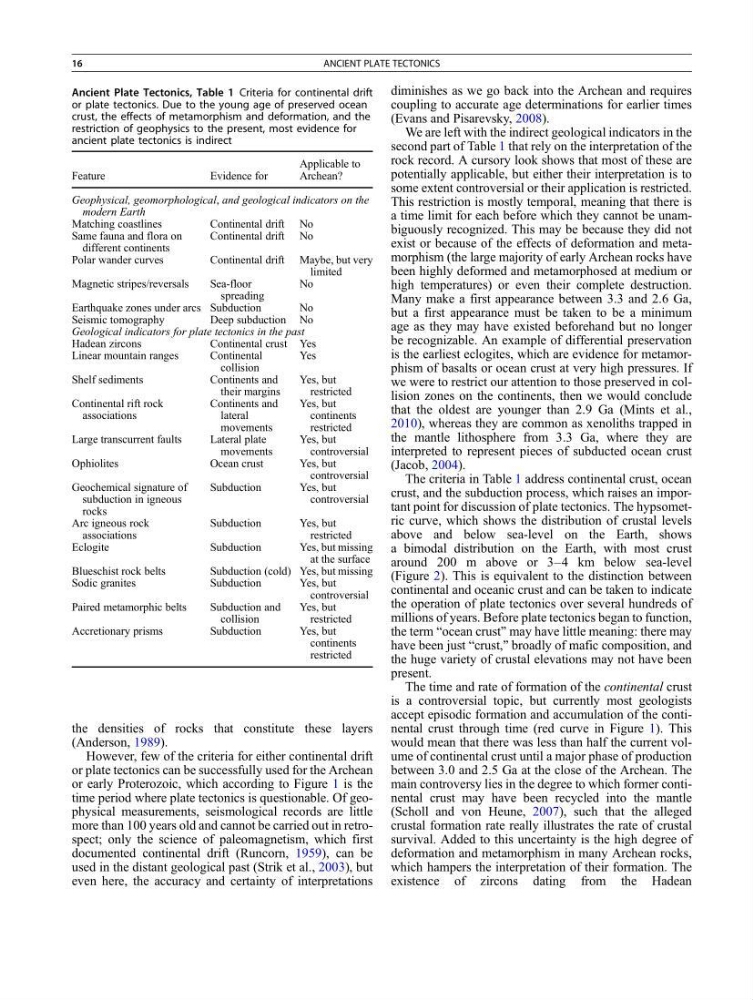
We are left with the indirect geological indicators in the
second part of Table 1 that rely on the interpretation of the
rock record. A cursory look shows that most of these are
potentially applicable, but either their interpretation is to
some extent controversial or their application is restricted.
This restriction is mostly temporal, meaning that there is
a time limit for each before which they cannot be unambiguously recognized. This may be because they did not
exist or because of the effects of deformation and metamorphism (the large majority of early Archean rocks have
been highly deformed and metamorphosed at medium or
high temperatures) or even their complete destruction.
Many make a first appearance between 3.3 and 2.6 Ga,
but a first appearance must be taken to be a minimum
age as they may have existed beforehand but no longer
be recognizable. An example of differential preservation
is the earliest eclogites, which are evidence for metamorphism of basalts or ocean crust at very high pressures. If
we were to restrict our attention to those preserved in collision zones on the continents, then we would conclude
that the oldest are younger than 2.9 Ga (Mints et al.,
2010), whereas they are common as xenoliths trapped in
the mantle lithosphere from 3.3 Ga, where they are
interpreted to represent pieces of subducted ocean crust
(Jacob, 2004).
The criteria in Table 1 address continental crust, ocean
crust, and the subduction process, which raises an important point for discussion of plate tectonics. The hypsometric curve, which shows the distribution of crustal levels
above and below sea-level on the Earth, shows
a bimodal distribution on the Earth, with most crust
around 200 m above or 3–4 km below sea-level
(Figure 2). This is equivalent to the distinction between
continental and oceanic crust and can be taken to indicate
the operation of plate tectonics over several hundreds of
millions of years. Before plate tectonics began to function,
the term “ocean crust” may have little meaning: there may
have been just “crust,” broadly of mafic composition, and
the huge variety of crustal elevations may not have been
present.
The time and rate of formation of the continental crust
is a controversial topic, but currently most geologists
accept episodic formation and accumulation of the continental crust through time (red curve in Figure 1). This
would mean that there was less than half the current volume of continental crust until a major phase of production
between 3.0 and 2.5 Ga at the close of the Archean. The
main controversy lies in the degree to which former continental crust may have been recycled into the mantle
(Scholl and von Heune, 2007), such that the alleged
crustal formation rate really illustrates the rate of crustal
survival. Added to this uncertainty is the high degree of
deformation and metamorphism in many Archean rocks,
which hampers the interpretation of their formation. The
existence of zircons dating from the Hadean
Ancient Plate Tectonics, Table 1 Criteria for continental drift
or plate tectonics. Due to the young age of preserved ocean
crust, the effects of metamorphism and deformation, and the
restriction of geophysics to the present, most evidence for
ancient plate tectonics is indirect
Feature
Evidence for
Applicable to
Archean?
Geophysical, geomorphological, and geological indicators on the
modern Earth
Matching coastlines
Continental drift No
Same fauna and flora on
different continents
Continental drift No
Polar wander curves
Continental drift Maybe, but very
limited
Magnetic stripes/reversals
Sea-floor
spreading
No
Earthquake zones under arcs Subduction
No
Seismic tomography
Deep subduction No
Geological indicators for plate tectonics in the past
Hadean zircons
Continental crust Yes
Linear mountain ranges
Continental
collision
Yes
Shelf sediments
Continents and
their margins
Yes, but
restricted
Continental rift rock
associations
Continents and
lateral
movements
Yes, but
continents
restricted
Large transcurrent faults
Lateral plate
movements
Yes, but
controversial
Ophiolites
Ocean crust
Yes, but
controversial
Geochemical signature of
subduction in igneous
rocks
Subduction
Yes, but
controversial
Arc igneous rock
associations
Subduction
Yes, but
restricted
Eclogite
Subduction
Yes, but missing
at the surface
Blueschist rock belts
Subduction (cold) Yes, but missing
Sodic granites
Subduction
Yes, but
controversial
Paired metamorphic belts
Subduction and
collision
Yes, but
restricted
Accretionary prisms
Subduction
Yes, but
continents
restricted
16
ANCIENT PLATE TECTONICS
(Anderson, 1989).
However, few of the criteria for either continental drift
or plate tectonics can be successfully used for the Archean
or early Proterozoic, which according to Figure 1 is the
time period where plate tectonics is questionable. Of geophysical measurements, seismological records are little
more than 100 years old and cannot be carried out in retrospect; only the science of paleomagnetism, which first
documented continental drift (Runcorn, 1959), can be
used in the distant geological past (Strik et al., 2003), but
even here, the accuracy and certainty of interpretations
diminishes as we go back into the Archean and requires
coupling to accurate age determinations for earlier times
(Evans and Pisarevsky, 2008).
We are left with the indirect geological indicators in the
second part of Table 1 that rely on the interpretation of the
rock record. A cursory look shows that most of these are
potentially applicable, but either their interpretation is to
some extent controversial or their application is restricted.
This restriction is mostly temporal, meaning that there is
a time limit for each before which they cannot be unambiguously recognized. This may be because they did not
exist or because of the effects of deformation and metamorphism (the large majority of early Archean rocks have
been highly deformed and metamorphosed at medium or
high temperatures) or even their complete destruction.
Many make a first appearance between 3.3 and 2.6 Ga,
but a first appearance must be taken to be a minimum
age as they may have existed beforehand but no longer
be recognizable. An example of differential preservation
is the earliest eclogites, which are evidence for metamorphism of basalts or ocean crust at very high pressures. If
we were to restrict our attention to those preserved in collision zones on the continents, then we would conclude
that the oldest are younger than 2.9 Ga (Mints et al.,
2010), whereas they are common as xenoliths trapped in
the mantle lithosphere from 3.3 Ga, where they are
interpreted to represent pieces of subducted ocean crust
(Jacob, 2004).
The criteria in Table 1 address continental crust, ocean
crust, and the subduction process, which raises an important point for discussion of plate tectonics. The hypsometric curve, which shows the distribution of crustal levels
above and below sea-level on the Earth, shows
a bimodal distribution on the Earth, with most crust
around 200 m above or 3–4 km below sea-level
(Figure 2). This is equivalent to the distinction between
continental and oceanic crust and can be taken to indicate
the operation of plate tectonics over several hundreds of
millions of years. Before plate tectonics began to function,
the term “ocean crust” may have little meaning: there may
have been just “crust,” broadly of mafic composition, and
the huge variety of crustal elevations may not have been
present.
The time and rate of formation of the continental crust
is a controversial topic, but currently most geologists
accept episodic formation and accumulation of the continental crust through time (red curve in Figure 1). This
would mean that there was less than half the current volume of continental crust until a major phase of production
between 3.0 and 2.5 Ga at the close of the Archean. The
main controversy lies in the degree to which former continental crust may have been recycled into the mantle
(Scholl and von Heune, 2007), such that the alleged
crustal formation rate really illustrates the rate of crustal
survival. Added to this uncertainty is the high degree of
deformation and metamorphism in many Archean rocks,
which hampers the interpretation of their formation. The
existence of zircons dating from the Hadean
Ancient Plate Tectonics, Table 1 Criteria for continental drift
or plate tectonics. Due to the young age of preserved ocean
crust, the effects of metamorphism and deformation, and the
restriction of geophysics to the present, most evidence for
ancient plate tectonics is indirect
Feature
Evidence for
Applicable to
Archean?
Geophysical, geomorphological, and geological indicators on the
modern Earth
Matching coastlines
Continental drift No
Same fauna and flora on
different continents
Continental drift No
Polar wander curves
Continental drift Maybe, but very
limited
Magnetic stripes/reversals
Sea-floor
spreading
No
Earthquake zones under arcs Subduction
No
Seismic tomography
Deep subduction No
Geological indicators for plate tectonics in the past
Hadean zircons
Continental crust Yes
Linear mountain ranges
Continental
collision
Yes
Shelf sediments
Continents and
their margins
Yes, but
restricted
Continental rift rock
associations
Continents and
lateral
movements
Yes, but
continents
restricted
Large transcurrent faults
Lateral plate
movements
Yes, but
controversial
Ophiolites
Ocean crust
Yes, but
controversial
Geochemical signature of
subduction in igneous
rocks
Subduction
Yes, but
controversial
Arc igneous rock
associations
Subduction
Yes, but
restricted
Eclogite
Subduction
Yes, but missing
at the surface
Blueschist rock belts
Subduction (cold) Yes, but missing
Sodic granites
Subduction
Yes, but
controversial
Paired metamorphic belts
Subduction and
collision
Yes, but
restricted
Accretionary prisms
Subduction
Yes, but
continents
restricted
16
ANCIENT PLATE TECTONICS