

retrieved. Both have extensive exploration contracts in
several countries of the Western Pacific, and applications
for Italy, New Zealand, Japan, and Portugal are pending.
In a 2013 paper, Hein et al. estimated about 900,000 km
2
for exploration contracts in areas of national jurisdiction.
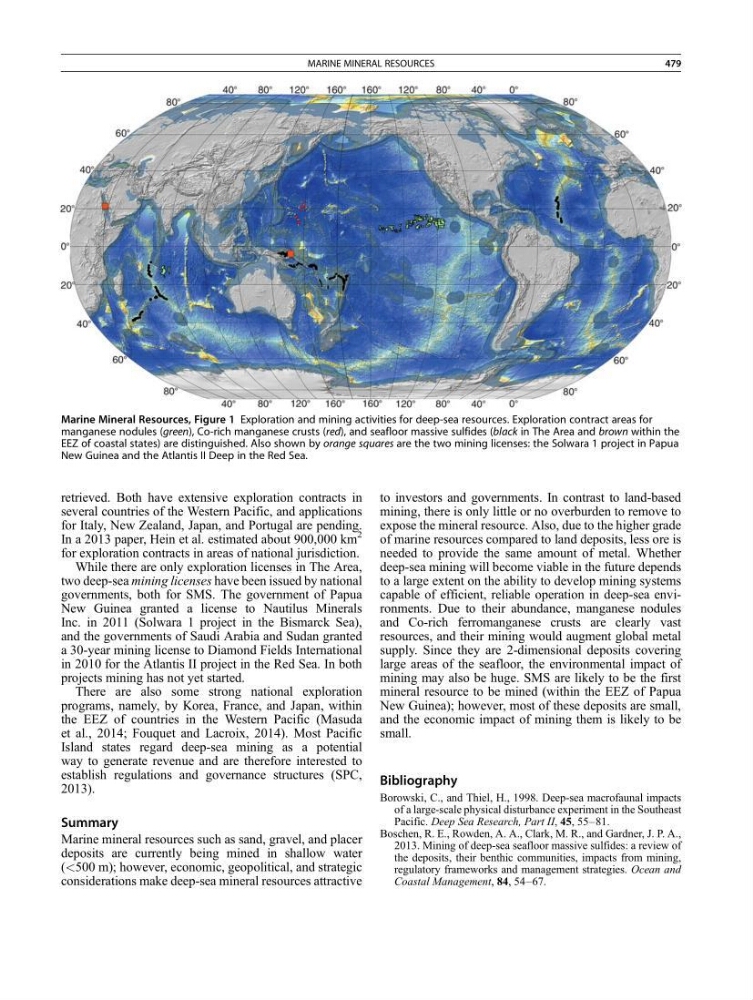
While there are only exploration licenses in The Area,
two deep-sea mining licenses have been issued by national
governments, both for SMS. The government of Papua
New Guinea granted a license to Nautilus Minerals
Inc. in 2011 (Solwara 1 project in the Bismarck Sea),
and the governments of Saudi Arabia and Sudan granted
a 30-year mining license to Diamond Fields International
in 2010 for the Atlantis II project in the Red Sea. In both
projects mining has not yet started.
There are also some strong national exploration
programs, namely, by Korea, France, and Japan, within
the EEZ of countries in the Western Pacific (Masuda
et al., 2014; Fouquet and Lacroix, 2014). Most Pacific
Island states regard deep-sea mining as a potential
way to generate revenue and are therefore interested to
establish regulations and governance structures (SPC,
2013).
Summary
Marine mineral resources such as sand, gravel, and placer
deposits are currently being mined in shallow water
(<500 m); however, economic, geopolitical, and strategic
considerations make deep-sea mineral resources attractive
to investors and governments. In contrast to land-based
mining, there is only little or no overburden to remove to
expose the mineral resource. Also, due to the higher grade
of marine resources compared to land deposits, less ore is
needed to provide the same amount of metal. Whether
deep-sea mining will become viable in the future depends
to a large extent on the ability to develop mining systems
capable of efficient, reliable operation in deep-sea environments. Due to their abundance, manganese nodules
and Co-rich ferromanganese crusts are clearly vast
resources, and their mining would augment global metal
supply. Since they are 2-dimensional deposits covering
large areas of the seafloor, the environmental impact of
mining may also be huge. SMS are likely to be the first
mineral resource to be mined (within the EEZ of Papua
New Guinea); however, most of these deposits are small,
and the economic impact of mining them is likely to be
small.
Bibliography
Borowski, C., and Thiel, H., 1998. Deep-sea macrofaunal impacts
of a large-scale physical disturbance experiment in the Southeast
Pacific. Deep Sea Research, Part II, 45, 55–81.
Boschen, R. E., Rowden, A. A., Clark, M. R., and Gardner, J. P. A.,
2013. Mining of deep-sea seafloor massive sulfides: a review of
the deposits, their benthic communities, impacts from mining,
regulatory frameworks and management strategies. Ocean and
Coastal Management, 84, 54–67.
Marine Mineral Resources, Figure 1 Exploration and mining activities for deep-sea resources. Exploration contract areas for
manganese nodules (green), Co-rich manganese crusts (red), and seafloor massive sulfides (black in The Area and brown within the
EEZ of coastal states) are distinguished. Also shown by orange squares are the two mining licenses: the Solwara 1 project in Papua
New Guinea and the Atlantis II Deep in the Red Sea.
MARINE MINERAL RESOURCES
479