

addition of an unreasonably high value for the crustal
radioactivity.
Whether or not the depths increase as the square root of
age on the oldest seafloor has proven controversial (e.g.,
Crough, 1975; Schroder, 1984; Marty and Cazenave,
1989; Stein and Stein, 1992; Carlson and Johnson, 1994;
Hillier and Watts, 2005). The distinction is key: a direct
continuation would favor the simplest cooling half-space
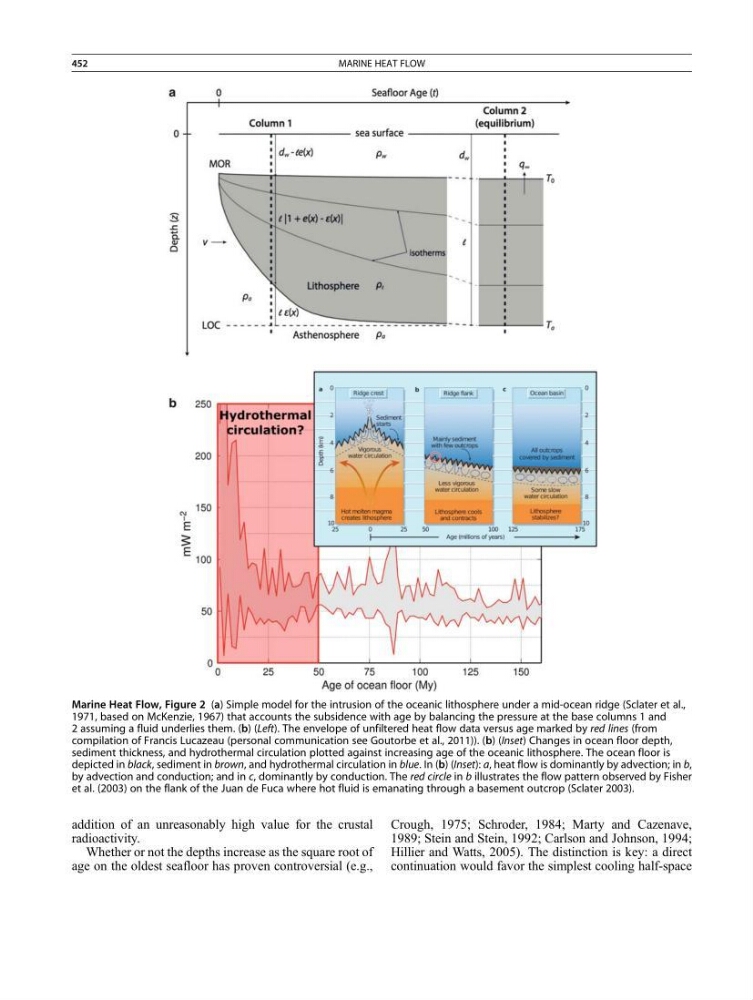
Marine Heat Flow, Figure 2 (a) Simple model for the intrusion of the oceanic lithosphere under a mid-ocean ridge (Sclater et al.,
1971, based on McKenzie, 1967) that accounts the subsidence with age by balancing the pressure at the base columns 1 and
2 assuming a fluid underlies them. (b) (Left). The envelope of unfiltered heat flow data versus age marked by red lines (from
compilation of Francis Lucazeau (personal communication see Goutorbe et al., 2011)). (b) (Inset) Changes in ocean floor depth,
sediment thickness, and hydrothermal circulation plotted against increasing age of the oceanic lithosphere. The ocean floor is
depicted in black, sediment in brown, and hydrothermal circulation in blue. In (b) (Inset): a, heat flow is dominantly by advection; in b,
by advection and conduction; and in c, dominantly by conduction. The red circle in b illustrates the flow pattern observed by Fisher
et al. (2003) on the flank of the Juan de Fuca where hot fluid is emanating through a basement outcrop (Sclater 2003).
452
MARINE HEAT FLOW
radioactivity.
Whether or not the depths increase as the square root of
age on the oldest seafloor has proven controversial (e.g.,
Crough, 1975; Schroder, 1984; Marty and Cazenave,
1989; Stein and Stein, 1992; Carlson and Johnson, 1994;
Hillier and Watts, 2005). The distinction is key: a direct
continuation would favor the simplest cooling half-space
Marine Heat Flow, Figure 2 (a) Simple model for the intrusion of the oceanic lithosphere under a mid-ocean ridge (Sclater et al.,
1971, based on McKenzie, 1967) that accounts the subsidence with age by balancing the pressure at the base columns 1 and
2 assuming a fluid underlies them. (b) (Left). The envelope of unfiltered heat flow data versus age marked by red lines (from
compilation of Francis Lucazeau (personal communication see Goutorbe et al., 2011)). (b) (Inset) Changes in ocean floor depth,
sediment thickness, and hydrothermal circulation plotted against increasing age of the oceanic lithosphere. The ocean floor is
depicted in black, sediment in brown, and hydrothermal circulation in blue. In (b) (Inset): a, heat flow is dominantly by advection; in b,
by advection and conduction; and in c, dominantly by conduction. The red circle in b illustrates the flow pattern observed by Fisher
et al. (2003) on the flank of the Juan de Fuca where hot fluid is emanating through a basement outcrop (Sclater 2003).
452
MARINE HEAT FLOW