

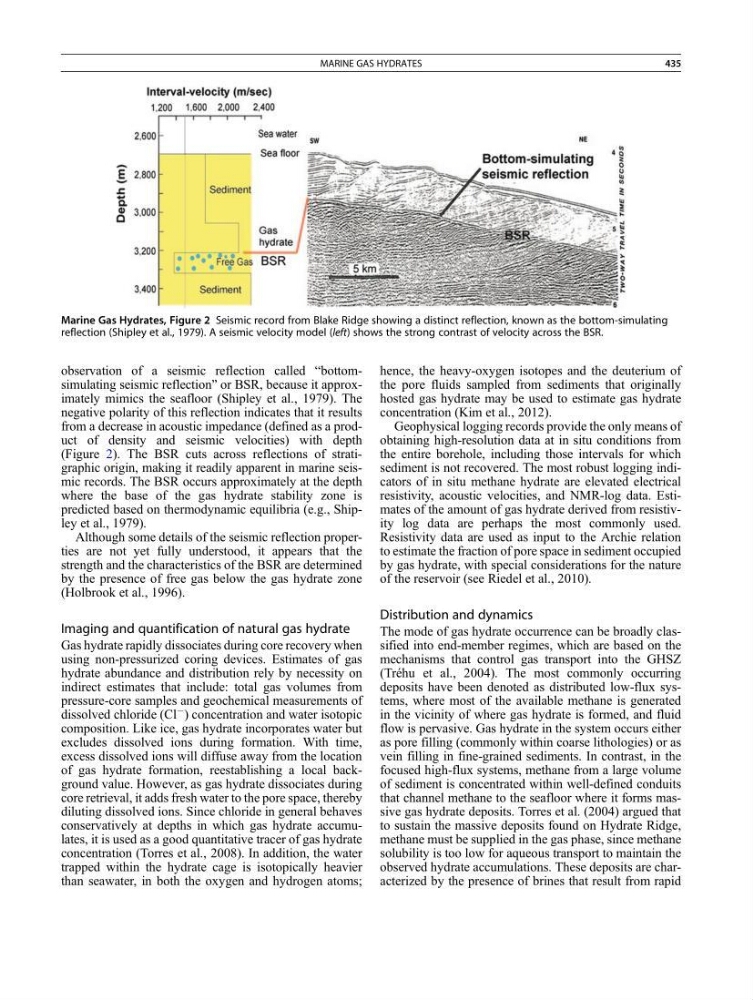
observation of a seismic reflection called “bottomsimulating seismic reflection” or BSR, because it approximately mimics the seafloor (Shipley et al., 1979). The
negative polarity of this reflection indicates that it results
from a decrease in acoustic impedance (defined as a product of density and seismic velocities) with depth
(Figure 2). The BSR cuts across reflections of stratigraphic origin, making it readily apparent in marine seismic records. The BSR occurs approximately at the depth
where the base of the gas hydrate stability zone is
predicted based on thermodynamic equilibria (e.g., Shipley et al., 1979).
Although some details of the seismic reflection properties are not yet fully understood, it appears that the
strength and the characteristics of the BSR are determined
by the presence of free gas below the gas hydrate zone
(Holbrook et al., 1996).
Imaging and quantification of natural gas hydrate
Gas hydrate rapidly dissociates during core recovery when
using non-pressurized coring devices. Estimates of gas
hydrate abundance and distribution rely by necessity on
indirect estimates that include: total gas volumes from
pressure-core samples and geochemical measurements of
dissolved chloride (Cl
À ) concentration and water isotopic
composition. Like ice, gas hydrate incorporates water but
excludes dissolved ions during formation. With time,
excess dissolved ions will diffuse away from the location
of gas hydrate formation, reestablishing a local background value. However, as gas hydrate dissociates during
core retrieval, it adds fresh water to the pore space, thereby
diluting dissolved ions. Since chloride in general behaves
conservatively at depths in which gas hydrate accumulates, it is used as a good quantitative tracer of gas hydrate
concentration (Torres et al., 2008). In addition, the water
trapped within the hydrate cage is isotopically heavier
than seawater, in both the oxygen and hydrogen atoms;
hence, the heavy-oxygen isotopes and the deuterium of
the pore fluids sampled from sediments that originally
hosted gas hydrate may be used to estimate gas hydrate
concentration (Kim et al., 2012).
Geophysical logging records provide the only means of
obtaining high-resolution data at in situ conditions from
the entire borehole, including those intervals for which
sediment is not recovered. The most robust logging indicators of in situ methane hydrate are elevated electrical
resistivity, acoustic velocities, and NMR-log data. Estimates of the amount of gas hydrate derived from resistivity log data are perhaps the most commonly used.
Resistivity data are used as input to the Archie relation
to estimate the fraction of pore space in sediment occupied
by gas hydrate, with special considerations for the nature
of the reservoir (see Riedel et al., 2010).
Distribution and dynamics
The mode of gas hydrate occurrence can be broadly classified into end-member regimes, which are based on the
mechanisms that control gas transport into the GHSZ
(Tréhu et al., 2004). The most commonly occurring
deposits have been denoted as distributed low-flux systems, where most of the available methane is generated
in the vicinity of where gas hydrate is formed, and fluid
flow is pervasive. Gas hydrate in the system occurs either
as pore filling (commonly within coarse lithologies) or as
vein filling in fine-grained sediments. In contrast, in the
focused high-flux systems, methane from a large volume
of sediment is concentrated within well-defined conduits
that channel methane to the seafloor where it forms massive gas hydrate deposits. Torres et al. (2004) argued that
to sustain the massive deposits found on Hydrate Ridge,
methane must be supplied in the gas phase, since methane
solubility is too low for aqueous transport to maintain the
observed hydrate accumulations. These deposits are characterized by the presence of brines that result from rapid
Marine Gas Hydrates, Figure 2 Seismic record from Blake Ridge showing a distinct reflection, known as the bottom-simulating
reflection (Shipley et al., 1979). A seismic velocity model (left) shows the strong contrast of velocity across the BSR.
MARINE GAS HYDRATES
435
negative polarity of this reflection indicates that it results
from a decrease in acoustic impedance (defined as a product of density and seismic velocities) with depth
(Figure 2). The BSR cuts across reflections of stratigraphic origin, making it readily apparent in marine seismic records. The BSR occurs approximately at the depth
where the base of the gas hydrate stability zone is
predicted based on thermodynamic equilibria (e.g., Shipley et al., 1979).
Although some details of the seismic reflection properties are not yet fully understood, it appears that the
strength and the characteristics of the BSR are determined
by the presence of free gas below the gas hydrate zone
(Holbrook et al., 1996).
Imaging and quantification of natural gas hydrate
Gas hydrate rapidly dissociates during core recovery when
using non-pressurized coring devices. Estimates of gas
hydrate abundance and distribution rely by necessity on
indirect estimates that include: total gas volumes from
pressure-core samples and geochemical measurements of
dissolved chloride (Cl
À ) concentration and water isotopic
composition. Like ice, gas hydrate incorporates water but
excludes dissolved ions during formation. With time,
excess dissolved ions will diffuse away from the location
of gas hydrate formation, reestablishing a local background value. However, as gas hydrate dissociates during
core retrieval, it adds fresh water to the pore space, thereby
diluting dissolved ions. Since chloride in general behaves
conservatively at depths in which gas hydrate accumulates, it is used as a good quantitative tracer of gas hydrate
concentration (Torres et al., 2008). In addition, the water
trapped within the hydrate cage is isotopically heavier
than seawater, in both the oxygen and hydrogen atoms;
hence, the heavy-oxygen isotopes and the deuterium of
the pore fluids sampled from sediments that originally
hosted gas hydrate may be used to estimate gas hydrate
concentration (Kim et al., 2012).
Geophysical logging records provide the only means of
obtaining high-resolution data at in situ conditions from
the entire borehole, including those intervals for which
sediment is not recovered. The most robust logging indicators of in situ methane hydrate are elevated electrical
resistivity, acoustic velocities, and NMR-log data. Estimates of the amount of gas hydrate derived from resistivity log data are perhaps the most commonly used.
Resistivity data are used as input to the Archie relation
to estimate the fraction of pore space in sediment occupied
by gas hydrate, with special considerations for the nature
of the reservoir (see Riedel et al., 2010).
Distribution and dynamics
The mode of gas hydrate occurrence can be broadly classified into end-member regimes, which are based on the
mechanisms that control gas transport into the GHSZ
(Tréhu et al., 2004). The most commonly occurring
deposits have been denoted as distributed low-flux systems, where most of the available methane is generated
in the vicinity of where gas hydrate is formed, and fluid
flow is pervasive. Gas hydrate in the system occurs either
as pore filling (commonly within coarse lithologies) or as
vein filling in fine-grained sediments. In contrast, in the
focused high-flux systems, methane from a large volume
of sediment is concentrated within well-defined conduits
that channel methane to the seafloor where it forms massive gas hydrate deposits. Torres et al. (2004) argued that
to sustain the massive deposits found on Hydrate Ridge,
methane must be supplied in the gas phase, since methane
solubility is too low for aqueous transport to maintain the
observed hydrate accumulations. These deposits are characterized by the presence of brines that result from rapid
Marine Gas Hydrates, Figure 2 Seismic record from Blake Ridge showing a distinct reflection, known as the bottom-simulating
reflection (Shipley et al., 1979). A seismic velocity model (left) shows the strong contrast of velocity across the BSR.
MARINE GAS HYDRATES
435