

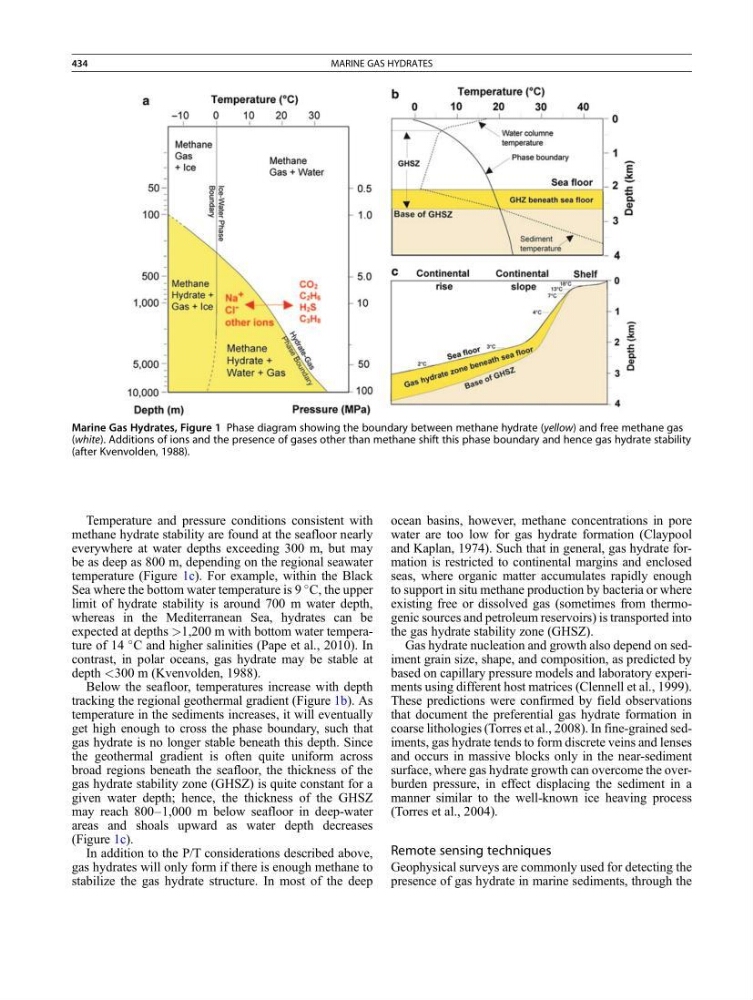
Temperature and pressure conditions consistent with
methane hydrate stability are found at the seafloor nearly
everywhere at water depths exceeding 300 m, but may
be as deep as 800 m, depending on the regional seawater
temperature (Figure 1c). For example, within the Black
Sea where the bottom water temperature is 9
C, the upper
limit of hydrate stability is around 700 m water depth,
whereas in the Mediterranean Sea, hydrates can be
expected at depths >1,200 m with bottom water temperature of 14
C and higher salinities (Pape et al., 2010). In
contrast, in polar oceans, gas hydrate may be stable at
depth <300 m (Kvenvolden, 1988).
Below the seafloor, temperatures increase with depth
tracking the regional geothermal gradient (Figure 1b). As
temperature in the sediments increases, it will eventually
get high enough to cross the phase boundary, such that
gas hydrate is no longer stable beneath this depth. Since
the geothermal gradient is often quite uniform across
broad regions beneath the seafloor, the thickness of the
gas hydrate stability zone (GHSZ) is quite constant for a
given water depth; hence, the thickness of the GHSZ
may reach 800–1,000 m below seafloor in deep-water
areas and shoals upward as water depth decreases
(Figure 1c).
In addition to the P/T considerations described above,
gas hydrates will only form if there is enough methane to
stabilize the gas hydrate structure. In most of the deep
ocean basins, however, methane concentrations in pore
water are too low for gas hydrate formation (Claypool
and Kaplan, 1974). Such that in general, gas hydrate formation is restricted to continental margins and enclosed
seas, where organic matter accumulates rapidly enough
to support in situ methane production by bacteria or where
existing free or dissolved gas (sometimes from thermogenic sources and petroleum reservoirs) is transported into
the gas hydrate stability zone (GHSZ).
Gas hydrate nucleation and growth also depend on sediment grain size, shape, and composition, as predicted by
based on capillary pressure models and laboratory experiments using different host matrices (Clennell et al., 1999).
These predictions were confirmed by field observations
that document the preferential gas hydrate formation in
coarse lithologies (Torres et al., 2008). In fine-grained sediments, gas hydrate tends to form discrete veins and lenses
and occurs in massive blocks only in the near-sediment
surface, where gas hydrate growth can overcome the overburden pressure, in effect displacing the sediment in a
manner similar to the well-known ice heaving process
(Torres et al., 2004).
Remote sensing techniques
Geophysical surveys are commonly used for detecting the
presence of gas hydrate in marine sediments, through the
Marine Gas Hydrates, Figure 1 Phase diagram showing the boundary between methane hydrate (yellow) and free methane gas
(white). Additions of ions and the presence of gases other than methane shift this phase boundary and hence gas hydrate stability
(after Kvenvolden, 1988).
434
MARINE GAS HYDRATES
methane hydrate stability are found at the seafloor nearly
everywhere at water depths exceeding 300 m, but may
be as deep as 800 m, depending on the regional seawater
temperature (Figure 1c). For example, within the Black
Sea where the bottom water temperature is 9
C, the upper
limit of hydrate stability is around 700 m water depth,
whereas in the Mediterranean Sea, hydrates can be
expected at depths >1,200 m with bottom water temperature of 14
C and higher salinities (Pape et al., 2010). In
contrast, in polar oceans, gas hydrate may be stable at
depth <300 m (Kvenvolden, 1988).
Below the seafloor, temperatures increase with depth
tracking the regional geothermal gradient (Figure 1b). As
temperature in the sediments increases, it will eventually
get high enough to cross the phase boundary, such that
gas hydrate is no longer stable beneath this depth. Since
the geothermal gradient is often quite uniform across
broad regions beneath the seafloor, the thickness of the
gas hydrate stability zone (GHSZ) is quite constant for a
given water depth; hence, the thickness of the GHSZ
may reach 800–1,000 m below seafloor in deep-water
areas and shoals upward as water depth decreases
(Figure 1c).
In addition to the P/T considerations described above,
gas hydrates will only form if there is enough methane to
stabilize the gas hydrate structure. In most of the deep
ocean basins, however, methane concentrations in pore
water are too low for gas hydrate formation (Claypool
and Kaplan, 1974). Such that in general, gas hydrate formation is restricted to continental margins and enclosed
seas, where organic matter accumulates rapidly enough
to support in situ methane production by bacteria or where
existing free or dissolved gas (sometimes from thermogenic sources and petroleum reservoirs) is transported into
the gas hydrate stability zone (GHSZ).
Gas hydrate nucleation and growth also depend on sediment grain size, shape, and composition, as predicted by
based on capillary pressure models and laboratory experiments using different host matrices (Clennell et al., 1999).
These predictions were confirmed by field observations
that document the preferential gas hydrate formation in
coarse lithologies (Torres et al., 2008). In fine-grained sediments, gas hydrate tends to form discrete veins and lenses
and occurs in massive blocks only in the near-sediment
surface, where gas hydrate growth can overcome the overburden pressure, in effect displacing the sediment in a
manner similar to the well-known ice heaving process
(Torres et al., 2004).
Remote sensing techniques
Geophysical surveys are commonly used for detecting the
presence of gas hydrate in marine sediments, through the
Marine Gas Hydrates, Figure 1 Phase diagram showing the boundary between methane hydrate (yellow) and free methane gas
(white). Additions of ions and the presence of gases other than methane shift this phase boundary and hence gas hydrate stability
(after Kvenvolden, 1988).
434
MARINE GAS HYDRATES