

variety of paleoceanographic and paleoclimatic events
and has been the subject of numerous articles in both the
scientific and popular literature, of books, and even of
television shows.
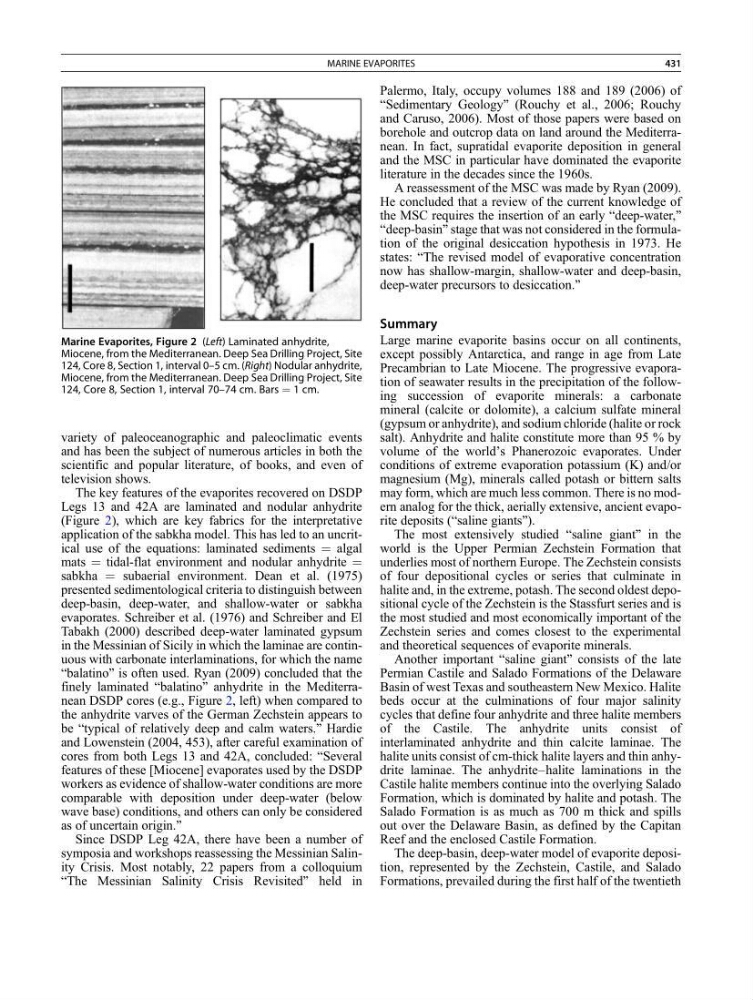
The key features of the evaporites recovered on DSDP
Legs 13 and 42A are laminated and nodular anhydrite
(Figure 2), which are key fabrics for the interpretative
application of the sabkha model. This has led to an uncritical use of the equations: laminated sediments ¼ algal
mats ¼ tidal-flat environment and nodular anhydrite ¼
sabkha ¼ subaerial environment. Dean et al. (1975)
presented sedimentological criteria to distinguish between
deep-basin, deep-water, and shallow-water or sabkha
evaporates. Schreiber et al. (1976) and Schreiber and El
Tabakh (2000) described deep-water laminated gypsum
in the Messinian of Sicily in which the laminae are continuous with carbonate interlaminations, for which the name
“balatino” is often used. Ryan (2009) concluded that the
finely laminated “balatino” anhydrite in the Mediterranean DSDP cores (e.g., Figure 2, left) when compared to
the anhydrite varves of the German Zechstein appears to
be “typical of relatively deep and calm waters.” Hardie
and Lowenstein (2004, 453), after careful examination of
cores from both Legs 13 and 42A, concluded: “Several
features of these [Miocene] evaporates used by the DSDP
workers as evidence of shallow-water conditions are more
comparable with deposition under deep-water (below
wave base) conditions, and others can only be considered
as of uncertain origin.”
Since DSDP Leg 42A, there have been a number of
symposia and workshops reassessing the Messinian Salinity Crisis. Most notably, 22 papers from a colloquium
“The Messinian Salinity Crisis Revisited” held in
Palermo, Italy, occupy volumes 188 and 189 (2006) of
“Sedimentary Geology” (Rouchy et al., 2006; Rouchy
and Caruso, 2006). Most of those papers were based on
borehole and outcrop data on land around the Mediterranean. In fact, supratidal evaporite deposition in general
and the MSC in particular have dominated the evaporite
literature in the decades since the 1960s.
A reassessment of the MSC was made by Ryan (2009).
He concluded that a review of the current knowledge of
the MSC requires the insertion of an early “deep-water,”
“deep-basin” stage that was not considered in the formulation of the original desiccation hypothesis in 1973. He
states: “The revised model of evaporative concentration
now has shallow-margin, shallow-water and deep-basin,
deep-water precursors to desiccation.”
Summary
Large marine evaporite basins occur on all continents,
except possibly Antarctica, and range in age from Late
Precambrian to Late Miocene. The progressive evaporation of seawater results in the precipitation of the following succession of evaporite minerals: a carbonate
mineral (calcite or dolomite), a calcium sulfate mineral
(gypsum or anhydrite), and sodium chloride (halite or rock
salt). Anhydrite and halite constitute more than 95 % by
volume of the world’s Phanerozoic evaporates. Under
conditions of extreme evaporation potassium (K) and/or
magnesium (Mg), minerals called potash or bittern salts
may form, which are much less common. There is no modern analog for the thick, aerially extensive, ancient evaporite deposits (“saline giants”).
The most extensively studied “saline giant” in the
world is the Upper Permian Zechstein Formation that
underlies most of northern Europe. The Zechstein consists
of four depositional cycles or series that culminate in
halite and, in the extreme, potash. The second oldest depositional cycle of the Zechstein is the Stassfurt series and is
the most studied and most economically important of the
Zechstein series and comes closest to the experimental
and theoretical sequences of evaporite minerals.
Another important “saline giant” consists of the late
Permian Castile and Salado Formations of the Delaware
Basin of west Texas and southeastern New Mexico. Halite
beds occur at the culminations of four major salinity
cycles that define four anhydrite and three halite members
of the Castile. The anhydrite units consist of
interlaminated anhydrite and thin calcite laminae. The
halite units consist of cm-thick halite layers and thin anhydrite laminae. The anhydrite–halite laminations in the
Castile halite members continue into the overlying Salado
Formation, which is dominated by halite and potash. The
Salado Formation is as much as 700 m thick and spills
out over the Delaware Basin, as defined by the Capitan
Reef and the enclosed Castile Formation.
The deep-basin, deep-water model of evaporite deposition, represented by the Zechstein, Castile, and Salado
Formations, prevailed during the first half of the twentieth
Marine Evaporites, Figure 2 (Left) Laminated anhydrite,
Miocene, from the Mediterranean. Deep Sea Drilling Project, Site
124, Core 8, Section 1, interval 0–5 cm. (Right) Nodular anhydrite,
Miocene, from the Mediterranean. Deep Sea Drilling Project, Site
124, Core 8, Section 1, interval 70–74 cm. Bars ¼ 1 cm.
MARINE EVAPORITES
431
and has been the subject of numerous articles in both the
scientific and popular literature, of books, and even of
television shows.
The key features of the evaporites recovered on DSDP
Legs 13 and 42A are laminated and nodular anhydrite
(Figure 2), which are key fabrics for the interpretative
application of the sabkha model. This has led to an uncritical use of the equations: laminated sediments ¼ algal
mats ¼ tidal-flat environment and nodular anhydrite ¼
sabkha ¼ subaerial environment. Dean et al. (1975)
presented sedimentological criteria to distinguish between
deep-basin, deep-water, and shallow-water or sabkha
evaporates. Schreiber et al. (1976) and Schreiber and El
Tabakh (2000) described deep-water laminated gypsum
in the Messinian of Sicily in which the laminae are continuous with carbonate interlaminations, for which the name
“balatino” is often used. Ryan (2009) concluded that the
finely laminated “balatino” anhydrite in the Mediterranean DSDP cores (e.g., Figure 2, left) when compared to
the anhydrite varves of the German Zechstein appears to
be “typical of relatively deep and calm waters.” Hardie
and Lowenstein (2004, 453), after careful examination of
cores from both Legs 13 and 42A, concluded: “Several
features of these [Miocene] evaporates used by the DSDP
workers as evidence of shallow-water conditions are more
comparable with deposition under deep-water (below
wave base) conditions, and others can only be considered
as of uncertain origin.”
Since DSDP Leg 42A, there have been a number of
symposia and workshops reassessing the Messinian Salinity Crisis. Most notably, 22 papers from a colloquium
“The Messinian Salinity Crisis Revisited” held in
Palermo, Italy, occupy volumes 188 and 189 (2006) of
“Sedimentary Geology” (Rouchy et al., 2006; Rouchy
and Caruso, 2006). Most of those papers were based on
borehole and outcrop data on land around the Mediterranean. In fact, supratidal evaporite deposition in general
and the MSC in particular have dominated the evaporite
literature in the decades since the 1960s.
A reassessment of the MSC was made by Ryan (2009).
He concluded that a review of the current knowledge of
the MSC requires the insertion of an early “deep-water,”
“deep-basin” stage that was not considered in the formulation of the original desiccation hypothesis in 1973. He
states: “The revised model of evaporative concentration
now has shallow-margin, shallow-water and deep-basin,
deep-water precursors to desiccation.”
Summary
Large marine evaporite basins occur on all continents,
except possibly Antarctica, and range in age from Late
Precambrian to Late Miocene. The progressive evaporation of seawater results in the precipitation of the following succession of evaporite minerals: a carbonate
mineral (calcite or dolomite), a calcium sulfate mineral
(gypsum or anhydrite), and sodium chloride (halite or rock
salt). Anhydrite and halite constitute more than 95 % by
volume of the world’s Phanerozoic evaporates. Under
conditions of extreme evaporation potassium (K) and/or
magnesium (Mg), minerals called potash or bittern salts
may form, which are much less common. There is no modern analog for the thick, aerially extensive, ancient evaporite deposits (“saline giants”).
The most extensively studied “saline giant” in the
world is the Upper Permian Zechstein Formation that
underlies most of northern Europe. The Zechstein consists
of four depositional cycles or series that culminate in
halite and, in the extreme, potash. The second oldest depositional cycle of the Zechstein is the Stassfurt series and is
the most studied and most economically important of the
Zechstein series and comes closest to the experimental
and theoretical sequences of evaporite minerals.
Another important “saline giant” consists of the late
Permian Castile and Salado Formations of the Delaware
Basin of west Texas and southeastern New Mexico. Halite
beds occur at the culminations of four major salinity
cycles that define four anhydrite and three halite members
of the Castile. The anhydrite units consist of
interlaminated anhydrite and thin calcite laminae. The
halite units consist of cm-thick halite layers and thin anhydrite laminae. The anhydrite–halite laminations in the
Castile halite members continue into the overlying Salado
Formation, which is dominated by halite and potash. The
Salado Formation is as much as 700 m thick and spills
out over the Delaware Basin, as defined by the Capitan
Reef and the enclosed Castile Formation.
The deep-basin, deep-water model of evaporite deposition, represented by the Zechstein, Castile, and Salado
Formations, prevailed during the first half of the twentieth
Marine Evaporites, Figure 2 (Left) Laminated anhydrite,
Miocene, from the Mediterranean. Deep Sea Drilling Project, Site
124, Core 8, Section 1, interval 0–5 cm. (Right) Nodular anhydrite,
Miocene, from the Mediterranean. Deep Sea Drilling Project, Site
124, Core 8, Section 1, interval 70–74 cm. Bars ¼ 1 cm.
MARINE EVAPORITES
431