

Richter-Bernburg (1957). The stratigraphic regularity and
lateral continuity of laminated anhydrite, such as those
found in the Castile and Zechstein Formations, are the
main hallmarks of deep-basin, deep-water evaporates.
The anhydrite–halite laminations in the Castile halite
members continue into the base of the overlying Salado
Formation, which is dominated by halite and potash. The
Salado is as much as 700 m thick and spills out over the
Delaware Basin, as defined by the Capitan Reef and
enclosed Castile Formation. Most of the Salado was
deposited in shallow water over a longer time span than
the Castile with much of the time represented by
nondeposition. The Salado covers an area of about
150,000 km
2
, although the area that includes the Carlsbad
Potash District is only 70,000 km
2 (Lowenstein, 1988).
The main potash-bearing unit is the McNutt Zone in the
middle of the Salado that contains sylvite and langbeinite
and minor carnallite, kieserite, and kainite (Barker and
Austin, 1993). It is in the thick halite beds of the Salado
that the Waste Isolation Pilot Plant (WIPP) site is located
east of Carlsbad, New Mexico, for the disposal of
low-level radioactive wastes.
Shallow-water evaporites
The deep-basin, deep-water model of evaporite deposition, represented by the Zechstein, Castile, and Salado
Formations, prevailed during the first half of the twentieth
century, but during the 1950s, examples of shallow-water
evaporites began to emerge, interpreted as having been
deposited in restricted estuaries or basins (“arms of the
sea”) (e.g., Scruton, 1953; Masson, 1955; Morris and
Dickey, 1957).
Marginal-marine evaporite deposition was further stimulated with the documentation in the 1960s of supratidal
(“sabkha”) evaporite deposition along the Arabian (Abu
Dhabi) margin of the Persian Gulf (e.g., Shearman,
1966; Kinsman, 1966, 1969; Butler, 1969). Here a whole
spectrum of shelf carbonates and evaporites has been
developed. A typical sediment sequence might include
subtidal aragonite muds, pelleted muds, and oolites; intertidal laminated cyanobacterial (blue-green algal) mats
with trapped and bound carbonate muds; and supratidal
(sabkha) nodular anhydrite or gypsum in a carbonate
matrix that may be dolomitized. With no modern analogs
for the thick, extensive evaporite sequences of the Phanerozoic, the Holocene occurrences of marginal-marine
evaporates have been used, and sometimes overused, to
explain ancient evaporite deposits. For example,
Shearman (1966) suggested that many ancient evaporite
deposits, especially those dominated by anhydrite, but
not excluding thick halite and potash deposits, had been
formed by diagenesis in a sabkha-like environment.
A review of Holocene carbonates and evaporites of the
Arabian coast is presented by Alsharhan and Kendell
(2003), and a discussion of supratidal mudflat evaporite
deposition in general is presented in Kirkland and
Evans (1973).
The application of the “sabkha model” was accelerated
with the exciting recovery of upper Miocene (Messinian)
anhydrite and halite from the floor of the Mediterranean
Sea on Leg 13 of the Deep Sea Drilling Project (DSDP;
Ryan et al., 1973; Hsü et al., 1973) and cored again in
1975 on DSDP Leg 42A (Garrison et al., 1978; Hsü
et al., 1978; Kidd et al., 1978). The sediments that were
cored with poor recovery on DSDP Legs 13 and 42A were
from the upper ~70 m of the upper Messinian evaporite
that may be up to 2 km thick based on seismic profiles
and boreholes in the seafloor, outcrops on land, and up
to 600 m of halite in the subsurface. The conclusion was
that the evaporites from the upper part of the upper evaporite in eastern and western basins of the Mediterranean
were deposited in shallow subaqueous to subaerial environments and that the Mediterranean must have dried up
and refilled several times with a huge waterfall at the Strait
of Gibraltar. This is called the deep-basin, desiccation
hypothesis, and the event has been called the “Messinian
Salinity Crisis” (MSC). It has been used to explain a wide
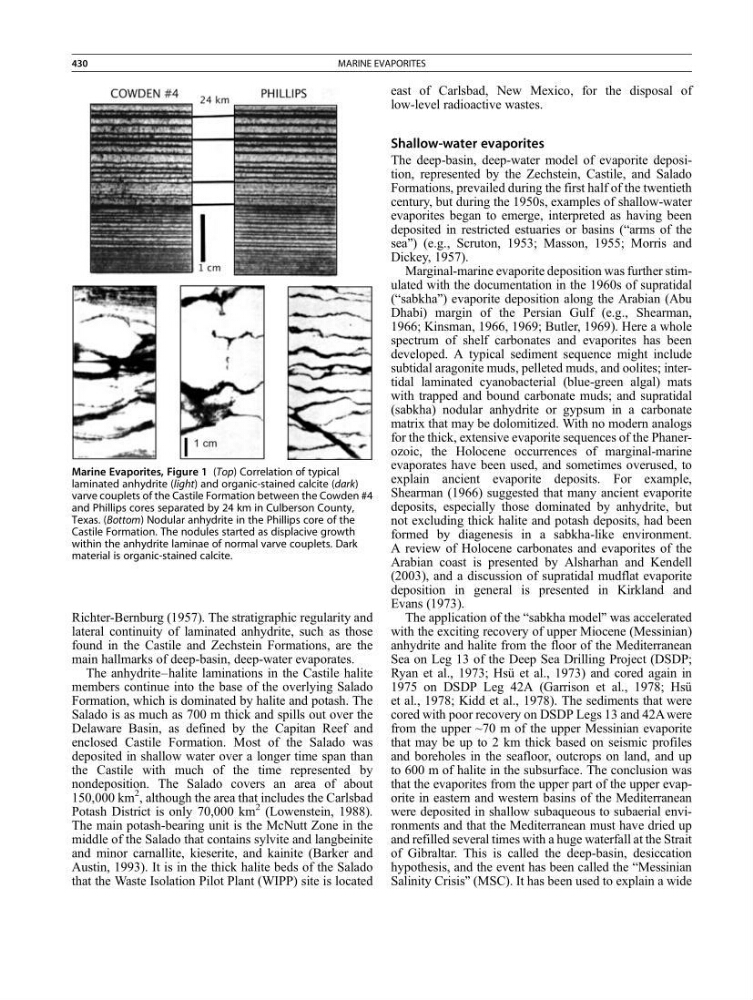
Marine Evaporites, Figure 1 (Top) Correlation of typical
laminated anhydrite (light) and organic-stained calcite (dark)
varve couplets of the Castile Formation between the Cowden #4
and Phillips cores separated by 24 km in Culberson County,
Texas. (Bottom) Nodular anhydrite in the Phillips core of the
Castile Formation. The nodules started as displacive growth
within the anhydrite laminae of normal varve couplets. Dark
material is organic-stained calcite.
430
MARINE EVAPORITES
lateral continuity of laminated anhydrite, such as those
found in the Castile and Zechstein Formations, are the
main hallmarks of deep-basin, deep-water evaporates.
The anhydrite–halite laminations in the Castile halite
members continue into the base of the overlying Salado
Formation, which is dominated by halite and potash. The
Salado is as much as 700 m thick and spills out over the
Delaware Basin, as defined by the Capitan Reef and
enclosed Castile Formation. Most of the Salado was
deposited in shallow water over a longer time span than
the Castile with much of the time represented by
nondeposition. The Salado covers an area of about
150,000 km
2
, although the area that includes the Carlsbad
Potash District is only 70,000 km
2 (Lowenstein, 1988).
The main potash-bearing unit is the McNutt Zone in the
middle of the Salado that contains sylvite and langbeinite
and minor carnallite, kieserite, and kainite (Barker and
Austin, 1993). It is in the thick halite beds of the Salado
that the Waste Isolation Pilot Plant (WIPP) site is located
east of Carlsbad, New Mexico, for the disposal of
low-level radioactive wastes.
Shallow-water evaporites
The deep-basin, deep-water model of evaporite deposition, represented by the Zechstein, Castile, and Salado
Formations, prevailed during the first half of the twentieth
century, but during the 1950s, examples of shallow-water
evaporites began to emerge, interpreted as having been
deposited in restricted estuaries or basins (“arms of the
sea”) (e.g., Scruton, 1953; Masson, 1955; Morris and
Dickey, 1957).
Marginal-marine evaporite deposition was further stimulated with the documentation in the 1960s of supratidal
(“sabkha”) evaporite deposition along the Arabian (Abu
Dhabi) margin of the Persian Gulf (e.g., Shearman,
1966; Kinsman, 1966, 1969; Butler, 1969). Here a whole
spectrum of shelf carbonates and evaporites has been
developed. A typical sediment sequence might include
subtidal aragonite muds, pelleted muds, and oolites; intertidal laminated cyanobacterial (blue-green algal) mats
with trapped and bound carbonate muds; and supratidal
(sabkha) nodular anhydrite or gypsum in a carbonate
matrix that may be dolomitized. With no modern analogs
for the thick, extensive evaporite sequences of the Phanerozoic, the Holocene occurrences of marginal-marine
evaporates have been used, and sometimes overused, to
explain ancient evaporite deposits. For example,
Shearman (1966) suggested that many ancient evaporite
deposits, especially those dominated by anhydrite, but
not excluding thick halite and potash deposits, had been
formed by diagenesis in a sabkha-like environment.
A review of Holocene carbonates and evaporites of the
Arabian coast is presented by Alsharhan and Kendell
(2003), and a discussion of supratidal mudflat evaporite
deposition in general is presented in Kirkland and
Evans (1973).
The application of the “sabkha model” was accelerated
with the exciting recovery of upper Miocene (Messinian)
anhydrite and halite from the floor of the Mediterranean
Sea on Leg 13 of the Deep Sea Drilling Project (DSDP;
Ryan et al., 1973; Hsü et al., 1973) and cored again in
1975 on DSDP Leg 42A (Garrison et al., 1978; Hsü
et al., 1978; Kidd et al., 1978). The sediments that were
cored with poor recovery on DSDP Legs 13 and 42A were
from the upper ~70 m of the upper Messinian evaporite
that may be up to 2 km thick based on seismic profiles
and boreholes in the seafloor, outcrops on land, and up
to 600 m of halite in the subsurface. The conclusion was
that the evaporites from the upper part of the upper evaporite in eastern and western basins of the Mediterranean
were deposited in shallow subaqueous to subaerial environments and that the Mediterranean must have dried up
and refilled several times with a huge waterfall at the Strait
of Gibraltar. This is called the deep-basin, desiccation
hypothesis, and the event has been called the “Messinian
Salinity Crisis” (MSC). It has been used to explain a wide
Marine Evaporites, Figure 1 (Top) Correlation of typical
laminated anhydrite (light) and organic-stained calcite (dark)
varve couplets of the Castile Formation between the Cowden #4
and Phillips cores separated by 24 km in Culberson County,
Texas. (Bottom) Nodular anhydrite in the Phillips core of the
Castile Formation. The nodules started as displacive growth
within the anhydrite laminae of normal varve couplets. Dark
material is organic-stained calcite.
430
MARINE EVAPORITES