

moisture for the summer monsoon rain in China, the
reduction of shelf area in the last glacial maximum has
enhanced the aridity in the China hinterland (Wang, 2004).
Primary productivity and biomass production
Marginal seas generally exhibit intermediate levels of primary production and biomass production, in comparison
with the highest rates in coastal upwelling regions and
the lowest rates in open ocean regions. This is because variations in primary productivity in oceans and seas occur as
a result of water column chemistry (e.g., nutrient and trace
elements concentrations) and dominant physical processes. River runoff and water column mixing introduce
dissolved nutrients, trace elements, and suspended particles into the photic (light) zones of nearshore regions
and resulted in increased primary production; the addition
160
o
150
o
140
o
130
o
60
o
50
o
a
b
120
o
110
o
100
o
40
o
30
o
20
o
10
o
0
o
Warm current
Cold current
Passageway
Arctic Circle
Amur
Yellow
Yangtze
Pearl
Red
Mekong
Tropic of Cancer
SOUTH CHINA SEA
EAST CHINA SEA
JAPAN SEA
OKHOTSK
SEA
Oyashio
K u r o s h io
PACIFIC
ASIA
Equator
E K
-
1 5
2 5
1 0 - 15 O
7 2 O E
- 1
3 - 5 O G
5 5
K E
T
1
-
3
HW
H C
2 1 - 2 4
K
30
N E 55
2 5
WN
C
E
N
C
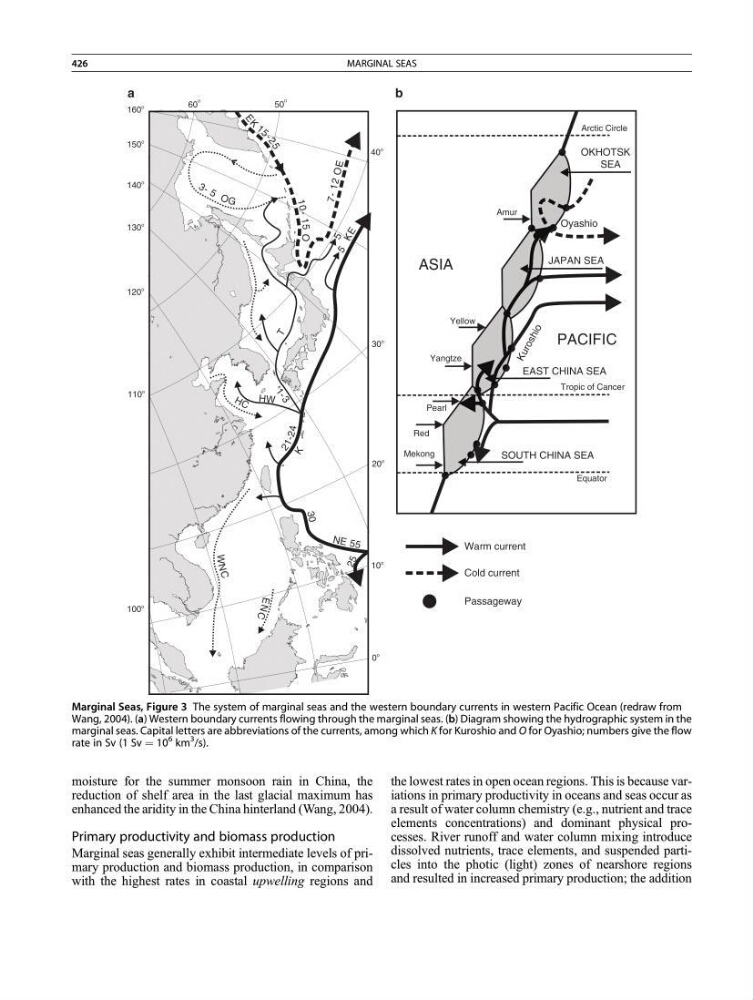
Marginal Seas, Figure 3 The system of marginal seas and the western boundary currents in western Pacific Ocean (redraw from
Wang, 2004). (a) Western boundary currents flowing through the marginal seas. (b) Diagram showing the hydrographic system in the
marginal seas. Capital letters are abbreviations of the currents, among which K for Kuroshio and O for Oyashio; numbers give the flow
rate in Sv (1 Sv ¼ 10
6 km
3 /s).
426
MARGINAL SEAS
reduction of shelf area in the last glacial maximum has
enhanced the aridity in the China hinterland (Wang, 2004).
Primary productivity and biomass production
Marginal seas generally exhibit intermediate levels of primary production and biomass production, in comparison
with the highest rates in coastal upwelling regions and
the lowest rates in open ocean regions. This is because variations in primary productivity in oceans and seas occur as
a result of water column chemistry (e.g., nutrient and trace
elements concentrations) and dominant physical processes. River runoff and water column mixing introduce
dissolved nutrients, trace elements, and suspended particles into the photic (light) zones of nearshore regions
and resulted in increased primary production; the addition
160
o
150
o
140
o
130
o
60
o
50
o
a
b
120
o
110
o
100
o
40
o
30
o
20
o
10
o
0
o
Warm current
Cold current
Passageway
Arctic Circle
Amur
Yellow
Yangtze
Pearl
Red
Mekong
Tropic of Cancer
SOUTH CHINA SEA
EAST CHINA SEA
JAPAN SEA
OKHOTSK
SEA
Oyashio
K u r o s h io
PACIFIC
ASIA
Equator
E K
-
1 5
2 5
1 0 - 15 O
7 2 O E
- 1
3 - 5 O G
5 5
K E
T
1
-
3
HW
H C
2 1 - 2 4
K
30
N E 55
2 5
WN
C
E
N
C
Marginal Seas, Figure 3 The system of marginal seas and the western boundary currents in western Pacific Ocean (redraw from
Wang, 2004). (a) Western boundary currents flowing through the marginal seas. (b) Diagram showing the hydrographic system in the
marginal seas. Capital letters are abbreviations of the currents, among which K for Kuroshio and O for Oyashio; numbers give the flow
rate in Sv (1 Sv ¼ 10
6 km
3 /s).
426
MARGINAL SEAS