

climatic conditions. For instance, more frequent lightning
strikes will result in more forest gaps leading to increased
forest replacement, recruitment, recovery, and turnover
(Duke 2001). And, all extreme events exemplified by
large seas, storm surges, and especially tsunami waves
have added influences on waterfront stands, ever vulnerable to erosion and severely limited opportunities for
recruitment and replacement.
Factor indicators
Changes due to severe natural disturbances are influenced
by a number of factors. Following severe storm activity
and blooms emanating from deteriorating water quality,
bloom and storm debris will accumulate and build up to
smother mangrove and salt marsh plants. Affected plants
may or may not die. By contrast, severe storms, cyclonic
winds, twisters, gusts, hailstorms, strong wave activity,
and high flows will usually have notable and severe
impacts on mangrove coast plants. This is expected to be
exacerbated by climate change with increased severity of
storms and other pressures. Forest light gaps will be created more frequently and they may well increase in size.
Such impacts will be enhanced by large waves and strong
currents from severe storms, large run off events, chronic
boat wash, tectonic events and tsunami waves.
Change type and corresponding factors
For severe natural disturbance (Figure 2) easurable areas
of disturbance for respective types of change include:
wrack accumulation with storm seas (Boston, 1983; Ellison, 2009), storm damage with strong winds and hail
(Houston, 1999; Greening et al., 2006; Proffitt et al.,
2006), light gaps with lightning (Sousa, 1984; Duke,
2001; Amir and Duke, 2009), and waterfront erosion with
large waves and tsunami (Danielsen et al., 2005;
Dahdouh-Guebas et al., 2005; Gedan et al., 2011).
Conclusions
Mangroves and tidal wetlands of the mangrove coast are
essential to the sustainability of highly productive natural
coastal environments. However, these ecosystems and
their dependent biota are under serious threat this century
from the escalation of large-scale land clearing and conversion of coastal wetlands (including mangrove coasts)
associated with the development of coastal lands for agricultural, aquaculture, port, urban, and industrial use. In
populated areas, key coastal rivers have become little
more than drains transporting eroded mud and effluent to
settle in downstream estuarine reaches, as well as on shallow embayments and inshore coral reefs. The mangrove
coasts that remain are becoming depauperate,
nonfunctional vestiges of their former state. Where
healthy, mangrove-lined estuaries had traditionally
offered respite and critical dampening of land runoff, in
recent years these bastions of coastal buffering – the
unique “coastal kidney,” mangrove coasts – are
succumbing to the increasing and unrelenting pressure of
expanding human population into coastal and estuarine
tidal wetland habitat of tropical and subtropical shorelines
worldwide.
To help allay the worsening situation, a program called
MangroveWatch (Duke and Mackenzie 2009; 2010;
www.mangrovewatch.org.au) specifically fosters and
facilitates partnerships between community volunteers
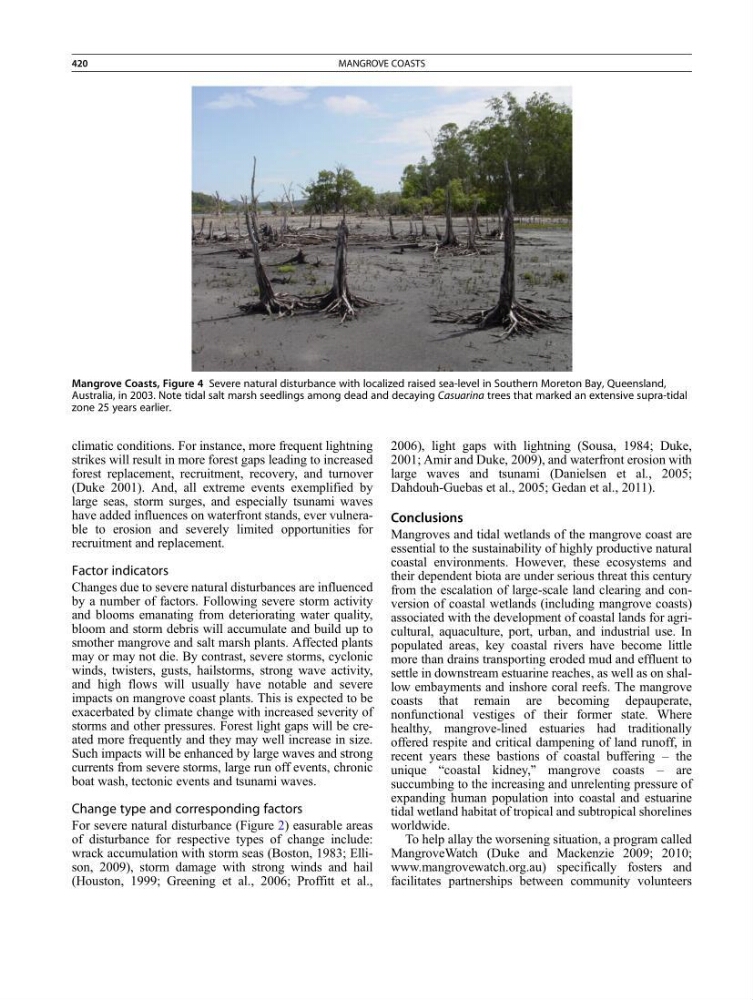
Mangrove Coasts, Figure 4 Severe natural disturbance with localized raised sea-level in Southern Moreton Bay, Queensland,
Australia, in 2003. Note tidal salt marsh seedlings among dead and decaying Casuarina trees that marked an extensive supra-tidal
zone 25 years earlier.
420
MANGROVE COASTS
strikes will result in more forest gaps leading to increased
forest replacement, recruitment, recovery, and turnover
(Duke 2001). And, all extreme events exemplified by
large seas, storm surges, and especially tsunami waves
have added influences on waterfront stands, ever vulnerable to erosion and severely limited opportunities for
recruitment and replacement.
Factor indicators
Changes due to severe natural disturbances are influenced
by a number of factors. Following severe storm activity
and blooms emanating from deteriorating water quality,
bloom and storm debris will accumulate and build up to
smother mangrove and salt marsh plants. Affected plants
may or may not die. By contrast, severe storms, cyclonic
winds, twisters, gusts, hailstorms, strong wave activity,
and high flows will usually have notable and severe
impacts on mangrove coast plants. This is expected to be
exacerbated by climate change with increased severity of
storms and other pressures. Forest light gaps will be created more frequently and they may well increase in size.
Such impacts will be enhanced by large waves and strong
currents from severe storms, large run off events, chronic
boat wash, tectonic events and tsunami waves.
Change type and corresponding factors
For severe natural disturbance (Figure 2) easurable areas
of disturbance for respective types of change include:
wrack accumulation with storm seas (Boston, 1983; Ellison, 2009), storm damage with strong winds and hail
(Houston, 1999; Greening et al., 2006; Proffitt et al.,
2006), light gaps with lightning (Sousa, 1984; Duke,
2001; Amir and Duke, 2009), and waterfront erosion with
large waves and tsunami (Danielsen et al., 2005;
Dahdouh-Guebas et al., 2005; Gedan et al., 2011).
Conclusions
Mangroves and tidal wetlands of the mangrove coast are
essential to the sustainability of highly productive natural
coastal environments. However, these ecosystems and
their dependent biota are under serious threat this century
from the escalation of large-scale land clearing and conversion of coastal wetlands (including mangrove coasts)
associated with the development of coastal lands for agricultural, aquaculture, port, urban, and industrial use. In
populated areas, key coastal rivers have become little
more than drains transporting eroded mud and effluent to
settle in downstream estuarine reaches, as well as on shallow embayments and inshore coral reefs. The mangrove
coasts that remain are becoming depauperate,
nonfunctional vestiges of their former state. Where
healthy, mangrove-lined estuaries had traditionally
offered respite and critical dampening of land runoff, in
recent years these bastions of coastal buffering – the
unique “coastal kidney,” mangrove coasts – are
succumbing to the increasing and unrelenting pressure of
expanding human population into coastal and estuarine
tidal wetland habitat of tropical and subtropical shorelines
worldwide.
To help allay the worsening situation, a program called
MangroveWatch (Duke and Mackenzie 2009; 2010;
www.mangrovewatch.org.au) specifically fosters and
facilitates partnerships between community volunteers
Mangrove Coasts, Figure 4 Severe natural disturbance with localized raised sea-level in Southern Moreton Bay, Queensland,
Australia, in 2003. Note tidal salt marsh seedlings among dead and decaying Casuarina trees that marked an extensive supra-tidal
zone 25 years earlier.
420
MANGROVE COASTS