

drought periods, fires also severely damage mangroves,
further destroying the shallow root systems as well as
foliage. These latter drivers often result in the largely
unquantified loss of tidal wetlands and their function associated with significant habitat damage, degradation, and
disruption. Furthermore, these activities exacerbate negative perceptions of tidal wetlands where many damaged
areas become breeding grounds for mosquitoes and other
biting insects, as well as becoming a prime source of noxious smells from degrading sulfurous soils.
Factor indicators
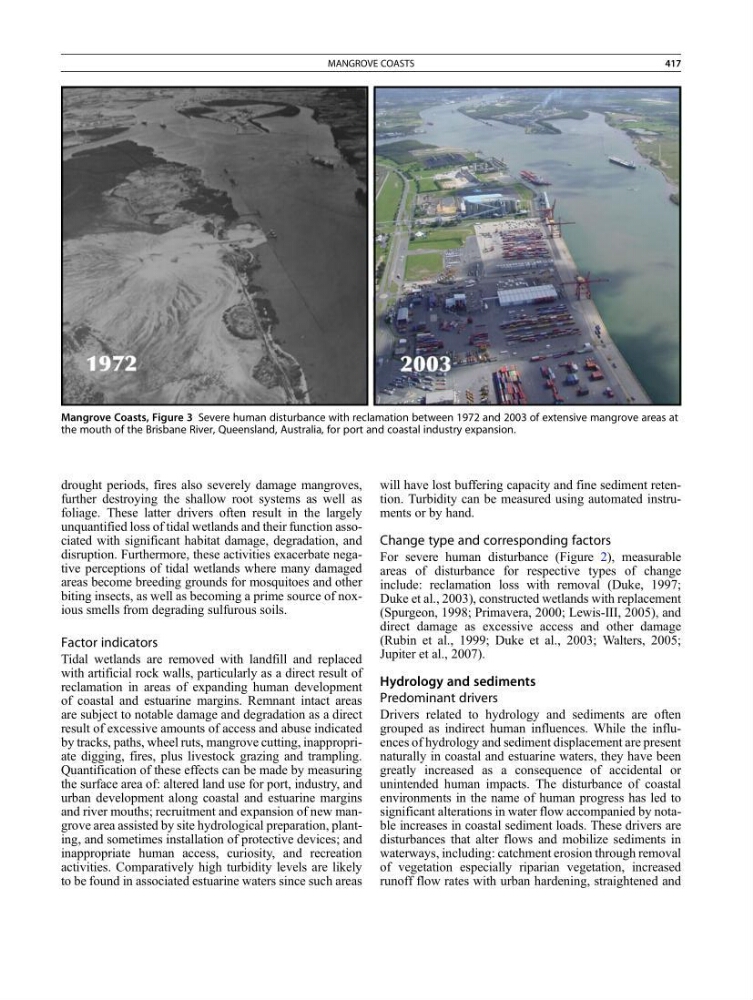
Tidal wetlands are removed with landfill and replaced
with artificial rock walls, particularly as a direct result of
reclamation in areas of expanding human development
of coastal and estuarine margins. Remnant intact areas
are subject to notable damage and degradation as a direct
result of excessive amounts of access and abuse indicated
by tracks, paths, wheel ruts, mangrove cutting, inappropriate digging, fires, plus livestock grazing and trampling.
Quantification of these effects can be made by measuring
the surface area of: altered land use for port, industry, and
urban development along coastal and estuarine margins
and river mouths; recruitment and expansion of new mangrove area assisted by site hydrological preparation, planting, and sometimes installation of protective devices; and
inappropriate human access, curiosity, and recreation
activities. Comparatively high turbidity levels are likely
to be found in associated estuarine waters since such areas
will have lost buffering capacity and fine sediment retention. Turbidity can be measured using automated instruments or by hand.
Change type and corresponding factors
For severe human disturbance (Figure 2), measurable
areas of disturbance for respective types of change
include: reclamation loss with removal (Duke, 1997;
Duke et al., 2003), constructed wetlands with replacement
(Spurgeon, 1998; Primavera, 2000; Lewis-III, 2005), and
direct damage as excessive access and other damage
(Rubin et al., 1999; Duke et al., 2003; Walters, 2005;
Jupiter et al., 2007).
Hydrology and sediments
Predominant drivers
Drivers related to hydrology and sediments are often
grouped as indirect human influences. While the influences of hydrology and sediment displacement are present
naturally in coastal and estuarine waters, they have been
greatly increased as a consequence of accidental or
unintended human impacts. The disturbance of coastal
environments in the name of human progress has led to
significant alterations in water flow accompanied by notable increases in coastal sediment loads. These drivers are
disturbances that alter flows and mobilize sediments in
waterways, including: catchment erosion through removal
of vegetation especially riparian vegetation, increased
runoff flow rates with urban hardening, straightened and
Mangrove Coasts, Figure 3 Severe human disturbance with reclamation between 1972 and 2003 of extensive mangrove areas at
the mouth of the Brisbane River, Queensland, Australia, for port and coastal industry expansion.
MANGROVE COASTS
417
further destroying the shallow root systems as well as
foliage. These latter drivers often result in the largely
unquantified loss of tidal wetlands and their function associated with significant habitat damage, degradation, and
disruption. Furthermore, these activities exacerbate negative perceptions of tidal wetlands where many damaged
areas become breeding grounds for mosquitoes and other
biting insects, as well as becoming a prime source of noxious smells from degrading sulfurous soils.
Factor indicators
Tidal wetlands are removed with landfill and replaced
with artificial rock walls, particularly as a direct result of
reclamation in areas of expanding human development
of coastal and estuarine margins. Remnant intact areas
are subject to notable damage and degradation as a direct
result of excessive amounts of access and abuse indicated
by tracks, paths, wheel ruts, mangrove cutting, inappropriate digging, fires, plus livestock grazing and trampling.
Quantification of these effects can be made by measuring
the surface area of: altered land use for port, industry, and
urban development along coastal and estuarine margins
and river mouths; recruitment and expansion of new mangrove area assisted by site hydrological preparation, planting, and sometimes installation of protective devices; and
inappropriate human access, curiosity, and recreation
activities. Comparatively high turbidity levels are likely
to be found in associated estuarine waters since such areas
will have lost buffering capacity and fine sediment retention. Turbidity can be measured using automated instruments or by hand.
Change type and corresponding factors
For severe human disturbance (Figure 2), measurable
areas of disturbance for respective types of change
include: reclamation loss with removal (Duke, 1997;
Duke et al., 2003), constructed wetlands with replacement
(Spurgeon, 1998; Primavera, 2000; Lewis-III, 2005), and
direct damage as excessive access and other damage
(Rubin et al., 1999; Duke et al., 2003; Walters, 2005;
Jupiter et al., 2007).
Hydrology and sediments
Predominant drivers
Drivers related to hydrology and sediments are often
grouped as indirect human influences. While the influences of hydrology and sediment displacement are present
naturally in coastal and estuarine waters, they have been
greatly increased as a consequence of accidental or
unintended human impacts. The disturbance of coastal
environments in the name of human progress has led to
significant alterations in water flow accompanied by notable increases in coastal sediment loads. These drivers are
disturbances that alter flows and mobilize sediments in
waterways, including: catchment erosion through removal
of vegetation especially riparian vegetation, increased
runoff flow rates with urban hardening, straightened and
Mangrove Coasts, Figure 3 Severe human disturbance with reclamation between 1972 and 2003 of extensive mangrove areas at
the mouth of the Brisbane River, Queensland, Australia, for port and coastal industry expansion.
MANGROVE COASTS
417