

on the evolution of a lagoon. If a transgressive lagoonal
barrier stabilizes against a break in slope or topographic
high and accretes upward rather than landward, the volume of the lagoon may increase if the sea-level rise
exceeds the fluvial sediment supply. If the barrier continues to move landward as the sea-level rises, the actual
lagoon volume may remain constant (Cooper, 1997).
However, evolutionary models for coarse-grained barriers
and associated lagoons in temperate latitudes show that
they differ from sandy barriers (Carter et al., 1989).
An important element of each lagoon system is connection to the open sea. Typically, there are one or more
entrances or tidal inlets. Most inlets form by the following
mechanisms: (1) storm-generated scour channels, (2) spit
growth across the entrances to flooded valleys during the
mid-Holocene, (3) intersection of major tidal channels
by landward-migrating transgressive barrier islands, and
(4) tidal prism-controlled, evenly spaced inlets that evolve
in regions lacking major former river valleys (Hayes and
FitzGerald, 2013).
Based on the morphology of the barrier-inlet elements,
Davis and Hayes (1984) distinguished three types of barrier coasts based on the morphology of the barrier-inlet
elements: (1) “wave dominated” (the barrier is narrow
with abundant washover features and a generally low elevation; inlets are typically widely spaced, small, and
unstable); (2) “mixed-energy” (barriers are typically short
and drumstick shaped, with one end prograding in the
form of beach/dune ridges and the other transgressing
landward; inlets are large and stable); (3) “tide dominated”
(barriers are absent, and sand bodies tend to be oriented
with an onshore-offshore orientation as the result of strong
tidal currents).
Gibeaut and Davis (1991), taking into account previous
findings relating to the synergies between wave and tidal
energy, have identified four categories of barrier inlets:
(1) tide dominated, (2) mixed-energy straight, (3) mixedenergy offset, (4) wave dominated. This relationship also
affects the shape of the ebb delta. Generally, the “tidedominated” ebb delta extends well beyond the barriers
and is dominated by channel-margin linear bars. The
“mixed-energy” ebb delta has a distinct terminal lobe but
also with well-defined channel-margin linear bars. The
barrier shorelines may be aligned or offset. The “wavedominated” ebb delta is very small and is dominated by
the terminal lobe if the inlet is not completely closed
(Davis, 2013). Although the comparative influence of
waves and tides is the fundamental relationship in
barrier-inlet morphodynamics, in the opinion of Davis
(2013), variables such as tidal prism, sediment abundance,
and sea-level change are equally important.
In general, coastal lagoons are naturally net sediment
sinks. However, sometimes some portion of sediments
may escape a lagoon by flushing into the sea, by wind erosion of coastal flats, or by oxidation of organic matter.
Sediments can be supplied to lagoons from various
sources. In many lagoons, the sediment components are
derived locally from shore or barrier erosion or from
sources inside lagoon, which are organic production and
chemical precipitation. In other lagoons, sedimentary
material can come also from distant sources. Very often,
a catchment area is a source of significant amounts of fluvial sediments. Some amounts of sediment may reach the
lagoon from the sea during tide action (Nichols and Allen,
1981). It should be noted that the supply of sediment is
strongly influenced by climate. Comparison of lagoon features and processes in different climatic zones was given
by Nichols and Allen (1981).
Lagoons act as sinks of particles through sedimentation, acting as important buffers of the land-sea interface.
A large number of processes are responsible for this phenomenon. During transport and recycling, fine particles
are modified by aggregation, disintegration, and
reforming. Microorganisms and benthic fauna play an
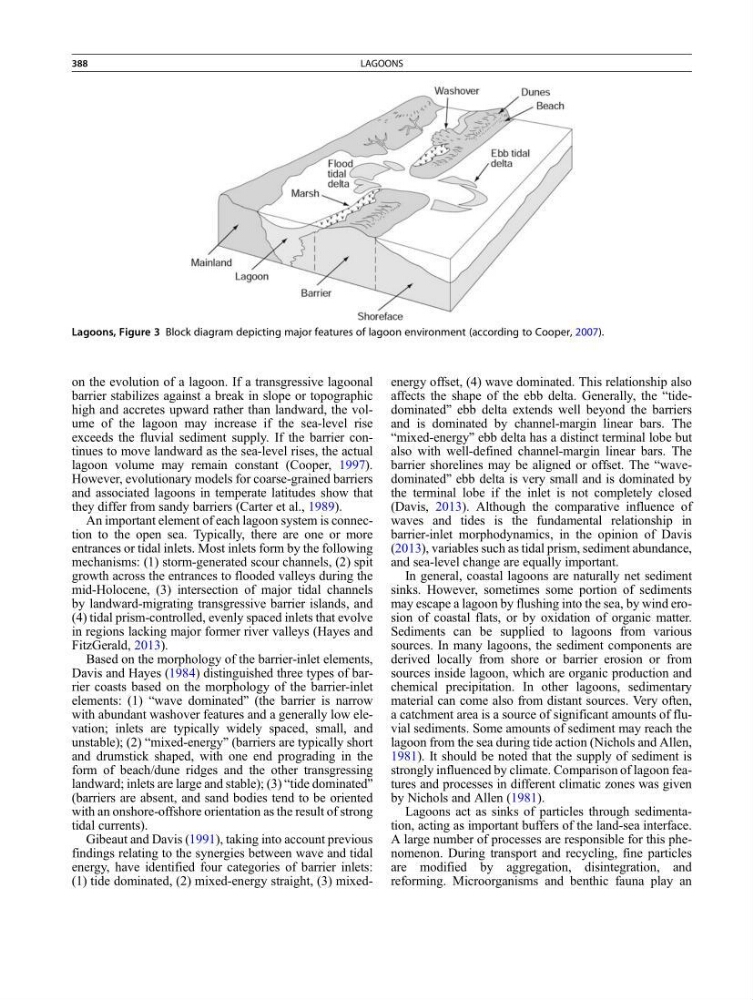
Lagoons, Figure 3 Block diagram depicting major features of lagoon environment (according to Cooper, 2007).
388
LAGOONS
barrier stabilizes against a break in slope or topographic
high and accretes upward rather than landward, the volume of the lagoon may increase if the sea-level rise
exceeds the fluvial sediment supply. If the barrier continues to move landward as the sea-level rises, the actual
lagoon volume may remain constant (Cooper, 1997).
However, evolutionary models for coarse-grained barriers
and associated lagoons in temperate latitudes show that
they differ from sandy barriers (Carter et al., 1989).
An important element of each lagoon system is connection to the open sea. Typically, there are one or more
entrances or tidal inlets. Most inlets form by the following
mechanisms: (1) storm-generated scour channels, (2) spit
growth across the entrances to flooded valleys during the
mid-Holocene, (3) intersection of major tidal channels
by landward-migrating transgressive barrier islands, and
(4) tidal prism-controlled, evenly spaced inlets that evolve
in regions lacking major former river valleys (Hayes and
FitzGerald, 2013).
Based on the morphology of the barrier-inlet elements,
Davis and Hayes (1984) distinguished three types of barrier coasts based on the morphology of the barrier-inlet
elements: (1) “wave dominated” (the barrier is narrow
with abundant washover features and a generally low elevation; inlets are typically widely spaced, small, and
unstable); (2) “mixed-energy” (barriers are typically short
and drumstick shaped, with one end prograding in the
form of beach/dune ridges and the other transgressing
landward; inlets are large and stable); (3) “tide dominated”
(barriers are absent, and sand bodies tend to be oriented
with an onshore-offshore orientation as the result of strong
tidal currents).
Gibeaut and Davis (1991), taking into account previous
findings relating to the synergies between wave and tidal
energy, have identified four categories of barrier inlets:
(1) tide dominated, (2) mixed-energy straight, (3) mixedenergy offset, (4) wave dominated. This relationship also
affects the shape of the ebb delta. Generally, the “tidedominated” ebb delta extends well beyond the barriers
and is dominated by channel-margin linear bars. The
“mixed-energy” ebb delta has a distinct terminal lobe but
also with well-defined channel-margin linear bars. The
barrier shorelines may be aligned or offset. The “wavedominated” ebb delta is very small and is dominated by
the terminal lobe if the inlet is not completely closed
(Davis, 2013). Although the comparative influence of
waves and tides is the fundamental relationship in
barrier-inlet morphodynamics, in the opinion of Davis
(2013), variables such as tidal prism, sediment abundance,
and sea-level change are equally important.
In general, coastal lagoons are naturally net sediment
sinks. However, sometimes some portion of sediments
may escape a lagoon by flushing into the sea, by wind erosion of coastal flats, or by oxidation of organic matter.
Sediments can be supplied to lagoons from various
sources. In many lagoons, the sediment components are
derived locally from shore or barrier erosion or from
sources inside lagoon, which are organic production and
chemical precipitation. In other lagoons, sedimentary
material can come also from distant sources. Very often,
a catchment area is a source of significant amounts of fluvial sediments. Some amounts of sediment may reach the
lagoon from the sea during tide action (Nichols and Allen,
1981). It should be noted that the supply of sediment is
strongly influenced by climate. Comparison of lagoon features and processes in different climatic zones was given
by Nichols and Allen (1981).
Lagoons act as sinks of particles through sedimentation, acting as important buffers of the land-sea interface.
A large number of processes are responsible for this phenomenon. During transport and recycling, fine particles
are modified by aggregation, disintegration, and
reforming. Microorganisms and benthic fauna play an
Lagoons, Figure 3 Block diagram depicting major features of lagoon environment (according to Cooper, 2007).
388
LAGOONS