

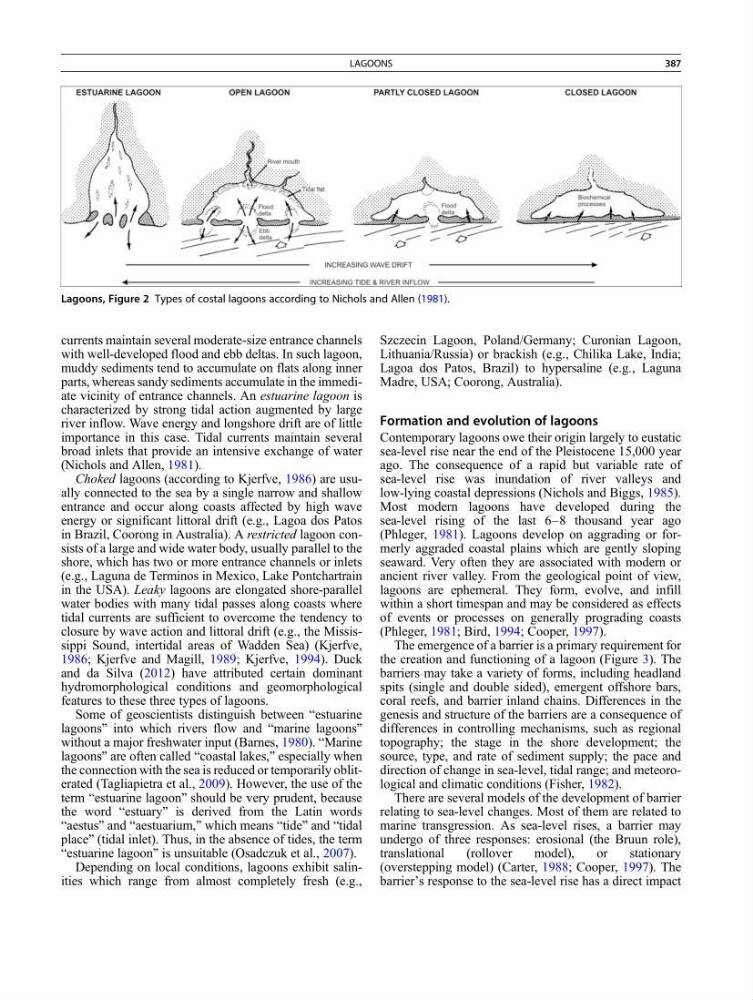
currents maintain several moderate-size entrance channels
with well-developed flood and ebb deltas. In such lagoon,
muddy sediments tend to accumulate on flats along inner
parts, whereas sandy sediments accumulate in the immediate vicinity of entrance channels. An estuarine lagoon is
characterized by strong tidal action augmented by large
river inflow. Wave energy and longshore drift are of little
importance in this case. Tidal currents maintain several
broad inlets that provide an intensive exchange of water
(Nichols and Allen, 1981).
Choked lagoons (according to Kjerfve, 1986) are usually connected to the sea by a single narrow and shallow
entrance and occur along coasts affected by high wave
energy or significant littoral drift (e.g., Lagoa dos Patos
in Brazil, Coorong in Australia). A restricted lagoon consists of a large and wide water body, usually parallel to the
shore, which has two or more entrance channels or inlets
(e.g., Laguna de Terminos in Mexico, Lake Pontchartrain
in the USA). Leaky lagoons are elongated shore-parallel
water bodies with many tidal passes along coasts where
tidal currents are sufficient to overcome the tendency to
closure by wave action and littoral drift (e.g., the Mississippi Sound, intertidal areas of Wadden Sea) (Kjerfve,
1986; Kjerfve and Magill, 1989; Kjerfve, 1994). Duck
and da Silva (2012) have attributed certain dominant
hydromorphological conditions and geomorphological
features to these three types of lagoons.
Some of geoscientists distinguish between “estuarine
lagoons” into which rivers flow and “marine lagoons”
without a major freshwater input (Barnes, 1980). “Marine
lagoons” are often called “coastal lakes,” especially when
the connection with the sea is reduced or temporarily obliterated (Tagliapietra et al., 2009). However, the use of the
term “estuarine lagoon” should be very prudent, because
the word “estuary” is derived from the Latin words
“aestus” and “aestuarium,” which means “tide” and “tidal
place” (tidal inlet). Thus, in the absence of tides, the term
“estuarine lagoon” is unsuitable (Osadczuk et al., 2007).
Depending on local conditions, lagoons exhibit salinities which range from almost completely fresh (e.g.,
Szczecin Lagoon, Poland/Germany; Curonian Lagoon,
Lithuania/Russia) or brackish (e.g., Chilika Lake, India;
Lagoa dos Patos, Brazil) to hypersaline (e.g., Laguna
Madre, USA; Coorong, Australia).
Formation and evolution of lagoons
Contemporary lagoons owe their origin largely to eustatic
sea-level rise near the end of the Pleistocene 15,000 year
ago. The consequence of a rapid but variable rate of
sea-level rise was inundation of river valleys and
low-lying coastal depressions (Nichols and Biggs, 1985).
Most modern lagoons have developed during the
sea-level rising of the last 6–8 thousand year ago
(Phleger, 1981). Lagoons develop on aggrading or formerly aggraded coastal plains which are gently sloping
seaward. Very often they are associated with modern or
ancient river valley. From the geological point of view,
lagoons are ephemeral. They form, evolve, and infill
within a short timespan and may be considered as effects
of events or processes on generally prograding coasts
(Phleger, 1981; Bird, 1994; Cooper, 1997).
The emergence of a barrier is a primary requirement for
the creation and functioning of a lagoon (Figure 3). The
barriers may take a variety of forms, including headland
spits (single and double sided), emergent offshore bars,
coral reefs, and barrier inland chains. Differences in the
genesis and structure of the barriers are a consequence of
differences in controlling mechanisms, such as regional
topography; the stage in the shore development; the
source, type, and rate of sediment supply; the pace and
direction of change in sea-level, tidal range; and meteorological and climatic conditions (Fisher, 1982).
There are several models of the development of barrier
relating to sea-level changes. Most of them are related to
marine transgression. As sea-level rises, a barrier may
undergo of three responses: erosional (the Bruun role),
translational
(rollover
model),
or
stationary
(overstepping model) (Carter, 1988; Cooper, 1997). The
barrier’s response to the sea-level rise has a direct impact
Lagoons, Figure 2 Types of costal lagoons according to Nichols and Allen (1981).
LAGOONS
387
with well-developed flood and ebb deltas. In such lagoon,
muddy sediments tend to accumulate on flats along inner
parts, whereas sandy sediments accumulate in the immediate vicinity of entrance channels. An estuarine lagoon is
characterized by strong tidal action augmented by large
river inflow. Wave energy and longshore drift are of little
importance in this case. Tidal currents maintain several
broad inlets that provide an intensive exchange of water
(Nichols and Allen, 1981).
Choked lagoons (according to Kjerfve, 1986) are usually connected to the sea by a single narrow and shallow
entrance and occur along coasts affected by high wave
energy or significant littoral drift (e.g., Lagoa dos Patos
in Brazil, Coorong in Australia). A restricted lagoon consists of a large and wide water body, usually parallel to the
shore, which has two or more entrance channels or inlets
(e.g., Laguna de Terminos in Mexico, Lake Pontchartrain
in the USA). Leaky lagoons are elongated shore-parallel
water bodies with many tidal passes along coasts where
tidal currents are sufficient to overcome the tendency to
closure by wave action and littoral drift (e.g., the Mississippi Sound, intertidal areas of Wadden Sea) (Kjerfve,
1986; Kjerfve and Magill, 1989; Kjerfve, 1994). Duck
and da Silva (2012) have attributed certain dominant
hydromorphological conditions and geomorphological
features to these three types of lagoons.
Some of geoscientists distinguish between “estuarine
lagoons” into which rivers flow and “marine lagoons”
without a major freshwater input (Barnes, 1980). “Marine
lagoons” are often called “coastal lakes,” especially when
the connection with the sea is reduced or temporarily obliterated (Tagliapietra et al., 2009). However, the use of the
term “estuarine lagoon” should be very prudent, because
the word “estuary” is derived from the Latin words
“aestus” and “aestuarium,” which means “tide” and “tidal
place” (tidal inlet). Thus, in the absence of tides, the term
“estuarine lagoon” is unsuitable (Osadczuk et al., 2007).
Depending on local conditions, lagoons exhibit salinities which range from almost completely fresh (e.g.,
Szczecin Lagoon, Poland/Germany; Curonian Lagoon,
Lithuania/Russia) or brackish (e.g., Chilika Lake, India;
Lagoa dos Patos, Brazil) to hypersaline (e.g., Laguna
Madre, USA; Coorong, Australia).
Formation and evolution of lagoons
Contemporary lagoons owe their origin largely to eustatic
sea-level rise near the end of the Pleistocene 15,000 year
ago. The consequence of a rapid but variable rate of
sea-level rise was inundation of river valleys and
low-lying coastal depressions (Nichols and Biggs, 1985).
Most modern lagoons have developed during the
sea-level rising of the last 6–8 thousand year ago
(Phleger, 1981). Lagoons develop on aggrading or formerly aggraded coastal plains which are gently sloping
seaward. Very often they are associated with modern or
ancient river valley. From the geological point of view,
lagoons are ephemeral. They form, evolve, and infill
within a short timespan and may be considered as effects
of events or processes on generally prograding coasts
(Phleger, 1981; Bird, 1994; Cooper, 1997).
The emergence of a barrier is a primary requirement for
the creation and functioning of a lagoon (Figure 3). The
barriers may take a variety of forms, including headland
spits (single and double sided), emergent offshore bars,
coral reefs, and barrier inland chains. Differences in the
genesis and structure of the barriers are a consequence of
differences in controlling mechanisms, such as regional
topography; the stage in the shore development; the
source, type, and rate of sediment supply; the pace and
direction of change in sea-level, tidal range; and meteorological and climatic conditions (Fisher, 1982).
There are several models of the development of barrier
relating to sea-level changes. Most of them are related to
marine transgression. As sea-level rises, a barrier may
undergo of three responses: erosional (the Bruun role),
translational
(rollover
model),
or
stationary
(overstepping model) (Carter, 1988; Cooper, 1997). The
barrier’s response to the sea-level rise has a direct impact
Lagoons, Figure 2 Types of costal lagoons according to Nichols and Allen (1981).
LAGOONS
387