

fluids if they are added at depth within the reaction zone
(Gamo et al., 2006; Reeves et al., 2011). These magmatic
fluids may also discharge directly toward the seafloor
forming unique acidic hydrothermal vents. Apart from in
situ studies and direct sampling and analysis, laboratory
experimental studies and thermodynamic calculations
(e.g., Bischoff and Rosenbauer, 1985) have also helped
to understand factors controlling the composition of
hydrothermal fluids.
High temperatures, as well as acidity, are necessary to
leach large amounts of metals such as Fe and Cu from
the rock and keep them in solution. Fluids emanating with
very high temperatures and very rich in metals (up to millimolar amounts of Fe and Mn and micromolar amounts of
Cu and other metals) can be found in deep (!3,000 m
water depth) hydrothermal systems, where the pressuredependent boiling point allows the fluids to reach temperatures of !400
C (e.g., Koschinsky et al., 2008). Fluids
reaching the boiling point phase-separate into a vapor
phase rich in gases and a residual brine phase being rich
in major ions and trace metals. Emanation of
low-chlorinity vapor and high-chlorinity brine phases
can be observed both spatially and temporally segregated,
with the denser brine phase often emanating subsequent to
the vapor phase (Butterfield et al., 1997; von Damm et al.,
1997).
The difference in composition for fluids from different
types of hydrothermal systems is also related to the different host rocks that react with the entraining seawater. At
fast-spreading centers, the fluids are characterized by reaction with basalt, resulting in high concentrations of S, Si,
and many metals. At slow-spreading ridges such as the
MAR, fluids often carry a pronounced ultramafic signature from reactions with mantle rocks, such as very high
hydrogen and methane concentrations due to serpentinization reactions (e.g., Kelley et al., 2001; Charlou
et al., 2002; Kelley et al., 2005; Schmidt et al., 2011).
The few available fluid data from back-arc basins and
island arcs indicate typically very low pH values and a
strong enrichment of trace metals including As, Au, Hg,
Pb, Sn, and Sb originating potentially from magmatic
sources as well as leaching of the rocks (e.g., andesites)
(e.g., Hannington et al., 2005; Yang and Scott, 2006; De
Ronde et al., 2011; Reeves et al., 2011).
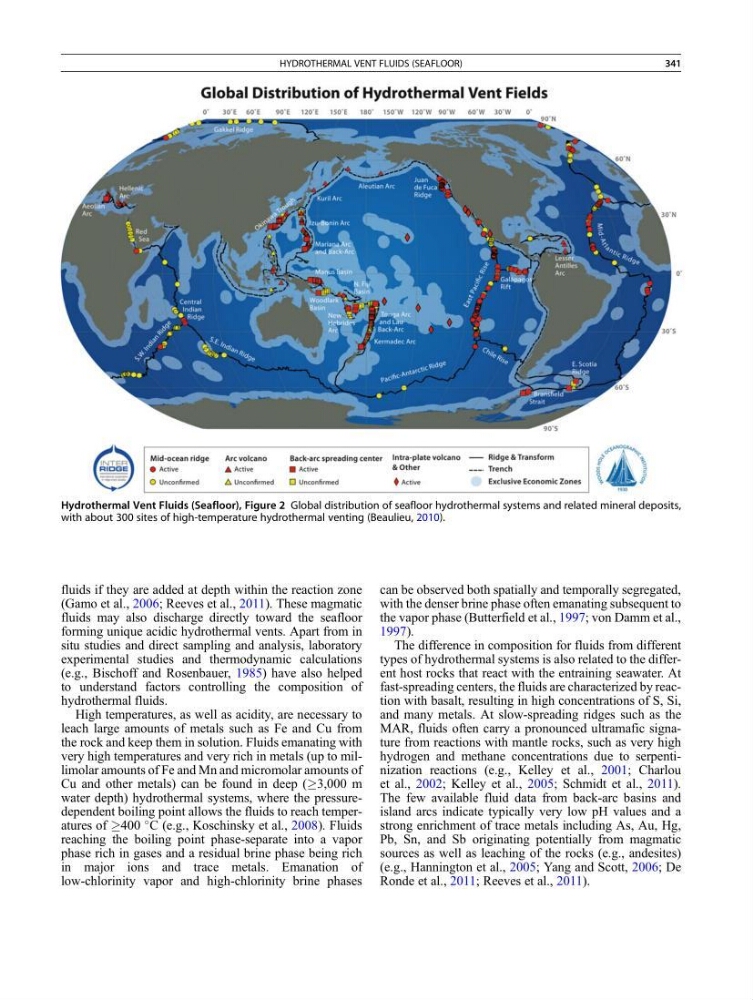
Hydrothermal Vent Fluids (Seafloor), Figure 2 Global distribution of seafloor hydrothermal systems and related mineral deposits,
with about 300 sites of high-temperature hydrothermal venting (Beaulieu, 2010).
HYDROTHERMAL VENT FLUIDS (SEAFLOOR)
341
(Gamo et al., 2006; Reeves et al., 2011). These magmatic
fluids may also discharge directly toward the seafloor
forming unique acidic hydrothermal vents. Apart from in
situ studies and direct sampling and analysis, laboratory
experimental studies and thermodynamic calculations
(e.g., Bischoff and Rosenbauer, 1985) have also helped
to understand factors controlling the composition of
hydrothermal fluids.
High temperatures, as well as acidity, are necessary to
leach large amounts of metals such as Fe and Cu from
the rock and keep them in solution. Fluids emanating with
very high temperatures and very rich in metals (up to millimolar amounts of Fe and Mn and micromolar amounts of
Cu and other metals) can be found in deep (!3,000 m
water depth) hydrothermal systems, where the pressuredependent boiling point allows the fluids to reach temperatures of !400
C (e.g., Koschinsky et al., 2008). Fluids
reaching the boiling point phase-separate into a vapor
phase rich in gases and a residual brine phase being rich
in major ions and trace metals. Emanation of
low-chlorinity vapor and high-chlorinity brine phases
can be observed both spatially and temporally segregated,
with the denser brine phase often emanating subsequent to
the vapor phase (Butterfield et al., 1997; von Damm et al.,
1997).
The difference in composition for fluids from different
types of hydrothermal systems is also related to the different host rocks that react with the entraining seawater. At
fast-spreading centers, the fluids are characterized by reaction with basalt, resulting in high concentrations of S, Si,
and many metals. At slow-spreading ridges such as the
MAR, fluids often carry a pronounced ultramafic signature from reactions with mantle rocks, such as very high
hydrogen and methane concentrations due to serpentinization reactions (e.g., Kelley et al., 2001; Charlou
et al., 2002; Kelley et al., 2005; Schmidt et al., 2011).
The few available fluid data from back-arc basins and
island arcs indicate typically very low pH values and a
strong enrichment of trace metals including As, Au, Hg,
Pb, Sn, and Sb originating potentially from magmatic
sources as well as leaching of the rocks (e.g., andesites)
(e.g., Hannington et al., 2005; Yang and Scott, 2006; De
Ronde et al., 2011; Reeves et al., 2011).
Hydrothermal Vent Fluids (Seafloor), Figure 2 Global distribution of seafloor hydrothermal systems and related mineral deposits,
with about 300 sites of high-temperature hydrothermal venting (Beaulieu, 2010).
HYDROTHERMAL VENT FLUIDS (SEAFLOOR)
341