

In contrast, there is no evidence in any OIB of a component produced by melting in the deep mantle, although
there is seismic evidence that localized melting might occur
in small regions near the core–mantle boundary. Experiments show that partitioning of elements between deep
mantle minerals (those in which silicon is octahedrally
coordinated by oxygen) and liquids is quite different from
solid–liquid partitioning in the upper mantle (e.g., Corgne
et al., 2005). So far, element abundances in all OIB are consistent with their distinct signatures having formed in the
upper mantle or crust and not in the lower mantle.
Noble gas isotope ratios, however, indicate that a nearprimitive component is present in many mantle plumes.
As noted above, high
3
He/
4
He ratios in many OIB indicate
they are derived from mantle that has been substantially
less degassed than the depleted upper mantle. Decay of
U and Th constantly produces
4
He in the mantle so that
the
3
He/
4
He ratio decreases through time. When mantle
melts, He is efficiently degassed from the mantle into the
atmosphere and lost to space. Consequently, processed
mantle as well as recycled crustal material should have
low
3 He/
4
He (Porcelli and Elliott, 2008). Some OIB do,
but high ratios predominate. Hanan and Graham (1996)
noted the association of high
3 He/
4
He ratios with intermediate Pb isotope ratios and argued that a primitive component, which they termed “C,” is present in all or most
plumes. Thus, while recycled material dominates the geochemical signature of plumes just as strawberries, vanilla,
and chocolate dominate the flavor of ice cream, this may
not be the main ingredient.
Recent studies of other noble gas isotope ratios, particularly of xenon, support the notion that at least some
plumes contain a very primitive component indeed.
Xenon isotopic composition varies because of decay
of two extinct radionuclides:
129 I, which decays to
129 Xe
with a 15.7 Ma half-life, and
244
Pu, which has a 82 Ma
half-life and whose principal fission products include the
heavy Xe isotopes (Xe isotopic composition also varies
due mass-dependent fractionation and fission of
238 U).
129
Xe/
130 Xe ratios in OIB are higher than in the atmosphere and are higher still in MORB. These differences,
as well as those in heavy fissogenic Xe isotopes must have
been established within the first 100 Ma of Earth’s history,
require that the plume source to less degassed than the
MORB source and that subsequent mixing between them
over the next 4.3 billion years must have been limited
(Mukhopadhyay, 2012). The primitive signal appears to
be largely confined to noble gases; concentrations and isotope ratios of other elements indicate plumes consisting
primarily of processed material.
Mantle plumes can also be heterogeneous, exhibiting
systematic geographic variation in composition. The
0.7185
−8
−6
−4
−2
0
2
4
6
8
10
12
0.702
0.704
0.706
0.708
0.710
0.712
87
Sr/
86
Sr
ε
Nd
EM I
EM II
HIMU
PREMA
Galapagos
Hawaii
Iceland
Samoa
Austral-Cook
Comoros & Cape Verde
Ascension & St. Helena
Tristan & Gough
Kerguelen & Heard
Mascarene Is, Amsterdam-St. Paul
Society Is
MORB
Azores
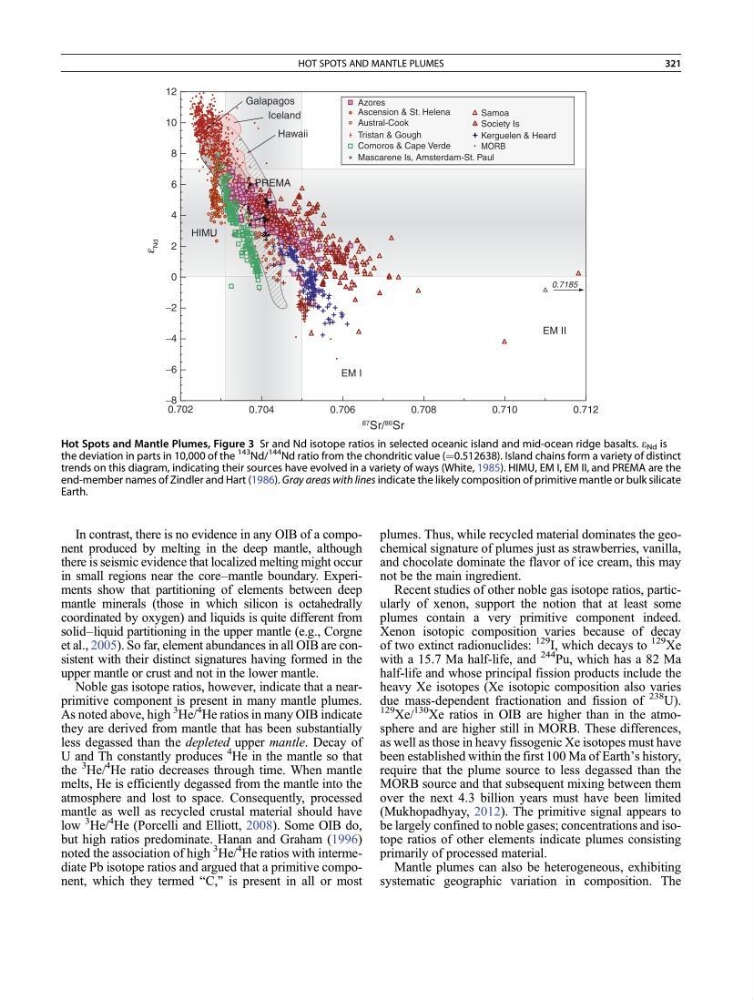
Hot Spots and Mantle Plumes, Figure 3 Sr and Nd isotope ratios in selected oceanic island and mid-ocean ridge basalts. e Nd is
the deviation in parts in 10,000 of the
143 Nd/
144 Nd ratio from the chondritic value (¼0.512638). Island chains form a variety of distinct
trends on this diagram, indicating their sources have evolved in a variety of ways (White, 1985). HIMU, EM I, EM II, and PREMA are the
end-member names of Zindler and Hart (1986). Gray areas with lines indicate the likely composition of primitive mantle or bulk silicate
Earth.
HOT SPOTS AND MANTLE PLUMES
321
there is seismic evidence that localized melting might occur
in small regions near the core–mantle boundary. Experiments show that partitioning of elements between deep
mantle minerals (those in which silicon is octahedrally
coordinated by oxygen) and liquids is quite different from
solid–liquid partitioning in the upper mantle (e.g., Corgne
et al., 2005). So far, element abundances in all OIB are consistent with their distinct signatures having formed in the
upper mantle or crust and not in the lower mantle.
Noble gas isotope ratios, however, indicate that a nearprimitive component is present in many mantle plumes.
As noted above, high
3
He/
4
He ratios in many OIB indicate
they are derived from mantle that has been substantially
less degassed than the depleted upper mantle. Decay of
U and Th constantly produces
4
He in the mantle so that
the
3
He/
4
He ratio decreases through time. When mantle
melts, He is efficiently degassed from the mantle into the
atmosphere and lost to space. Consequently, processed
mantle as well as recycled crustal material should have
low
3 He/
4
He (Porcelli and Elliott, 2008). Some OIB do,
but high ratios predominate. Hanan and Graham (1996)
noted the association of high
3 He/
4
He ratios with intermediate Pb isotope ratios and argued that a primitive component, which they termed “C,” is present in all or most
plumes. Thus, while recycled material dominates the geochemical signature of plumes just as strawberries, vanilla,
and chocolate dominate the flavor of ice cream, this may
not be the main ingredient.
Recent studies of other noble gas isotope ratios, particularly of xenon, support the notion that at least some
plumes contain a very primitive component indeed.
Xenon isotopic composition varies because of decay
of two extinct radionuclides:
129 I, which decays to
129 Xe
with a 15.7 Ma half-life, and
244
Pu, which has a 82 Ma
half-life and whose principal fission products include the
heavy Xe isotopes (Xe isotopic composition also varies
due mass-dependent fractionation and fission of
238 U).
129
Xe/
130 Xe ratios in OIB are higher than in the atmosphere and are higher still in MORB. These differences,
as well as those in heavy fissogenic Xe isotopes must have
been established within the first 100 Ma of Earth’s history,
require that the plume source to less degassed than the
MORB source and that subsequent mixing between them
over the next 4.3 billion years must have been limited
(Mukhopadhyay, 2012). The primitive signal appears to
be largely confined to noble gases; concentrations and isotope ratios of other elements indicate plumes consisting
primarily of processed material.
Mantle plumes can also be heterogeneous, exhibiting
systematic geographic variation in composition. The
0.7185
−8
−6
−4
−2
0
2
4
6
8
10
12
0.702
0.704
0.706
0.708
0.710
0.712
87
Sr/
86
Sr
ε
Nd
EM I
EM II
HIMU
PREMA
Galapagos
Hawaii
Iceland
Samoa
Austral-Cook
Comoros & Cape Verde
Ascension & St. Helena
Tristan & Gough
Kerguelen & Heard
Mascarene Is, Amsterdam-St. Paul
Society Is
MORB
Azores
Hot Spots and Mantle Plumes, Figure 3 Sr and Nd isotope ratios in selected oceanic island and mid-ocean ridge basalts. e Nd is
the deviation in parts in 10,000 of the
143 Nd/
144 Nd ratio from the chondritic value (¼0.512638). Island chains form a variety of distinct
trends on this diagram, indicating their sources have evolved in a variety of ways (White, 1985). HIMU, EM I, EM II, and PREMA are the
end-member names of Zindler and Hart (1986). Gray areas with lines indicate the likely composition of primitive mantle or bulk silicate
Earth.
HOT SPOTS AND MANTLE PLUMES
321