

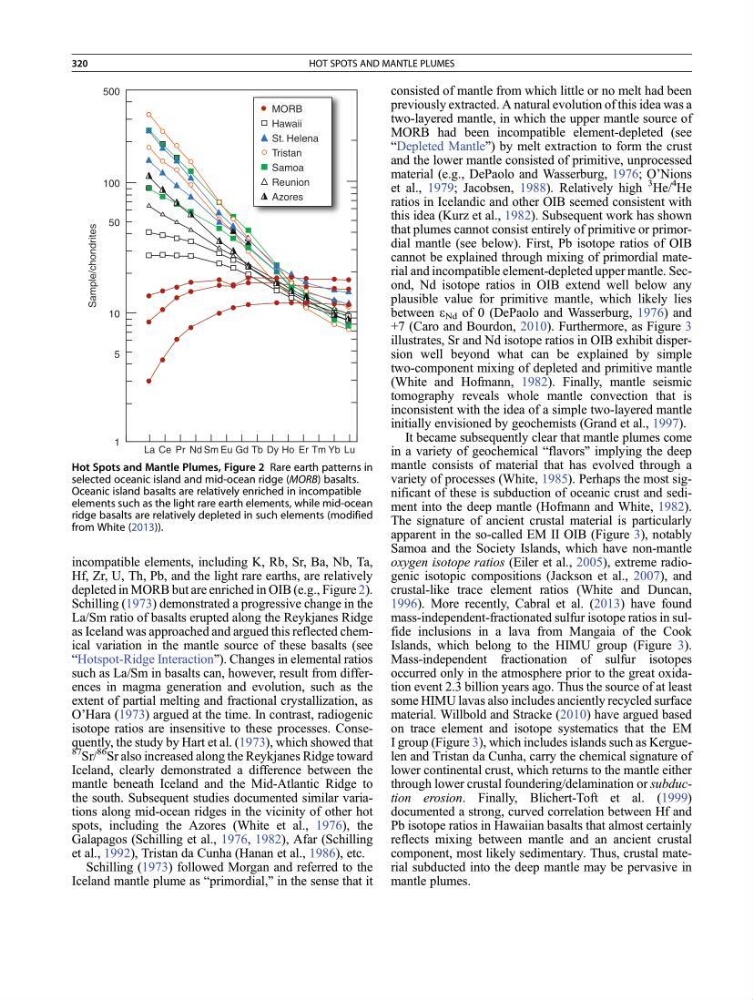
incompatible elements, including K, Rb, Sr, Ba, Nb, Ta,
Hf, Zr, U, Th, Pb, and the light rare earths, are relatively
depleted in MORB but are enriched in OIB (e.g., Figure 2).
Schilling (1973) demonstrated a progressive change in the
La/Sm ratio of basalts erupted along the Reykjanes Ridge
as Iceland was approached and argued this reflected chemical variation in the mantle source of these basalts (see
“Hotspot-Ridge Interaction”). Changes in elemental ratios
such as La/Sm in basalts can, however, result from differences in magma generation and evolution, such as the
extent of partial melting and fractional crystallization, as
O’Hara (1973) argued at the time. In contrast, radiogenic
isotope ratios are insensitive to these processes. Consequently, the study by Hart et al. (1973), which showed that
87
Sr/
86 Sr also increased along the Reykjanes Ridge toward
Iceland, clearly demonstrated a difference between the
mantle beneath Iceland and the Mid-Atlantic Ridge to
the south. Subsequent studies documented similar variations along mid-ocean ridges in the vicinity of other hot
spots, including the Azores (White et al., 1976), the
Galapagos (Schilling et al., 1976, 1982), Afar (Schilling
et al., 1992), Tristan da Cunha (Hanan et al., 1986), etc.
Schilling (1973) followed Morgan and referred to the
Iceland mantle plume as “primordial,” in the sense that it
consisted of mantle from which little or no melt had been
previously extracted. A natural evolution of this idea was a
two-layered mantle, in which the upper mantle source of
MORB had been incompatible element-depleted (see
“Depleted Mantle”) by melt extraction to form the crust
and the lower mantle consisted of primitive, unprocessed
material (e.g., DePaolo and Wasserburg, 1976; O’Nions
et al., 1979; Jacobsen, 1988). Relatively high
3 He/
4
He
ratios in Icelandic and other OIB seemed consistent with
this idea (Kurz et al., 1982). Subsequent work has shown
that plumes cannot consist entirely of primitive or primordial mantle (see below). First, Pb isotope ratios of OIB
cannot be explained through mixing of primordial material and incompatible element-depleted upper mantle. Second, Nd isotope ratios in OIB extend well below any
plausible value for primitive mantle, which likely lies
between e Nd of 0 (DePaolo and Wasserburg, 1976) and
+7 (Caro and Bourdon, 2010). Furthermore, as Figure 3
illustrates, Sr and Nd isotope ratios in OIB exhibit dispersion well beyond what can be explained by simple
two-component mixing of depleted and primitive mantle
(White and Hofmann, 1982). Finally, mantle seismic
tomography reveals whole mantle convection that is
inconsistent with the idea of a simple two-layered mantle
initially envisioned by geochemists (Grand et al., 1997).
It became subsequently clear that mantle plumes come
in a variety of geochemical “flavors” implying the deep
mantle consists of material that has evolved through a
variety of processes (White, 1985). Perhaps the most significant of these is subduction of oceanic crust and sediment into the deep mantle (Hofmann and White, 1982).
The signature of ancient crustal material is particularly
apparent in the so-called EM II OIB (Figure 3), notably
Samoa and the Society Islands, which have non-mantle
oxygen isotope ratios (Eiler et al., 2005), extreme radiogenic isotopic compositions (Jackson et al., 2007), and
crustal-like trace element ratios (White and Duncan,
1996). More recently, Cabral et al. (2013) have found
mass-independent-fractionated sulfur isotope ratios in sulfide inclusions in a lava from Mangaia of the Cook
Islands, which belong to the HIMU group (Figure 3).
Mass-independent fractionation of sulfur isotopes
occurred only in the atmosphere prior to the great oxidation event 2.3 billion years ago. Thus the source of at least
some HIMU lavas also includes anciently recycled surface
material. Willbold and Stracke (2010) have argued based
on trace element and isotope systematics that the EM
I group (Figure 3), which includes islands such as Kerguelen and Tristan da Cunha, carry the chemical signature of
lower continental crust, which returns to the mantle either
through lower crustal foundering/delamination or subduction erosion. Finally, Blichert-Toft et al. (1999)
documented a strong, curved correlation between Hf and
Pb isotope ratios in Hawaiian basalts that almost certainly
reflects mixing between mantle and an ancient crustal
component, most likely sedimentary. Thus, crustal material subducted into the deep mantle may be pervasive in
mantle plumes.
Sample/chondrites
500
100
50
10
5
1
La Ce Pr Nd Sm Eu Gd Tb Dy Ho Er Tm Yb Lu
MORB
Hawaii
St. Helena
Tristan
Samoa
Reunion
Azores
Hot Spots and Mantle Plumes, Figure 2 Rare earth patterns in
selected oceanic island and mid-ocean ridge (MORB) basalts.
Oceanic island basalts are relatively enriched in incompatible
elements such as the light rare earth elements, while mid-ocean
ridge basalts are relatively depleted in such elements (modified
from White (2013)).
320
HOT SPOTS AND MANTLE PLUMES
Hf, Zr, U, Th, Pb, and the light rare earths, are relatively
depleted in MORB but are enriched in OIB (e.g., Figure 2).
Schilling (1973) demonstrated a progressive change in the
La/Sm ratio of basalts erupted along the Reykjanes Ridge
as Iceland was approached and argued this reflected chemical variation in the mantle source of these basalts (see
“Hotspot-Ridge Interaction”). Changes in elemental ratios
such as La/Sm in basalts can, however, result from differences in magma generation and evolution, such as the
extent of partial melting and fractional crystallization, as
O’Hara (1973) argued at the time. In contrast, radiogenic
isotope ratios are insensitive to these processes. Consequently, the study by Hart et al. (1973), which showed that
87
Sr/
86 Sr also increased along the Reykjanes Ridge toward
Iceland, clearly demonstrated a difference between the
mantle beneath Iceland and the Mid-Atlantic Ridge to
the south. Subsequent studies documented similar variations along mid-ocean ridges in the vicinity of other hot
spots, including the Azores (White et al., 1976), the
Galapagos (Schilling et al., 1976, 1982), Afar (Schilling
et al., 1992), Tristan da Cunha (Hanan et al., 1986), etc.
Schilling (1973) followed Morgan and referred to the
Iceland mantle plume as “primordial,” in the sense that it
consisted of mantle from which little or no melt had been
previously extracted. A natural evolution of this idea was a
two-layered mantle, in which the upper mantle source of
MORB had been incompatible element-depleted (see
“Depleted Mantle”) by melt extraction to form the crust
and the lower mantle consisted of primitive, unprocessed
material (e.g., DePaolo and Wasserburg, 1976; O’Nions
et al., 1979; Jacobsen, 1988). Relatively high
3 He/
4
He
ratios in Icelandic and other OIB seemed consistent with
this idea (Kurz et al., 1982). Subsequent work has shown
that plumes cannot consist entirely of primitive or primordial mantle (see below). First, Pb isotope ratios of OIB
cannot be explained through mixing of primordial material and incompatible element-depleted upper mantle. Second, Nd isotope ratios in OIB extend well below any
plausible value for primitive mantle, which likely lies
between e Nd of 0 (DePaolo and Wasserburg, 1976) and
+7 (Caro and Bourdon, 2010). Furthermore, as Figure 3
illustrates, Sr and Nd isotope ratios in OIB exhibit dispersion well beyond what can be explained by simple
two-component mixing of depleted and primitive mantle
(White and Hofmann, 1982). Finally, mantle seismic
tomography reveals whole mantle convection that is
inconsistent with the idea of a simple two-layered mantle
initially envisioned by geochemists (Grand et al., 1997).
It became subsequently clear that mantle plumes come
in a variety of geochemical “flavors” implying the deep
mantle consists of material that has evolved through a
variety of processes (White, 1985). Perhaps the most significant of these is subduction of oceanic crust and sediment into the deep mantle (Hofmann and White, 1982).
The signature of ancient crustal material is particularly
apparent in the so-called EM II OIB (Figure 3), notably
Samoa and the Society Islands, which have non-mantle
oxygen isotope ratios (Eiler et al., 2005), extreme radiogenic isotopic compositions (Jackson et al., 2007), and
crustal-like trace element ratios (White and Duncan,
1996). More recently, Cabral et al. (2013) have found
mass-independent-fractionated sulfur isotope ratios in sulfide inclusions in a lava from Mangaia of the Cook
Islands, which belong to the HIMU group (Figure 3).
Mass-independent fractionation of sulfur isotopes
occurred only in the atmosphere prior to the great oxidation event 2.3 billion years ago. Thus the source of at least
some HIMU lavas also includes anciently recycled surface
material. Willbold and Stracke (2010) have argued based
on trace element and isotope systematics that the EM
I group (Figure 3), which includes islands such as Kerguelen and Tristan da Cunha, carry the chemical signature of
lower continental crust, which returns to the mantle either
through lower crustal foundering/delamination or subduction erosion. Finally, Blichert-Toft et al. (1999)
documented a strong, curved correlation between Hf and
Pb isotope ratios in Hawaiian basalts that almost certainly
reflects mixing between mantle and an ancient crustal
component, most likely sedimentary. Thus, crustal material subducted into the deep mantle may be pervasive in
mantle plumes.
Sample/chondrites
500
100
50
10
5
1
La Ce Pr Nd Sm Eu Gd Tb Dy Ho Er Tm Yb Lu
MORB
Hawaii
St. Helena
Tristan
Samoa
Reunion
Azores
Hot Spots and Mantle Plumes, Figure 2 Rare earth patterns in
selected oceanic island and mid-ocean ridge (MORB) basalts.
Oceanic island basalts are relatively enriched in incompatible
elements such as the light rare earth elements, while mid-ocean
ridge basalts are relatively depleted in such elements (modified
from White (2013)).
320
HOT SPOTS AND MANTLE PLUMES