

occasionally accompanied. Lawsonite occurs at lower
temperatures than epidote; and kyanite + omphacite
occurs at higher pressures than paragonite. Amphiboles
disappear as pressure increases. Equivalent pelitic rocks
are typically garnet-phengite schist occasionally with
talc + chloritoid and talc + kyanite associations (Mottana
et al., 1990). Stability of the eclogite facies extends to
the wet solidus temperatures, so that merely “highpressure (HP) metamorphism” is often applied to such
rocks. At higher pressure than ~2.7 GPa (ca. 100 km
deep), coesite occurs instead of quartz, and such rocks
are referred to as ultrahigh-pressure (UHP) rocks.
Metamorphic facies suggesting warmer conditions than
typical HPLT metamorphism are also not uncommon in
subduction and collision zones. These are the
pumpellyite-actinolite facies, high-pressure parts of the
greenschist and amphibolite facies (epidote amphibolites
and epidote-garnet amphibolites). Sodic-calcic amphiboles such as winchite and barroisite are common in these
rocks.
Prograde and retrograde metamorphism
Many of HPLT metamorphic rocks originated from volcanic and sedimentary rocks once on the surface and then
were subducted to depths and finally returned back to
the surface again. Such transports result in a general metamorphic history with increase and subsequent decrease of
pressure and temperature. Recrystallization at the highest
temperature and/or pressure which a rock experienced is
assigned to the peak metamorphism, and transitional processes toward and after the peak are prograde and retrograde metamorphism, respectively.
Starting materials of HPLT metamorphic rocks are rich
in hydrous minerals (clays in mudstone and alteration
minerals in basalt, etc.). Increasing temperature and pressure induce dehydration reactions. Prograde dehydration
reactions usually well proceed with scarce obstructing factors. It is thus sometimes difficult to find traces of prograde stage, except for mineral inclusions and relic cores
capsuled by progressively grown minerals.
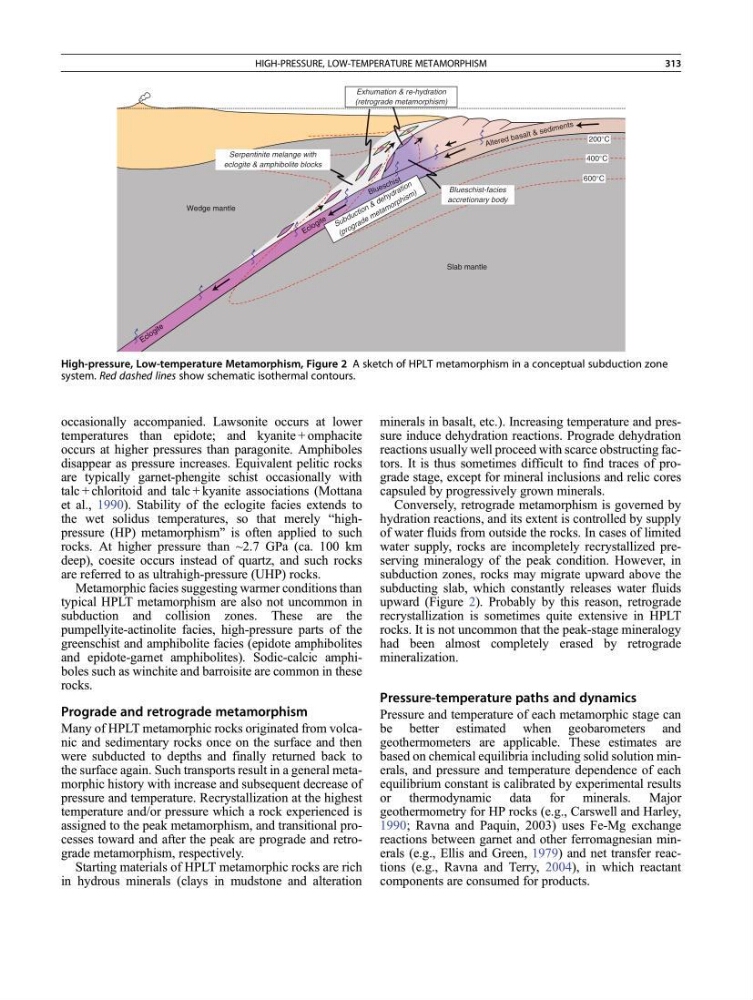
Conversely, retrograde metamorphism is governed by
hydration reactions, and its extent is controlled by supply
of water fluids from outside the rocks. In cases of limited
water supply, rocks are incompletely recrystallized preserving mineralogy of the peak condition. However, in
subduction zones, rocks may migrate upward above the
subducting slab, which constantly releases water fluids
upward (Figure 2). Probably by this reason, retrograde
recrystallization is sometimes quite extensive in HPLT
rocks. It is not uncommon that the peak-stage mineralogy
had been almost completely erased by retrograde
mineralization.
Pressure-temperature paths and dynamics
Pressure and temperature of each metamorphic stage can
be better estimated when geobarometers and
geothermometers are applicable. These estimates are
based on chemical equilibria including solid solution minerals, and pressure and temperature dependence of each
equilibrium constant is calibrated by experimental results
or thermodynamic data for minerals. Major
geothermometry for HP rocks (e.g., Carswell and Harley,
1990; Ravna and Paquin, 2003) uses Fe-Mg exchange
reactions between garnet and other ferromagnesian minerals (e.g., Ellis and Green, 1979) and net transfer reactions (e.g., Ravna and Terry, 2004), in which reactant
components are consumed for products.
Al te re d ba sa lt & se di m en ts
B lu e s c h is t
E c lo g it e
E c lo g it e
Slab mantle
Wedge mantle
Exhumation & re-hydration
(retrograde metamorphism)
S u b d u c ti o n & d e h y d ra ti o n
(p ro g ra d e m e ta m o rp h is m )
Serpentinite melange with
eclogite & amphibolite blocks
Blueschist-facies
accretionary body
200ЊC
400ЊC
600ЊC
High-pressure, Low-temperature Metamorphism, Figure 2 A sketch of HPLT metamorphism in a conceptual subduction zone
system. Red dashed lines show schematic isothermal contours.
HIGH-PRESSURE, LOW-TEMPERATURE METAMORPHISM
313
temperatures than epidote; and kyanite + omphacite
occurs at higher pressures than paragonite. Amphiboles
disappear as pressure increases. Equivalent pelitic rocks
are typically garnet-phengite schist occasionally with
talc + chloritoid and talc + kyanite associations (Mottana
et al., 1990). Stability of the eclogite facies extends to
the wet solidus temperatures, so that merely “highpressure (HP) metamorphism” is often applied to such
rocks. At higher pressure than ~2.7 GPa (ca. 100 km
deep), coesite occurs instead of quartz, and such rocks
are referred to as ultrahigh-pressure (UHP) rocks.
Metamorphic facies suggesting warmer conditions than
typical HPLT metamorphism are also not uncommon in
subduction and collision zones. These are the
pumpellyite-actinolite facies, high-pressure parts of the
greenschist and amphibolite facies (epidote amphibolites
and epidote-garnet amphibolites). Sodic-calcic amphiboles such as winchite and barroisite are common in these
rocks.
Prograde and retrograde metamorphism
Many of HPLT metamorphic rocks originated from volcanic and sedimentary rocks once on the surface and then
were subducted to depths and finally returned back to
the surface again. Such transports result in a general metamorphic history with increase and subsequent decrease of
pressure and temperature. Recrystallization at the highest
temperature and/or pressure which a rock experienced is
assigned to the peak metamorphism, and transitional processes toward and after the peak are prograde and retrograde metamorphism, respectively.
Starting materials of HPLT metamorphic rocks are rich
in hydrous minerals (clays in mudstone and alteration
minerals in basalt, etc.). Increasing temperature and pressure induce dehydration reactions. Prograde dehydration
reactions usually well proceed with scarce obstructing factors. It is thus sometimes difficult to find traces of prograde stage, except for mineral inclusions and relic cores
capsuled by progressively grown minerals.
Conversely, retrograde metamorphism is governed by
hydration reactions, and its extent is controlled by supply
of water fluids from outside the rocks. In cases of limited
water supply, rocks are incompletely recrystallized preserving mineralogy of the peak condition. However, in
subduction zones, rocks may migrate upward above the
subducting slab, which constantly releases water fluids
upward (Figure 2). Probably by this reason, retrograde
recrystallization is sometimes quite extensive in HPLT
rocks. It is not uncommon that the peak-stage mineralogy
had been almost completely erased by retrograde
mineralization.
Pressure-temperature paths and dynamics
Pressure and temperature of each metamorphic stage can
be better estimated when geobarometers and
geothermometers are applicable. These estimates are
based on chemical equilibria including solid solution minerals, and pressure and temperature dependence of each
equilibrium constant is calibrated by experimental results
or thermodynamic data for minerals. Major
geothermometry for HP rocks (e.g., Carswell and Harley,
1990; Ravna and Paquin, 2003) uses Fe-Mg exchange
reactions between garnet and other ferromagnesian minerals (e.g., Ellis and Green, 1979) and net transfer reactions (e.g., Ravna and Terry, 2004), in which reactant
components are consumed for products.
Al te re d ba sa lt & se di m en ts
B lu e s c h is t
E c lo g it e
E c lo g it e
Slab mantle
Wedge mantle
Exhumation & re-hydration
(retrograde metamorphism)
S u b d u c ti o n & d e h y d ra ti o n
(p ro g ra d e m e ta m o rp h is m )
Serpentinite melange with
eclogite & amphibolite blocks
Blueschist-facies
accretionary body
200ЊC
400ЊC
600ЊC
High-pressure, Low-temperature Metamorphism, Figure 2 A sketch of HPLT metamorphism in a conceptual subduction zone
system. Red dashed lines show schematic isothermal contours.
HIGH-PRESSURE, LOW-TEMPERATURE METAMORPHISM
313