

commonly associated with serpentinites especially abundant on seafloor exposures in intraoceanic subduction
zones and on-land regional metamorphic belts accompanied by ophiolites.
Mineralogy and metamorphic facies
A chemically equilibrated rock consists of the most stable
assemblage and compositions of minerals for a given pressure, temperature, and chemical compositions of bulkrock and interstitial fluids. When these conditions change,
chemical reactions occur consuming some mineral components or phases and producing others in order to maintain the stability. As pressure increases, sodic plagioclase
diminishes and finally disappears, generating sodic pyroxene (jadeite or omphacite) and sodic amphibole (e.g.,
glaucophane), both diagnostic of HPLT metamorphism.
Lawsonite and aragonite are formed exclusively in HPLT
conditions. In mafic rocks, Fe-Mg garnet tends to develop
at high pressure as well as high temperature.
As a result of changes above, blueschist (glaucophane
schist) at lower temperatures and eclogite (garnetomphacite rock) at higher temperatures represent HPLT
metamorphic rocks of basaltic compositions. Typical mineral assemblages of both the rocks define the blueschist
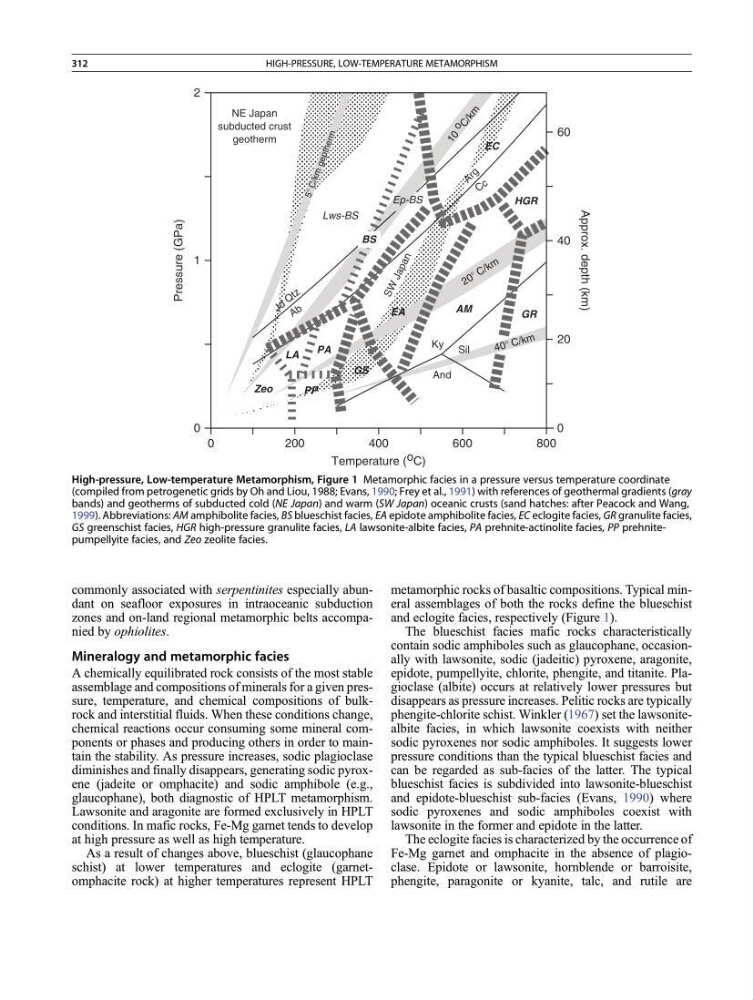
and eclogite facies, respectively (Figure 1).
The blueschist facies mafic rocks characteristically
contain sodic amphiboles such as glaucophane, occasionally with lawsonite, sodic (jadeitic) pyroxene, aragonite,
epidote, pumpellyite, chlorite, phengite, and titanite. Plagioclase (albite) occurs at relatively lower pressures but
disappears as pressure increases. Pelitic rocks are typically
phengite-chlorite schist. Winkler (1967) set the lawsonitealbite facies, in which lawsonite coexists with neither
sodic pyroxenes nor sodic amphiboles. It suggests lower
pressure conditions than the typical blueschist facies and
can be regarded as sub-facies of the latter. The typical
blueschist facies is subdivided into lawsonite-blueschist
and epidote-blueschist sub-facies (Evans, 1990) where
sodic pyroxenes and sodic amphiboles coexist with
lawsonite in the former and epidote in the latter.
The eclogite facies is characterized by the occurrence of
Fe-Mg garnet and omphacite in the absence of plagioclase. Epidote or lawsonite, hornblende or barroisite,
phengite, paragonite or kyanite, talc, and rutile are
Ky
And
Sil
A r g
J d
Q t z
A b
C c
0
0
0
200
400
600
800
1
20
40
60
Approx. depth (km)
Pressure (GPa)
PP
Zeo
PA
LA
GS
EA
AM
GR
HGR
EC
Temperature ( o C)
5
Њ C /k m g e p th e rm
1 0 o
C / k m
2 0 Њ C / k m
4 0 Њ C /k m
2
BS
Lws-BS
NE Japan
subducted crust
geotherm
S W
J a p a n
Ep-BS
High-pressure, Low-temperature Metamorphism, Figure 1 Metamorphic facies in a pressure versus temperature coordinate
(compiled from petrogenetic grids by Oh and Liou, 1988; Evans, 1990; Frey et al., 1991) with references of geothermal gradients (gray
bands) and geotherms of subducted cold (NE Japan) and warm (SW Japan) oceanic crusts (sand hatches: after Peacock and Wang,
1999). Abbreviations: AM amphibolite facies, BS blueschist facies, EA epidote amphibolite facies, EC eclogite facies, GR granulite facies,
GS greenschist facies, HGR high-pressure granulite facies, LA lawsonite-albite facies, PA prehnite-actinolite facies, PP prehnitepumpellyite facies, and Zeo zeolite facies.
312
HIGH-PRESSURE, LOW-TEMPERATURE METAMORPHISM
zones and on-land regional metamorphic belts accompanied by ophiolites.
Mineralogy and metamorphic facies
A chemically equilibrated rock consists of the most stable
assemblage and compositions of minerals for a given pressure, temperature, and chemical compositions of bulkrock and interstitial fluids. When these conditions change,
chemical reactions occur consuming some mineral components or phases and producing others in order to maintain the stability. As pressure increases, sodic plagioclase
diminishes and finally disappears, generating sodic pyroxene (jadeite or omphacite) and sodic amphibole (e.g.,
glaucophane), both diagnostic of HPLT metamorphism.
Lawsonite and aragonite are formed exclusively in HPLT
conditions. In mafic rocks, Fe-Mg garnet tends to develop
at high pressure as well as high temperature.
As a result of changes above, blueschist (glaucophane
schist) at lower temperatures and eclogite (garnetomphacite rock) at higher temperatures represent HPLT
metamorphic rocks of basaltic compositions. Typical mineral assemblages of both the rocks define the blueschist
and eclogite facies, respectively (Figure 1).
The blueschist facies mafic rocks characteristically
contain sodic amphiboles such as glaucophane, occasionally with lawsonite, sodic (jadeitic) pyroxene, aragonite,
epidote, pumpellyite, chlorite, phengite, and titanite. Plagioclase (albite) occurs at relatively lower pressures but
disappears as pressure increases. Pelitic rocks are typically
phengite-chlorite schist. Winkler (1967) set the lawsonitealbite facies, in which lawsonite coexists with neither
sodic pyroxenes nor sodic amphiboles. It suggests lower
pressure conditions than the typical blueschist facies and
can be regarded as sub-facies of the latter. The typical
blueschist facies is subdivided into lawsonite-blueschist
and epidote-blueschist sub-facies (Evans, 1990) where
sodic pyroxenes and sodic amphiboles coexist with
lawsonite in the former and epidote in the latter.
The eclogite facies is characterized by the occurrence of
Fe-Mg garnet and omphacite in the absence of plagioclase. Epidote or lawsonite, hornblende or barroisite,
phengite, paragonite or kyanite, talc, and rutile are
Ky
And
Sil
A r g
J d
Q t z
A b
C c
0
0
0
200
400
600
800
1
20
40
60
Approx. depth (km)
Pressure (GPa)
PP
Zeo
PA
LA
GS
EA
AM
GR
HGR
EC
Temperature ( o C)
5
Њ C /k m g e p th e rm
1 0 o
C / k m
2 0 Њ C / k m
4 0 Њ C /k m
2
BS
Lws-BS
NE Japan
subducted crust
geotherm
S W
J a p a n
Ep-BS
High-pressure, Low-temperature Metamorphism, Figure 1 Metamorphic facies in a pressure versus temperature coordinate
(compiled from petrogenetic grids by Oh and Liou, 1988; Evans, 1990; Frey et al., 1991) with references of geothermal gradients (gray
bands) and geotherms of subducted cold (NE Japan) and warm (SW Japan) oceanic crusts (sand hatches: after Peacock and Wang,
1999). Abbreviations: AM amphibolite facies, BS blueschist facies, EA epidote amphibolite facies, EC eclogite facies, GR granulite facies,
GS greenschist facies, HGR high-pressure granulite facies, LA lawsonite-albite facies, PA prehnite-actinolite facies, PP prehnitepumpellyite facies, and Zeo zeolite facies.
312
HIGH-PRESSURE, LOW-TEMPERATURE METAMORPHISM