

7
The activity in the ice recently was used to estimate
that the annual transport and release of sediments to the
ablation area of the Fram Strait is about 500 g m
À2
(Cámara-Mor et al., 2011), a value comparable to previously measured fluxes in sediment traps deployed in this
area and larger than in the areas mostly covered by ice
(Table 1).
Conclusions
Thus, the zone of modern glacial sedimentation,
connected with sea ice and icebergs, integrally occupies
about 20 % of the World Ocean surface, i.e., this type of
sedimentary process is very important in the ocean both
now and in the past (Lisitzin, 1968, 1996, 2002, 2010;
Powell, 1984; Dowdeswell and Scourse,1990; Stein,
2008; Levitan and Lavrushin, 2009). During of glacial
periods it became the major not only on continents but in
World Ocean. Thus, the studies of the last few decades
convincingly proved the existence of particular materialgenetic type of bottom sediments, which occupied during
the interglacials about 20 % of the surface of Cenozoic
oceans and during glaciations (now we know about 6 of
them) about 30 %, i.e., the global material-genetic type
of marine and continental sedimentation, discovered and
studied in the last century, is very important.
Bibliography
Bauerfeind, E., Nöthig, E.-M., Beszczynska, A., Fahl, K.,
Kaleschke, L., Kreker, K., Klages, M., Soltwedel, T., Lorenzen,
C., and Wegner, J., 2009. Particle sedimentation patterns in the
eastern Fram Strait during 2000–2005: results from the Arctic
long-term observatory HAUSGARTEN. Deep-Sea Research
Part I, 56, 1471–1487.
Cámara-Mor, P., Masque, P., Garcia-Orellana, J., Kern, S., Cochran,
J. K., and Hanfland, C., 2011. Interception of atmospheric fluxes
by Arctic sea ice: evidence from cosmogenic
7
Be. Journal of
Geophysical
Research,
116,
C12041,
doi:10.1029/
2010JC006847.
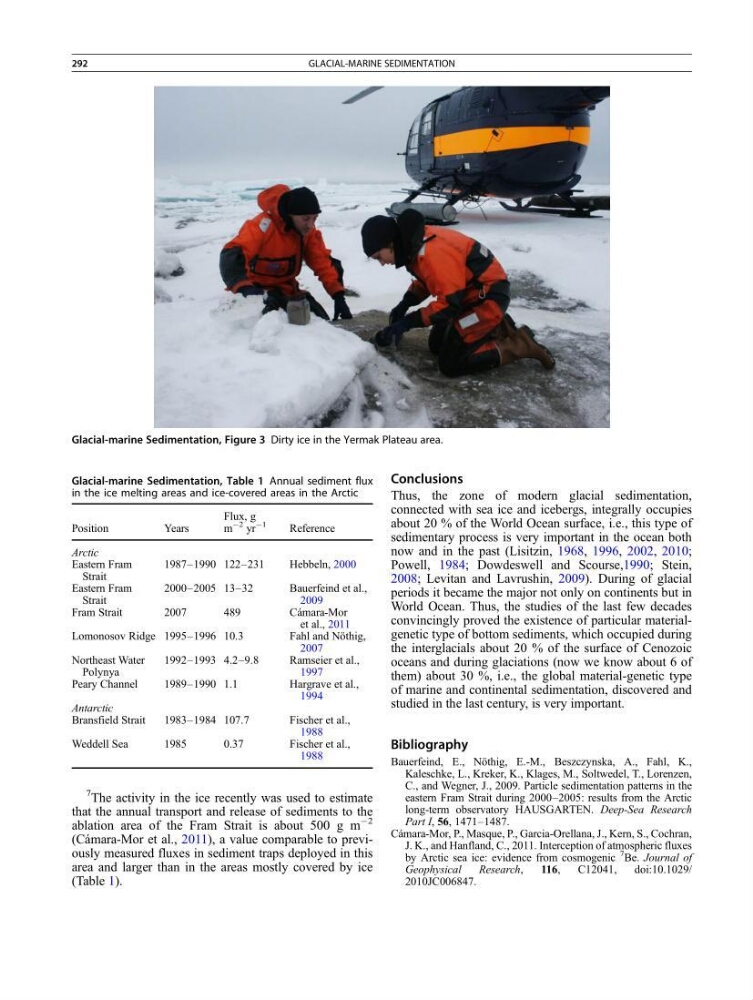
Glacial-marine Sedimentation, Figure 3 Dirty ice in the Yermak Plateau area.
Glacial-marine Sedimentation, Table 1 Annual sediment flux
in the ice melting areas and ice-covered areas in the Arctic
Position
Years
Flux, g
m
À2 yr
À1
Reference
Arctic
Eastern Fram
Strait
1987–1990 122–231
Hebbeln, 2000
Eastern Fram
Strait
2000–2005 13–32
Bauerfeind et al.,
2009
Fram Strait
2007
489
Cámara-Mor
et al., 2011
Lomonosov Ridge 1995–1996 10.3
Fahl and Nöthig,
2007
Northeast Water
Polynya
1992–1993 4.2–9.8
Ramseier et al.,
1997
Peary Channel
1989–1990 1.1
Hargrave et al.,
1994
Antarctic
Bransfield Strait
1983–1984 107.7
Fischer et al.,
1988
Weddell Sea
1985
0.37
Fischer et al.,
1988
292
GLACIAL-MARINE SEDIMENTATION
The activity in the ice recently was used to estimate
that the annual transport and release of sediments to the
ablation area of the Fram Strait is about 500 g m
À2
(Cámara-Mor et al., 2011), a value comparable to previously measured fluxes in sediment traps deployed in this
area and larger than in the areas mostly covered by ice
(Table 1).
Conclusions
Thus, the zone of modern glacial sedimentation,
connected with sea ice and icebergs, integrally occupies
about 20 % of the World Ocean surface, i.e., this type of
sedimentary process is very important in the ocean both
now and in the past (Lisitzin, 1968, 1996, 2002, 2010;
Powell, 1984; Dowdeswell and Scourse,1990; Stein,
2008; Levitan and Lavrushin, 2009). During of glacial
periods it became the major not only on continents but in
World Ocean. Thus, the studies of the last few decades
convincingly proved the existence of particular materialgenetic type of bottom sediments, which occupied during
the interglacials about 20 % of the surface of Cenozoic
oceans and during glaciations (now we know about 6 of
them) about 30 %, i.e., the global material-genetic type
of marine and continental sedimentation, discovered and
studied in the last century, is very important.
Bibliography
Bauerfeind, E., Nöthig, E.-M., Beszczynska, A., Fahl, K.,
Kaleschke, L., Kreker, K., Klages, M., Soltwedel, T., Lorenzen,
C., and Wegner, J., 2009. Particle sedimentation patterns in the
eastern Fram Strait during 2000–2005: results from the Arctic
long-term observatory HAUSGARTEN. Deep-Sea Research
Part I, 56, 1471–1487.
Cámara-Mor, P., Masque, P., Garcia-Orellana, J., Kern, S., Cochran,
J. K., and Hanfland, C., 2011. Interception of atmospheric fluxes
by Arctic sea ice: evidence from cosmogenic
7
Be. Journal of
Geophysical
Research,
116,
C12041,
doi:10.1029/
2010JC006847.
Glacial-marine Sedimentation, Figure 3 Dirty ice in the Yermak Plateau area.
Glacial-marine Sedimentation, Table 1 Annual sediment flux
in the ice melting areas and ice-covered areas in the Arctic
Position
Years
Flux, g
m
À2 yr
À1
Reference
Arctic
Eastern Fram
Strait
1987–1990 122–231
Hebbeln, 2000
Eastern Fram
Strait
2000–2005 13–32
Bauerfeind et al.,
2009
Fram Strait
2007
489
Cámara-Mor
et al., 2011
Lomonosov Ridge 1995–1996 10.3
Fahl and Nöthig,
2007
Northeast Water
Polynya
1992–1993 4.2–9.8
Ramseier et al.,
1997
Peary Channel
1989–1990 1.1
Hargrave et al.,
1994
Antarctic
Bransfield Strait
1983–1984 107.7
Fischer et al.,
1988
Weddell Sea
1985
0.37
Fischer et al.,
1988
292
GLACIAL-MARINE SEDIMENTATION