

quickly rise to the surface and aggregate to form shuga.
This phenomenon, called as ice pump (Lisitzin, 2010), is
widely spread, but studied insufficiently due to operation
in the polar night. Ice pump transfers fine suspended particulate matter from water to sea ice of the shelf. It is this
type of processes that facilitates the sedimentary matter
transportation from the major suppliers of newly formed
ice (the Laptev, Kara, East Siberian, Chukchi, Beaufort
seas) into the Central Arctic and after that to
cryodepocenters (Nürnberg et al., 1994; Reimnitz et al.,
1994; Lindemann et al., 1999; Eicken et al., 2005;
Dethleff and Kuhlmann, 2010; Darby et al., 2011, 2015).
Sediments can be entrained in sea ice during anchor ice
formation (Reimnitz et al., 1987; Darby et al., 2011). Polar
researches studying ice flows leaving the Arctic Ocean
through the Fram Strait have noticed that the ice in general
becomes darker and contains more dark spots of sedimentary matter (“dirty ice”) (Figure 3).
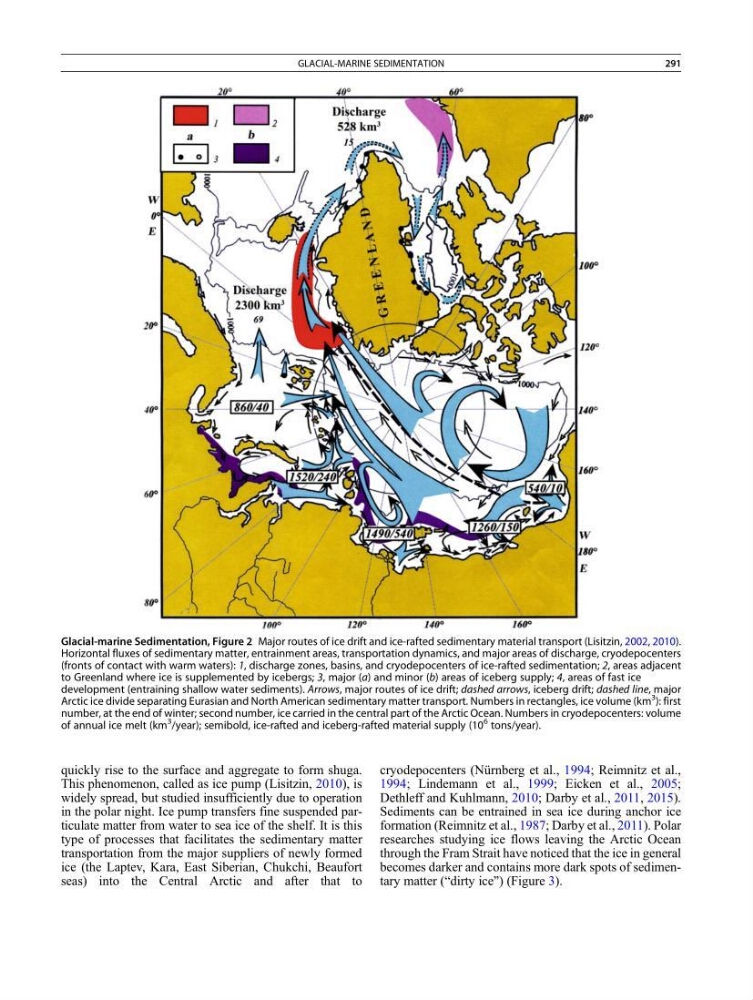
Glacial-marine Sedimentation, Figure 2 Major routes of ice drift and ice-rafted sedimentary material transport (Lisitzin, 2002, 2010).
Horizontal fluxes of sedimentary matter, entrainment areas, transportation dynamics, and major areas of discharge, cryodepocenters
(fronts of contact with warm waters): 1, discharge zones, basins, and cryodepocenters of ice-rafted sedimentation; 2, areas adjacent
to Greenland where ice is supplemented by icebergs; 3, major (a) and minor (b) areas of iceberg supply; 4, areas of fast ice
development (entraining shallow water sediments). Arrows, major routes of ice drift; dashed arrows, iceberg drift; dashed line, major
Arctic ice divide separating Eurasian and North American sedimentary matter transport. Numbers in rectangles, ice volume (km
3 ): first
number, at the end of winter; second number, ice carried in the central part of the Arctic Ocean. Numbers in cryodepocenters: volume
of annual ice melt (km
3 /year); semibold, ice-rafted and iceberg-rafted material supply (10
6 tons/year).
GLACIAL-MARINE SEDIMENTATION
291
This phenomenon, called as ice pump (Lisitzin, 2010), is
widely spread, but studied insufficiently due to operation
in the polar night. Ice pump transfers fine suspended particulate matter from water to sea ice of the shelf. It is this
type of processes that facilitates the sedimentary matter
transportation from the major suppliers of newly formed
ice (the Laptev, Kara, East Siberian, Chukchi, Beaufort
seas) into the Central Arctic and after that to
cryodepocenters (Nürnberg et al., 1994; Reimnitz et al.,
1994; Lindemann et al., 1999; Eicken et al., 2005;
Dethleff and Kuhlmann, 2010; Darby et al., 2011, 2015).
Sediments can be entrained in sea ice during anchor ice
formation (Reimnitz et al., 1987; Darby et al., 2011). Polar
researches studying ice flows leaving the Arctic Ocean
through the Fram Strait have noticed that the ice in general
becomes darker and contains more dark spots of sedimentary matter (“dirty ice”) (Figure 3).
Glacial-marine Sedimentation, Figure 2 Major routes of ice drift and ice-rafted sedimentary material transport (Lisitzin, 2002, 2010).
Horizontal fluxes of sedimentary matter, entrainment areas, transportation dynamics, and major areas of discharge, cryodepocenters
(fronts of contact with warm waters): 1, discharge zones, basins, and cryodepocenters of ice-rafted sedimentation; 2, areas adjacent
to Greenland where ice is supplemented by icebergs; 3, major (a) and minor (b) areas of iceberg supply; 4, areas of fast ice
development (entraining shallow water sediments). Arrows, major routes of ice drift; dashed arrows, iceberg drift; dashed line, major
Arctic ice divide separating Eurasian and North American sedimentary matter transport. Numbers in rectangles, ice volume (km
3 ): first
number, at the end of winter; second number, ice carried in the central part of the Arctic Ocean. Numbers in cryodepocenters: volume
of annual ice melt (km
3 /year); semibold, ice-rafted and iceberg-rafted material supply (10
6 tons/year).
GLACIAL-MARINE SEDIMENTATION
291