

Cross-references
Beach Processes
Coastal Engineering
Coasts
Earthquakes
Erosion-Hiatuses
Hurricanes and Typhoons
Integrated Coastal Zone Management
Lagoons
Oil Spill
Radiocarbon: Clock and Tracer
Submarine Slides
Tsunamis
Waves
GEOLOGIC TIME SCALE
Felix M. Gradstein
Museum of Natural History, University of Oslo, Oslo,
Norway
Introduction
The geologic time scale (GTS) is the principal tool for
deciphering and understanding the long and complex history of our planet, Earth. As Arthur Holmes, the father of
the geologic time scale, once wrote (Holmes, 1965,
p. 148): “To place all the scattered pages of earth history
in their proper chronological order is by no means an easy
task.” Ordering these scattered and torn pages and understanding the physical, chemical, and biological processes
that acted on them since Earth appeared and solidified
require a detailed and accurate time scale.
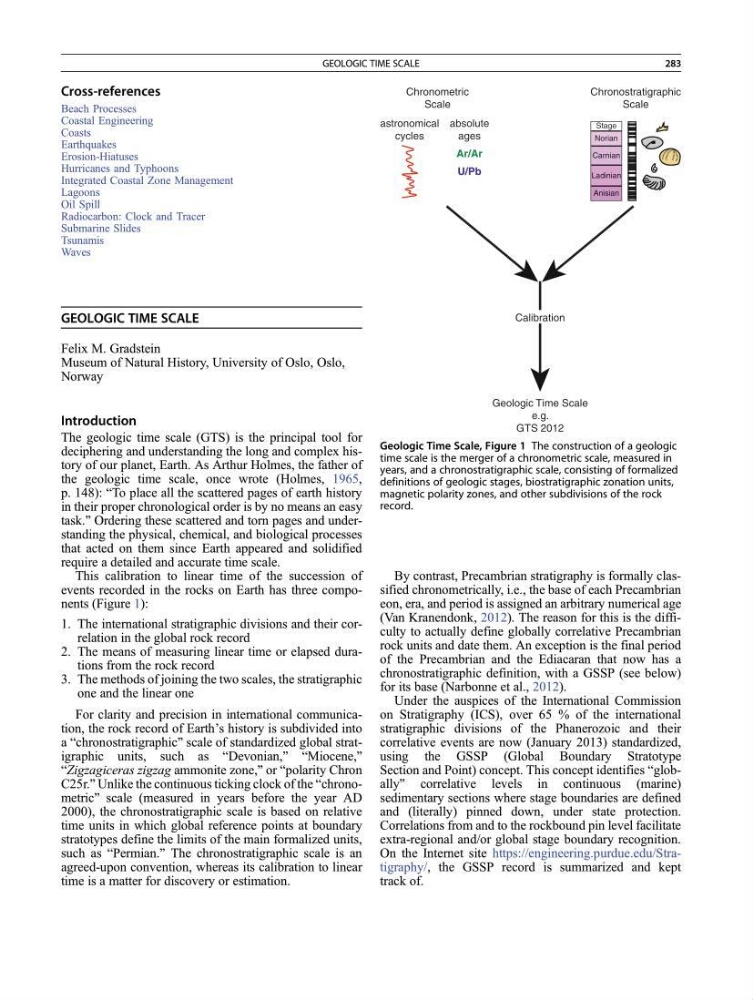
This calibration to linear time of the succession of
events recorded in the rocks on Earth has three components (Figure 1):
1. The international stratigraphic divisions and their correlation in the global rock record
2. The means of measuring linear time or elapsed durations from the rock record
3. The methods of joining the two scales, the stratigraphic
one and the linear one
For clarity and precision in international communication, the rock record of Earth’s history is subdivided into
a “chronostratigraphic” scale of standardized global stratigraphic units, such as “Devonian,” “Miocene,”
“Zigzagiceras zigzag ammonite zone,” or “polarity Chron
C25r.” Unlike the continuous ticking clock of the “chronometric” scale (measured in years before the year AD
2000), the chronostratigraphic scale is based on relative
time units in which global reference points at boundary
stratotypes define the limits of the main formalized units,
such as “Permian.” The chronostratigraphic scale is an
agreed-upon convention, whereas its calibration to linear
time is a matter for discovery or estimation.
By contrast, Precambrian stratigraphy is formally classified chronometrically, i.e., the base of each Precambrian
eon, era, and period is assigned an arbitrary numerical age
(Van Kranendonk, 2012). The reason for this is the difficulty to actually define globally correlative Precambrian
rock units and date them. An exception is the final period
of the Precambrian and the Ediacaran that now has a
chronostratigraphic definition, with a GSSP (see below)
for its base (Narbonne et al., 2012).
Under the auspices of the International Commission
on Stratigraphy (ICS), over 65 % of the international
stratigraphic divisions of the Phanerozoic and their
correlative events are now (January 2013) standardized,
using the GSSP (Global Boundary Stratotype
Section and Point) concept. This concept identifies “globally” correlative levels in continuous (marine)
sedimentary sections where stage boundaries are defined
and (literally) pinned down, under state protection.
Correlations from and to the rockbound pin level facilitate
extra-regional and/or global stage boundary recognition.
On the Internet site https://engineering.purdue.edu/Stratigraphy/, the GSSP record is summarized and kept
track of.
Chronostratigraphic
Scale
Stage
Norian
Carnian
Ladinian
Anisian
Chronometric
Scale
Ar/Ar
U/Pb
absolute
ages
astronomical
cycles
Geologic Time Scale
e.g.
GTS 2012
Calibration
Geologic Time Scale, Figure 1 The construction of a geologic
time scale is the merger of a chronometric scale, measured in
years, and a chronostratigraphic scale, consisting of formalized
definitions of geologic stages, biostratigraphic zonation units,
magnetic polarity zones, and other subdivisions of the rock
record.
GEOLOGIC TIME SCALE
283
Beach Processes
Coastal Engineering
Coasts
Earthquakes
Erosion-Hiatuses
Hurricanes and Typhoons
Integrated Coastal Zone Management
Lagoons
Oil Spill
Radiocarbon: Clock and Tracer
Submarine Slides
Tsunamis
Waves
GEOLOGIC TIME SCALE
Felix M. Gradstein
Museum of Natural History, University of Oslo, Oslo,
Norway
Introduction
The geologic time scale (GTS) is the principal tool for
deciphering and understanding the long and complex history of our planet, Earth. As Arthur Holmes, the father of
the geologic time scale, once wrote (Holmes, 1965,
p. 148): “To place all the scattered pages of earth history
in their proper chronological order is by no means an easy
task.” Ordering these scattered and torn pages and understanding the physical, chemical, and biological processes
that acted on them since Earth appeared and solidified
require a detailed and accurate time scale.
This calibration to linear time of the succession of
events recorded in the rocks on Earth has three components (Figure 1):
1. The international stratigraphic divisions and their correlation in the global rock record
2. The means of measuring linear time or elapsed durations from the rock record
3. The methods of joining the two scales, the stratigraphic
one and the linear one
For clarity and precision in international communication, the rock record of Earth’s history is subdivided into
a “chronostratigraphic” scale of standardized global stratigraphic units, such as “Devonian,” “Miocene,”
“Zigzagiceras zigzag ammonite zone,” or “polarity Chron
C25r.” Unlike the continuous ticking clock of the “chronometric” scale (measured in years before the year AD
2000), the chronostratigraphic scale is based on relative
time units in which global reference points at boundary
stratotypes define the limits of the main formalized units,
such as “Permian.” The chronostratigraphic scale is an
agreed-upon convention, whereas its calibration to linear
time is a matter for discovery or estimation.
By contrast, Precambrian stratigraphy is formally classified chronometrically, i.e., the base of each Precambrian
eon, era, and period is assigned an arbitrary numerical age
(Van Kranendonk, 2012). The reason for this is the difficulty to actually define globally correlative Precambrian
rock units and date them. An exception is the final period
of the Precambrian and the Ediacaran that now has a
chronostratigraphic definition, with a GSSP (see below)
for its base (Narbonne et al., 2012).
Under the auspices of the International Commission
on Stratigraphy (ICS), over 65 % of the international
stratigraphic divisions of the Phanerozoic and their
correlative events are now (January 2013) standardized,
using the GSSP (Global Boundary Stratotype
Section and Point) concept. This concept identifies “globally” correlative levels in continuous (marine)
sedimentary sections where stage boundaries are defined
and (literally) pinned down, under state protection.
Correlations from and to the rockbound pin level facilitate
extra-regional and/or global stage boundary recognition.
On the Internet site https://engineering.purdue.edu/Stratigraphy/, the GSSP record is summarized and kept
track of.
Chronostratigraphic
Scale
Stage
Norian
Carnian
Ladinian
Anisian
Chronometric
Scale
Ar/Ar
U/Pb
absolute
ages
astronomical
cycles
Geologic Time Scale
e.g.
GTS 2012
Calibration
Geologic Time Scale, Figure 1 The construction of a geologic
time scale is the merger of a chronometric scale, measured in
years, and a chronostratigraphic scale, consisting of formalized
definitions of geologic stages, biostratigraphic zonation units,
magnetic polarity zones, and other subdivisions of the rock
record.
GEOLOGIC TIME SCALE
283