

should prevail and not uplift and erosion; secondly, the
deposits should be distinguishable from storm layers
(tempestites); and thirdly, the deposits should yield datable material. The distinction of storm and tsunami
deposits proves to be particularly difficult. Hence, many
researchers (e.g., Lario et al., 2010) refer to extreme wave
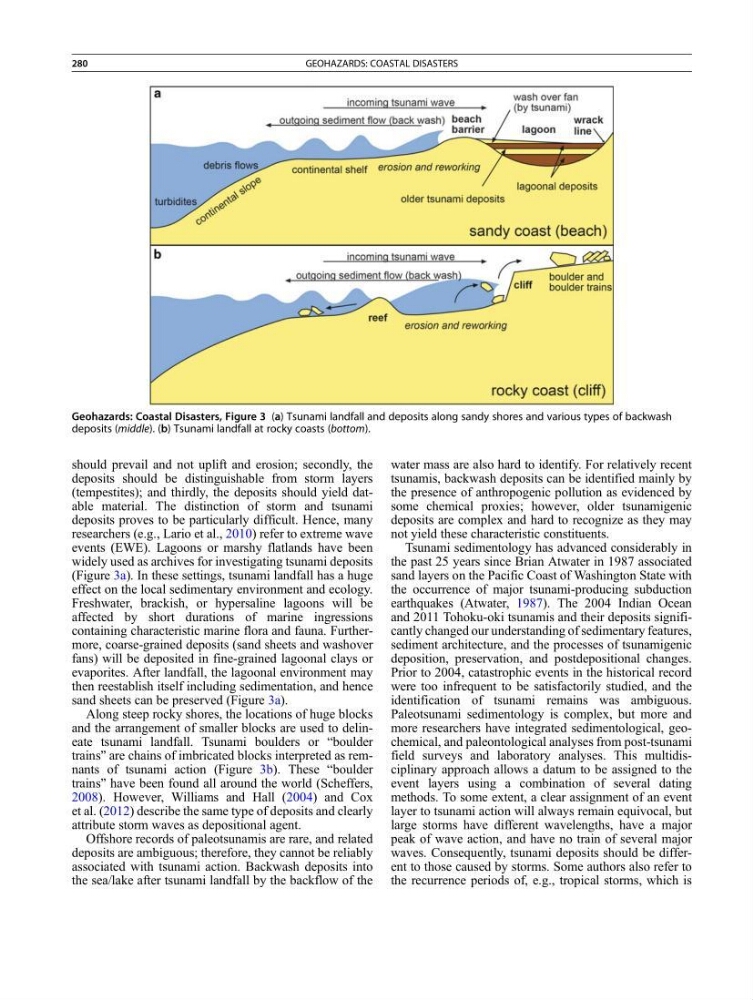
events (EWE). Lagoons or marshy flatlands have been
widely used as archives for investigating tsunami deposits
(Figure 3a). In these settings, tsunami landfall has a huge
effect on the local sedimentary environment and ecology.
Freshwater, brackish, or hypersaline lagoons will be
affected by short durations of marine ingressions
containing characteristic marine flora and fauna. Furthermore, coarse-grained deposits (sand sheets and washover
fans) will be deposited in fine-grained lagoonal clays or
evaporites. After landfall, the lagoonal environment may
then reestablish itself including sedimentation, and hence
sand sheets can be preserved (Figure 3a).
Along steep rocky shores, the locations of huge blocks
and the arrangement of smaller blocks are used to delineate tsunami landfall. Tsunami boulders or “boulder
trains” are chains of imbricated blocks interpreted as remnants of tsunami action (Figure 3b). These “boulder
trains” have been found all around the world (Scheffers,
2008). However, Williams and Hall (2004) and Cox
et al. (2012) describe the same type of deposits and clearly
attribute storm waves as depositional agent.
Offshore records of paleotsunamis are rare, and related
deposits are ambiguous; therefore, they cannot be reliably
associated with tsunami action. Backwash deposits into
the sea/lake after tsunami landfall by the backflow of the
water mass are also hard to identify. For relatively recent
tsunamis, backwash deposits can be identified mainly by
the presence of anthropogenic pollution as evidenced by
some chemical proxies; however, older tsunamigenic
deposits are complex and hard to recognize as they may
not yield these characteristic constituents.
Tsunami sedimentology has advanced considerably in
the past 25 years since Brian Atwater in 1987 associated
sand layers on the Pacific Coast of Washington State with
the occurrence of major tsunami-producing subduction
earthquakes (Atwater, 1987). The 2004 Indian Ocean
and 2011 Tohoku-oki tsunamis and their deposits significantly changed our understanding of sedimentary features,
sediment architecture, and the processes of tsunamigenic
deposition, preservation, and postdepositional changes.
Prior to 2004, catastrophic events in the historical record
were too infrequent to be satisfactorily studied, and the
identification of tsunami remains was ambiguous.
Paleotsunami sedimentology is complex, but more and
more researchers have integrated sedimentological, geochemical, and paleontological analyses from post-tsunami
field surveys and laboratory analyses. This multidisciplinary approach allows a datum to be assigned to the
event layers using a combination of several dating
methods. To some extent, a clear assignment of an event
layer to tsunami action will always remain equivocal, but
large storms have different wavelengths, have a major
peak of wave action, and have no train of several major
waves. Consequently, tsunami deposits should be different to those caused by storms. Some authors also refer to
the recurrence periods of, e.g., tropical storms, which is
Geohazards: Coastal Disasters, Figure 3 (a) Tsunami landfall and deposits along sandy shores and various types of backwash
deposits (middle). (b) Tsunami landfall at rocky coasts (bottom).
280
GEOHAZARDS: COASTAL DISASTERS
deposits should be distinguishable from storm layers
(tempestites); and thirdly, the deposits should yield datable material. The distinction of storm and tsunami
deposits proves to be particularly difficult. Hence, many
researchers (e.g., Lario et al., 2010) refer to extreme wave
events (EWE). Lagoons or marshy flatlands have been
widely used as archives for investigating tsunami deposits
(Figure 3a). In these settings, tsunami landfall has a huge
effect on the local sedimentary environment and ecology.
Freshwater, brackish, or hypersaline lagoons will be
affected by short durations of marine ingressions
containing characteristic marine flora and fauna. Furthermore, coarse-grained deposits (sand sheets and washover
fans) will be deposited in fine-grained lagoonal clays or
evaporites. After landfall, the lagoonal environment may
then reestablish itself including sedimentation, and hence
sand sheets can be preserved (Figure 3a).
Along steep rocky shores, the locations of huge blocks
and the arrangement of smaller blocks are used to delineate tsunami landfall. Tsunami boulders or “boulder
trains” are chains of imbricated blocks interpreted as remnants of tsunami action (Figure 3b). These “boulder
trains” have been found all around the world (Scheffers,
2008). However, Williams and Hall (2004) and Cox
et al. (2012) describe the same type of deposits and clearly
attribute storm waves as depositional agent.
Offshore records of paleotsunamis are rare, and related
deposits are ambiguous; therefore, they cannot be reliably
associated with tsunami action. Backwash deposits into
the sea/lake after tsunami landfall by the backflow of the
water mass are also hard to identify. For relatively recent
tsunamis, backwash deposits can be identified mainly by
the presence of anthropogenic pollution as evidenced by
some chemical proxies; however, older tsunamigenic
deposits are complex and hard to recognize as they may
not yield these characteristic constituents.
Tsunami sedimentology has advanced considerably in
the past 25 years since Brian Atwater in 1987 associated
sand layers on the Pacific Coast of Washington State with
the occurrence of major tsunami-producing subduction
earthquakes (Atwater, 1987). The 2004 Indian Ocean
and 2011 Tohoku-oki tsunamis and their deposits significantly changed our understanding of sedimentary features,
sediment architecture, and the processes of tsunamigenic
deposition, preservation, and postdepositional changes.
Prior to 2004, catastrophic events in the historical record
were too infrequent to be satisfactorily studied, and the
identification of tsunami remains was ambiguous.
Paleotsunami sedimentology is complex, but more and
more researchers have integrated sedimentological, geochemical, and paleontological analyses from post-tsunami
field surveys and laboratory analyses. This multidisciplinary approach allows a datum to be assigned to the
event layers using a combination of several dating
methods. To some extent, a clear assignment of an event
layer to tsunami action will always remain equivocal, but
large storms have different wavelengths, have a major
peak of wave action, and have no train of several major
waves. Consequently, tsunami deposits should be different to those caused by storms. Some authors also refer to
the recurrence periods of, e.g., tropical storms, which is
Geohazards: Coastal Disasters, Figure 3 (a) Tsunami landfall and deposits along sandy shores and various types of backwash
deposits (middle). (b) Tsunami landfall at rocky coasts (bottom).
280
GEOHAZARDS: COASTAL DISASTERS