

seasonally from one type to another (e.g., they are positive
during rainy seasons, whereas negative during dry
periods). The estuary during the neutral stadium represents a temporal transition between positive and negative
stages (Kjerfve, 1989).
Salinity vertical structure and mixing processes
Estuaries may be divided based on the vertical stratification and the extent of lateral homogeneity (Bowden,
1967; Pritchard, 1989). According to Valle-Levinson
(2010), this classification includes:
• Salt-wedge estuary: caused by weak tidal forcing and
large river discharge, the tidally averaged salinity profiles show the sharp pycnocline, with mean flow dominated by outflow throughout most of the water column
and weak inflow in a near-bottom layer; mixing
between fresh- and salt waters is negligible (e.g., the
Mississippi River, Ebro River, Rio de la Plata).
• Strongly stratified (fjord-type) estuaries: formed as
a result of moderate to large river discharge and weak
to moderate tidal forcing. The tidally averaged salinity
profiles have a well-developed pycnocline with weak
vertical variations above and below it. The inflow is
weak because of weak mixing with freshwater and
weak horizontal density gradients. An example of this
type of estuary is the almost tideless Baltic Sea.
• Weakly (partially) stratified estuaries: resulted from
moderate to strong tidal forcing and weak to moderate
river discharge. A weak pycnocline or continuous stratification from surface to bottom, except near the bottom
mixed layer, is observed. Stronger tidal currents induce
mixing between fresh- and salt waters (e.g., Chesapeake
Bay, Delaware Bay, James River).
• Well-mixed estuaries: produced by strong tidal forcing
and weak river discharge, in which mean salinity profiles are practically uniform and mean flows are unidirectional with depth. In wide estuaries inflow may
develop on one side across the estuary and outflow on
the other side (e.g., the lower Chesapeake Bay in early
autumn).
Estuaries would tend to shift from strongly stratified to
well mixed with (a) decreasing river flow, (b) increasing
tidal velocities, (c) increasing width, and (d) decreasing
depth (Pritchard, 1989). They respond to consecutive tidal
cycles, meteorological forcing, and topographic features.
For instance, the Hudson River Estuary changes from
highly stratified during neap tides to weakly stratified during spring tides (Valle-Levinson, 2010).
Principal forcing variables
The tidal velocity and the freshwater flow constitute the
basis of the prognostic approach to classification of estuaries. Geyer and MacCready (2014) mapped the estuarine
parameter space using two nondimensional parameters
Fr f and M, where Fr f is the freshwater Froude number,
the net velocity due to river flow scaled by the maximum
possible frontal propagation speed, with a tidal Froude
number as the other axis (Geyer, 2010) and M is the
mixing number which is based on the ratio of the tidal
timescale to the vertical mixing timescale (Geyer and
MacCready, 2014). Estuaries with similar hydrodynamic
conditions would be expected to appear at the similar
place in the Fr f -M parameter space. They are depicted as
not points in the parameter space but rectangles owing to
the spring-neap variations in tidal velocity as well as
changes in river discharge and variations in depth. Saltwedge estuaries such as the Mississippi and the Ebro
River (with higher values of the Fr f number) are near the
top of the Fr f -M space. Partially mixed estuaries fall in
the middle (e.g., the Hudson and the James Rivers). Fjords
appear in the lower-left corner, whereas well-mixed estuaries (the M number higher than 1) appear in the lowerright part of the estuarine parameter space.
Estuarine hydrodynamics
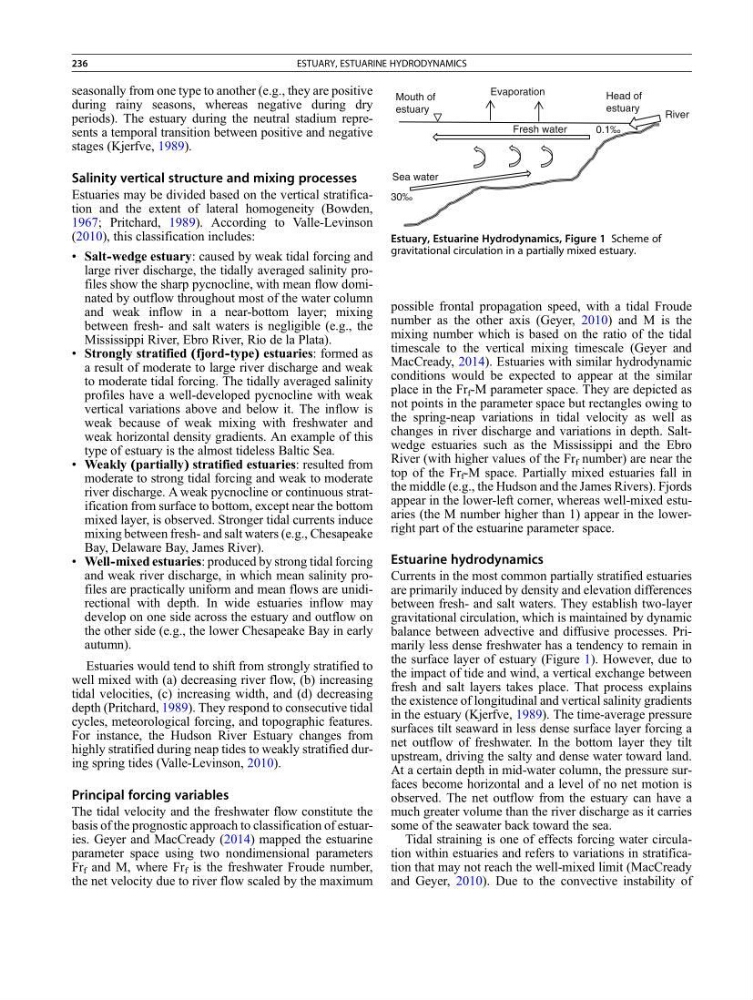
Currents in the most common partially stratified estuaries
are primarily induced by density and elevation differences
between fresh- and salt waters. They establish two-layer
gravitational circulation, which is maintained by dynamic
balance between advective and diffusive processes. Primarily less dense freshwater has a tendency to remain in
the surface layer of estuary (Figure 1). However, due to
the impact of tide and wind, a vertical exchange between
fresh and salt layers takes place. That process explains
the existence of longitudinal and vertical salinity gradients
in the estuary (Kjerfve, 1989). The time-average pressure
surfaces tilt seaward in less dense surface layer forcing a
net outflow of freshwater. In the bottom layer they tilt
upstream, driving the salty and dense water toward land.
At a certain depth in mid-water column, the pressure surfaces become horizontal and a level of no net motion is
observed. The net outflow from the estuary can have a
much greater volume than the river discharge as it carries
some of the seawater back toward the sea.
Tidal straining is one of effects forcing water circulation within estuaries and refers to variations in stratification that may not reach the well-mixed limit (MacCready
and Geyer, 2010). Due to the convective instability of
Mouth of
estuary
0.1‰
30‰
Head of
estuary
Fresh water
Sea water
Evaporation
River
Estuary, Estuarine Hydrodynamics, Figure 1 Scheme of
gravitational circulation in a partially mixed estuary.
236
ESTUARY, ESTUARINE HYDRODYNAMICS
during rainy seasons, whereas negative during dry
periods). The estuary during the neutral stadium represents a temporal transition between positive and negative
stages (Kjerfve, 1989).
Salinity vertical structure and mixing processes
Estuaries may be divided based on the vertical stratification and the extent of lateral homogeneity (Bowden,
1967; Pritchard, 1989). According to Valle-Levinson
(2010), this classification includes:
• Salt-wedge estuary: caused by weak tidal forcing and
large river discharge, the tidally averaged salinity profiles show the sharp pycnocline, with mean flow dominated by outflow throughout most of the water column
and weak inflow in a near-bottom layer; mixing
between fresh- and salt waters is negligible (e.g., the
Mississippi River, Ebro River, Rio de la Plata).
• Strongly stratified (fjord-type) estuaries: formed as
a result of moderate to large river discharge and weak
to moderate tidal forcing. The tidally averaged salinity
profiles have a well-developed pycnocline with weak
vertical variations above and below it. The inflow is
weak because of weak mixing with freshwater and
weak horizontal density gradients. An example of this
type of estuary is the almost tideless Baltic Sea.
• Weakly (partially) stratified estuaries: resulted from
moderate to strong tidal forcing and weak to moderate
river discharge. A weak pycnocline or continuous stratification from surface to bottom, except near the bottom
mixed layer, is observed. Stronger tidal currents induce
mixing between fresh- and salt waters (e.g., Chesapeake
Bay, Delaware Bay, James River).
• Well-mixed estuaries: produced by strong tidal forcing
and weak river discharge, in which mean salinity profiles are practically uniform and mean flows are unidirectional with depth. In wide estuaries inflow may
develop on one side across the estuary and outflow on
the other side (e.g., the lower Chesapeake Bay in early
autumn).
Estuaries would tend to shift from strongly stratified to
well mixed with (a) decreasing river flow, (b) increasing
tidal velocities, (c) increasing width, and (d) decreasing
depth (Pritchard, 1989). They respond to consecutive tidal
cycles, meteorological forcing, and topographic features.
For instance, the Hudson River Estuary changes from
highly stratified during neap tides to weakly stratified during spring tides (Valle-Levinson, 2010).
Principal forcing variables
The tidal velocity and the freshwater flow constitute the
basis of the prognostic approach to classification of estuaries. Geyer and MacCready (2014) mapped the estuarine
parameter space using two nondimensional parameters
Fr f and M, where Fr f is the freshwater Froude number,
the net velocity due to river flow scaled by the maximum
possible frontal propagation speed, with a tidal Froude
number as the other axis (Geyer, 2010) and M is the
mixing number which is based on the ratio of the tidal
timescale to the vertical mixing timescale (Geyer and
MacCready, 2014). Estuaries with similar hydrodynamic
conditions would be expected to appear at the similar
place in the Fr f -M parameter space. They are depicted as
not points in the parameter space but rectangles owing to
the spring-neap variations in tidal velocity as well as
changes in river discharge and variations in depth. Saltwedge estuaries such as the Mississippi and the Ebro
River (with higher values of the Fr f number) are near the
top of the Fr f -M space. Partially mixed estuaries fall in
the middle (e.g., the Hudson and the James Rivers). Fjords
appear in the lower-left corner, whereas well-mixed estuaries (the M number higher than 1) appear in the lowerright part of the estuarine parameter space.
Estuarine hydrodynamics
Currents in the most common partially stratified estuaries
are primarily induced by density and elevation differences
between fresh- and salt waters. They establish two-layer
gravitational circulation, which is maintained by dynamic
balance between advective and diffusive processes. Primarily less dense freshwater has a tendency to remain in
the surface layer of estuary (Figure 1). However, due to
the impact of tide and wind, a vertical exchange between
fresh and salt layers takes place. That process explains
the existence of longitudinal and vertical salinity gradients
in the estuary (Kjerfve, 1989). The time-average pressure
surfaces tilt seaward in less dense surface layer forcing a
net outflow of freshwater. In the bottom layer they tilt
upstream, driving the salty and dense water toward land.
At a certain depth in mid-water column, the pressure surfaces become horizontal and a level of no net motion is
observed. The net outflow from the estuary can have a
much greater volume than the river discharge as it carries
some of the seawater back toward the sea.
Tidal straining is one of effects forcing water circulation within estuaries and refers to variations in stratification that may not reach the well-mixed limit (MacCready
and Geyer, 2010). Due to the convective instability of
Mouth of
estuary
0.1‰
30‰
Head of
estuary
Fresh water
Sea water
Evaporation
River
Estuary, Estuarine Hydrodynamics, Figure 1 Scheme of
gravitational circulation in a partially mixed estuary.
236
ESTUARY, ESTUARINE HYDRODYNAMICS