

scalar seismic moment M 0 , a tensorial property related to
fault area, slip vector, and shear modulus (e.g., Hanks
and Kanamori, 1979; Scholz, 2002) or of the radiated
energy E s by integration of the squared P-wave velocity
records (e.g., Choy and Boatwright, 1995). The latter is
suggested to be superior to traditional seismic energy estimates from empirical Gutenberg–Richter magnitude–
energy relationships (e.g., Gutenberg and Richter, 1956).
However, also these modern moment (M w ) and energy
magnitudes (M e ) are semiempirical as they have been
scaled to the empirical 20 s M s surface-wave magnitude
and the classical empirical relationship log E s ¼ 1.5 M s
+ 4.8 according to Richter and Gutenberg.
The scalar seismic moment M 0 is a relation between
shear modulus m, rupture area A, and average displacement D (M 0 ¼ mAD). It is a static measure of earthquake
size, but does not say anything about, e.g., rupture velocity
or stress drop, which strongly control the energy radiated
by an earthquake of a given seismic moment. Therefore,
M 0 is only a rough average estimate of the released seismic energy and thus the moment magnitude M w
(M w ¼ 2/3 log 10 M 0 – 6.0 with M 0 in Nm; cf. Fowler,
2005) is less well suited for a realistic assessment of the
seismic shaking hazard than the energy magnitude M e
(M e ¼ 2/3 log 10 E s – 2.9; e.g., Choy and Boatwright,
1995). However, both modern magnitudes should be used
complementary, as they are related to different properties
of the source in order to achieve a reliable assessment of
important issues related to earthquakes such as hazard or
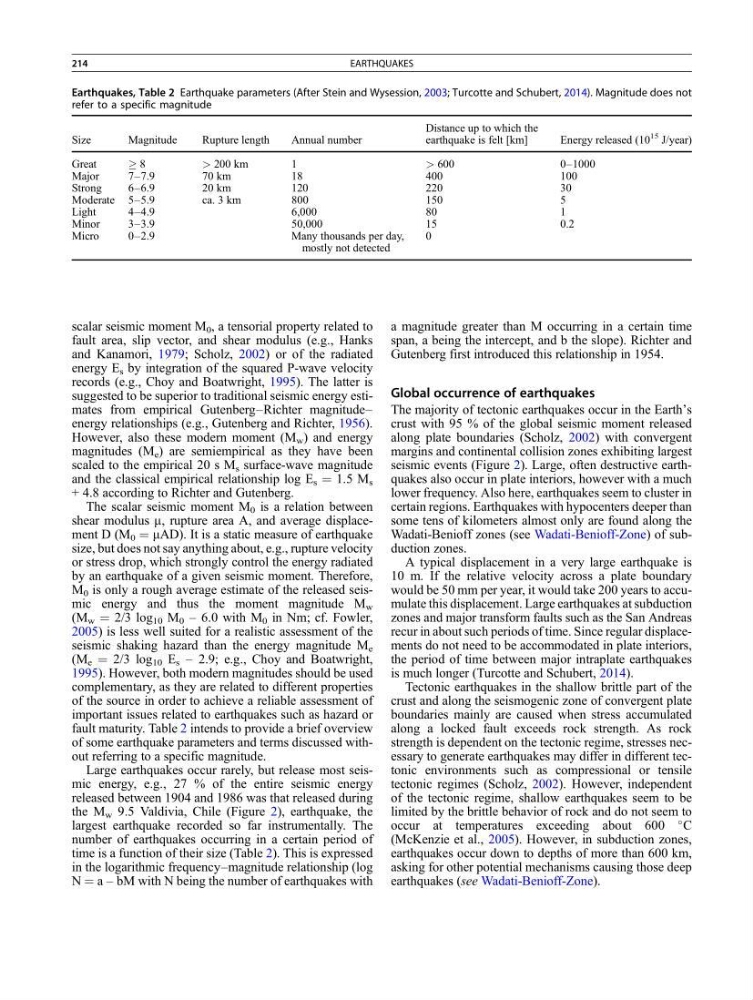
fault maturity. Table 2 intends to provide a brief overview
of some earthquake parameters and terms discussed without referring to a specific magnitude.
Large earthquakes occur rarely, but release most seismic energy, e.g., 27 % of the entire seismic energy
released between 1904 and 1986 was that released during
the M w 9.5 Valdivia, Chile (Figure 2), earthquake, the
largest earthquake recorded so far instrumentally. The
number of earthquakes occurring in a certain period of
time is a function of their size (Table 2). This is expressed
in the logarithmic frequency–magnitude relationship (log
N ¼ a – bM with N being the number of earthquakes with
a magnitude greater than M occurring in a certain time
span, a being the intercept, and b the slope). Richter and
Gutenberg first introduced this relationship in 1954.
Global occurrence of earthquakes
The majority of tectonic earthquakes occur in the Earth’s
crust with 95 % of the global seismic moment released
along plate boundaries (Scholz, 2002) with convergent
margins and continental collision zones exhibiting largest
seismic events (Figure 2). Large, often destructive earthquakes also occur in plate interiors, however with a much
lower frequency. Also here, earthquakes seem to cluster in
certain regions. Earthquakes with hypocenters deeper than
some tens of kilometers almost only are found along the
Wadati-Benioff zones (see Wadati-Benioff-Zone) of subduction zones.
A typical displacement in a very large earthquake is
10 m. If the relative velocity across a plate boundary
would be 50 mm per year, it would take 200 years to accumulate this displacement. Large earthquakes at subduction
zones and major transform faults such as the San Andreas
recur in about such periods of time. Since regular displacements do not need to be accommodated in plate interiors,
the period of time between major intraplate earthquakes
is much longer (Turcotte and Schubert, 2014).
Tectonic earthquakes in the shallow brittle part of the
crust and along the seismogenic zone of convergent plate
boundaries mainly are caused when stress accumulated
along a locked fault exceeds rock strength. As rock
strength is dependent on the tectonic regime, stresses necessary to generate earthquakes may differ in different tectonic environments such as compressional or tensile
tectonic regimes (Scholz, 2002). However, independent
of the tectonic regime, shallow earthquakes seem to be
limited by the brittle behavior of rock and do not seem to
occur at temperatures exceeding about 600
C
(McKenzie et al., 2005). However, in subduction zones,
earthquakes occur down to depths of more than 600 km,
asking for other potential mechanisms causing those deep
earthquakes (see Wadati-Benioff-Zone).
Earthquakes, Table 2 Earthquake parameters (After Stein and Wysession, 2003; Turcotte and Schubert, 2014). Magnitude does not
refer to a specific magnitude
Size
Magnitude
Rupture length
Annual number
Distance up to which the
earthquake is felt [km]
Energy released (10
15 J/year)
Great
! 8
> 200 km
1
> 600
0–1000
Major
7–7.9
70 km
18
400
100
Strong
6–6.9
20 km
120
220
30
Moderate 5–5.9
ca. 3 km
800
150
5
Light
4–4.9
6,000
80
1
Minor
3–3.9
50,000
15
0.2
Micro
0–2.9
Many thousands per day,
mostly not detected
0
214
EARTHQUAKES
fault area, slip vector, and shear modulus (e.g., Hanks
and Kanamori, 1979; Scholz, 2002) or of the radiated
energy E s by integration of the squared P-wave velocity
records (e.g., Choy and Boatwright, 1995). The latter is
suggested to be superior to traditional seismic energy estimates from empirical Gutenberg–Richter magnitude–
energy relationships (e.g., Gutenberg and Richter, 1956).
However, also these modern moment (M w ) and energy
magnitudes (M e ) are semiempirical as they have been
scaled to the empirical 20 s M s surface-wave magnitude
and the classical empirical relationship log E s ¼ 1.5 M s
+ 4.8 according to Richter and Gutenberg.
The scalar seismic moment M 0 is a relation between
shear modulus m, rupture area A, and average displacement D (M 0 ¼ mAD). It is a static measure of earthquake
size, but does not say anything about, e.g., rupture velocity
or stress drop, which strongly control the energy radiated
by an earthquake of a given seismic moment. Therefore,
M 0 is only a rough average estimate of the released seismic energy and thus the moment magnitude M w
(M w ¼ 2/3 log 10 M 0 – 6.0 with M 0 in Nm; cf. Fowler,
2005) is less well suited for a realistic assessment of the
seismic shaking hazard than the energy magnitude M e
(M e ¼ 2/3 log 10 E s – 2.9; e.g., Choy and Boatwright,
1995). However, both modern magnitudes should be used
complementary, as they are related to different properties
of the source in order to achieve a reliable assessment of
important issues related to earthquakes such as hazard or
fault maturity. Table 2 intends to provide a brief overview
of some earthquake parameters and terms discussed without referring to a specific magnitude.
Large earthquakes occur rarely, but release most seismic energy, e.g., 27 % of the entire seismic energy
released between 1904 and 1986 was that released during
the M w 9.5 Valdivia, Chile (Figure 2), earthquake, the
largest earthquake recorded so far instrumentally. The
number of earthquakes occurring in a certain period of
time is a function of their size (Table 2). This is expressed
in the logarithmic frequency–magnitude relationship (log
N ¼ a – bM with N being the number of earthquakes with
a magnitude greater than M occurring in a certain time
span, a being the intercept, and b the slope). Richter and
Gutenberg first introduced this relationship in 1954.
Global occurrence of earthquakes
The majority of tectonic earthquakes occur in the Earth’s
crust with 95 % of the global seismic moment released
along plate boundaries (Scholz, 2002) with convergent
margins and continental collision zones exhibiting largest
seismic events (Figure 2). Large, often destructive earthquakes also occur in plate interiors, however with a much
lower frequency. Also here, earthquakes seem to cluster in
certain regions. Earthquakes with hypocenters deeper than
some tens of kilometers almost only are found along the
Wadati-Benioff zones (see Wadati-Benioff-Zone) of subduction zones.
A typical displacement in a very large earthquake is
10 m. If the relative velocity across a plate boundary
would be 50 mm per year, it would take 200 years to accumulate this displacement. Large earthquakes at subduction
zones and major transform faults such as the San Andreas
recur in about such periods of time. Since regular displacements do not need to be accommodated in plate interiors,
the period of time between major intraplate earthquakes
is much longer (Turcotte and Schubert, 2014).
Tectonic earthquakes in the shallow brittle part of the
crust and along the seismogenic zone of convergent plate
boundaries mainly are caused when stress accumulated
along a locked fault exceeds rock strength. As rock
strength is dependent on the tectonic regime, stresses necessary to generate earthquakes may differ in different tectonic environments such as compressional or tensile
tectonic regimes (Scholz, 2002). However, independent
of the tectonic regime, shallow earthquakes seem to be
limited by the brittle behavior of rock and do not seem to
occur at temperatures exceeding about 600
C
(McKenzie et al., 2005). However, in subduction zones,
earthquakes occur down to depths of more than 600 km,
asking for other potential mechanisms causing those deep
earthquakes (see Wadati-Benioff-Zone).
Earthquakes, Table 2 Earthquake parameters (After Stein and Wysession, 2003; Turcotte and Schubert, 2014). Magnitude does not
refer to a specific magnitude
Size
Magnitude
Rupture length
Annual number
Distance up to which the
earthquake is felt [km]
Energy released (10
15 J/year)
Great
! 8
> 200 km
1
> 600
0–1000
Major
7–7.9
70 km
18
400
100
Strong
6–6.9
20 km
120
220
30
Moderate 5–5.9
ca. 3 km
800
150
5
Light
4–4.9
6,000
80
1
Minor
3–3.9
50,000
15
0.2
Micro
0–2.9
Many thousands per day,
mostly not detected
0
214
EARTHQUAKES