

repeated earthquakes, their record of faulting mirrors the
history of past seismicity (Scholz, 2002).
Shear stress builds up on a locked fault as a result of tectonic motions, until the failure stress is reached, and the
accumulated stress is completely, or mostly partially,
relieved in a seismic event. Most earthquakes are associated with recurring displacements on preexisting faults.
During an earthquake the accumulated elastic energy is
released by physical displacement of the ground. In the
case of shallow earthquakes, this rupture most often propagates along the fault at velocities of about 75–95 % of
that of shear waves (S-waves) (Kanamori and Brodsky,
2004) and generates seismic waves that propagate through
surrounding rocks and the entire Earth. However, minor
fractions of the stored energy may be dissipated as heat
by friction on the fault.
As the presence of overpressured fluid reduces
friction, and therefore rock strength, fluids may play an
important role in faulting and therefore also in
earthquake processes (e.g., Hickman et al., 1995 and
articles therein). There is worldwide evidence for fluid
driven seismicity for all types of tectonic earthquakes;
important examples are the Parkfield earthquake along
the San Andreas Fault zone, swarm earthquakes, or
megathrust events in the seismogenic zone of subduction
zones.
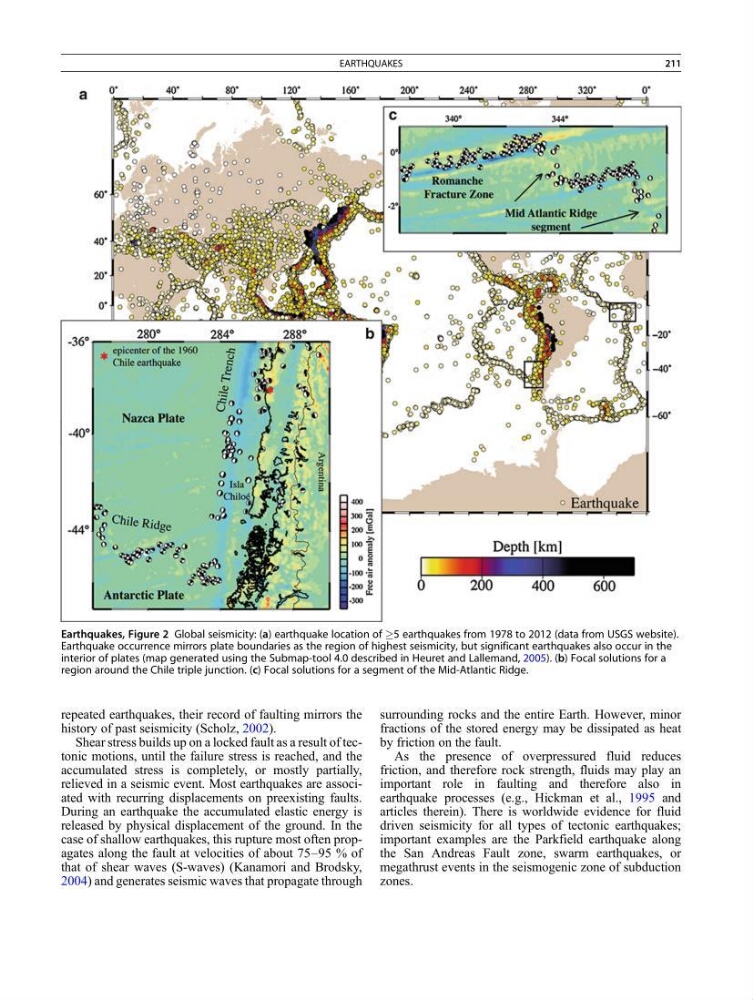
Earthquakes, Figure 2 Global seismicity: (a) earthquake location of !5 earthquakes from 1978 to 2012 (data from USGS website).
Earthquake occurrence mirrors plate boundaries as the region of highest seismicity, but significant earthquakes also occur in the
interior of plates (map generated using the Submap-tool 4.0 described in Heuret and Lallemand, 2005). (b) Focal solutions for a
region around the Chile triple junction. (c) Focal solutions for a segment of the Mid-Atlantic Ridge.
EARTHQUAKES
211
history of past seismicity (Scholz, 2002).
Shear stress builds up on a locked fault as a result of tectonic motions, until the failure stress is reached, and the
accumulated stress is completely, or mostly partially,
relieved in a seismic event. Most earthquakes are associated with recurring displacements on preexisting faults.
During an earthquake the accumulated elastic energy is
released by physical displacement of the ground. In the
case of shallow earthquakes, this rupture most often propagates along the fault at velocities of about 75–95 % of
that of shear waves (S-waves) (Kanamori and Brodsky,
2004) and generates seismic waves that propagate through
surrounding rocks and the entire Earth. However, minor
fractions of the stored energy may be dissipated as heat
by friction on the fault.
As the presence of overpressured fluid reduces
friction, and therefore rock strength, fluids may play an
important role in faulting and therefore also in
earthquake processes (e.g., Hickman et al., 1995 and
articles therein). There is worldwide evidence for fluid
driven seismicity for all types of tectonic earthquakes;
important examples are the Parkfield earthquake along
the San Andreas Fault zone, swarm earthquakes, or
megathrust events in the seismogenic zone of subduction
zones.
Earthquakes, Figure 2 Global seismicity: (a) earthquake location of !5 earthquakes from 1978 to 2012 (data from USGS website).
Earthquake occurrence mirrors plate boundaries as the region of highest seismicity, but significant earthquakes also occur in the
interior of plates (map generated using the Submap-tool 4.0 described in Heuret and Lallemand, 2005). (b) Focal solutions for a
region around the Chile triple junction. (c) Focal solutions for a segment of the Mid-Atlantic Ridge.
EARTHQUAKES
211