

a fault has been initiated, further motion is controlled by
friction along the fault planes. In the fifteenth
century, Leonardo da Vinci experimentally discovered
the two main laws of friction and also observed that rough
surfaces exert higher friction than smooth ones (Scholz,
2002). However, this knowledge remained largely forgotten until in 1699, Amontons described the two main laws
of friction, namely that frictional force is independent of
the size of the surface in contact but is proportional to
normal load.
As friction along faults is often unstable, slip usually
occurs rapidly as a rupture dynamically propagating along
a fault surface, leading to sudden motion that generates
seismic waves. Thus, seismicity is the short-timescale
phenomenon of brittle tectonics, whereas faulting is its
long-timescale expression. As faults move through
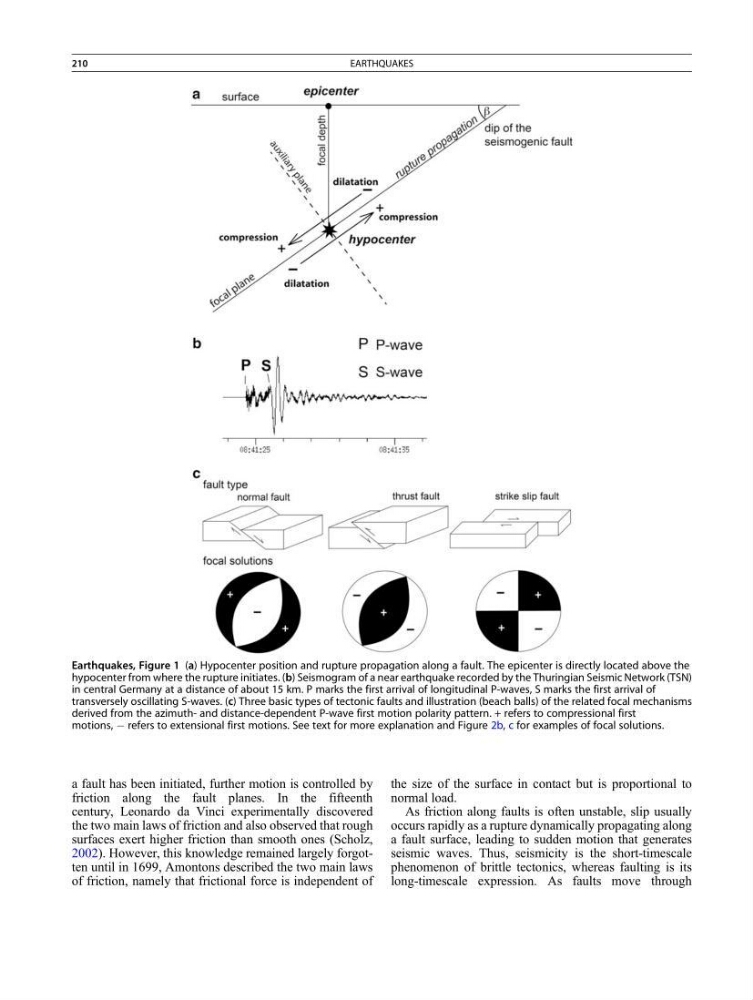
Earthquakes, Figure 1 (a) Hypocenter position and rupture propagation along a fault. The epicenter is directly located above the
hypocenter from where the rupture initiates. (b) Seismogram of a near earthquake recorded by the Thuringian Seismic Network (TSN)
in central Germany at a distance of about 15 km. P marks the first arrival of longitudinal P-waves, S marks the first arrival of
transversely oscillating S-waves. (c) Three basic types of tectonic faults and illustration (beach balls) of the related focal mechanisms
derived from the azimuth- and distance-dependent P-wave first motion polarity pattern. + refers to compressional first
motions, À refers to extensional first motions. See text for more explanation and Figure 2b, c for examples of focal solutions.
210
EARTHQUAKES
friction along the fault planes. In the fifteenth
century, Leonardo da Vinci experimentally discovered
the two main laws of friction and also observed that rough
surfaces exert higher friction than smooth ones (Scholz,
2002). However, this knowledge remained largely forgotten until in 1699, Amontons described the two main laws
of friction, namely that frictional force is independent of
the size of the surface in contact but is proportional to
normal load.
As friction along faults is often unstable, slip usually
occurs rapidly as a rupture dynamically propagating along
a fault surface, leading to sudden motion that generates
seismic waves. Thus, seismicity is the short-timescale
phenomenon of brittle tectonics, whereas faulting is its
long-timescale expression. As faults move through
Earthquakes, Figure 1 (a) Hypocenter position and rupture propagation along a fault. The epicenter is directly located above the
hypocenter from where the rupture initiates. (b) Seismogram of a near earthquake recorded by the Thuringian Seismic Network (TSN)
in central Germany at a distance of about 15 km. P marks the first arrival of longitudinal P-waves, S marks the first arrival of
transversely oscillating S-waves. (c) Three basic types of tectonic faults and illustration (beach balls) of the related focal mechanisms
derived from the azimuth- and distance-dependent P-wave first motion polarity pattern. + refers to compressional first
motions, À refers to extensional first motions. See text for more explanation and Figure 2b, c for examples of focal solutions.
210
EARTHQUAKES