

deposition. Our knowledge on this partitioning both from
models and observation is still quite fragmented
(Mahowald et al., 2005). The few observationally based
estimates suggest that wet deposition is more important
than dry deposition over ocean regions (Hand et al.,
2004), although observations are limited in both space
and time.
Variability of the emissions/deposition in geological
history and present time: Desert dust emission being
very sensitive to climate, dust deposition is not constant
over time. For example, during glacial periods, dust deposition rates were three to four times higher globally (Rea,
1994; Kohfeld and Harrison, 2001) and 2–20 times higher
at high latitude (e.g., Fisher, 1979; Petit et al., 1990;
Steffensen, 1997) compared to interglacial periods. Dust
deposition varied by a factor of 4 regionally in the later
part of the twentieth century (Prospero and Lamb, 2003)
and doubled in the twentieth century over much, but not
the entire globe (Mahowald et al., 2010).
Contribution to ocean sedimentation: The regions
where “arid marine (oceanic) sedimentation” occurs are
located in the tropical zone and cover the same climatic
zones as arid continental regions. The arid oceanic
regions – where evaporation is higher than atmospheric
precipitation – account for about one third of the modern
ocean surface. They are by far larger than the total area
of arid continental sedimentogenesis (Lisitzin, 1996;
Lisitzin, 2011). In North Atlantic, Pacific, and Indian
Ocean deep-sea sediments, dust particles account for up
to 10–50 % or more of the noncarbonate fraction (e.g.,
Chavagnac et al., 2008; Lisitzin, 2011). The sedimentation
rate in these areas is very low (<1 mm/1,000 year). Red
clays and other abyssal sediments contain fine detrital
quartz (diameter <1 mm). Volcanic ashes that are
transformed to authigenic minerals (phillipsite, montmorillonite, clinoptilolite, etc.) play an important role in
Pacific Ocean sediments, suggesting the influence of a tectonic factor, i.e., active margins (Lisitzin, 2011). Using
sediment traps, studies of airborne dust settling in the
water column (e.g., Romero et al., 1999; Lee et al.,
2009; Brust and Waniek, 2010; Ternon et al., 2010)
attempted to link the atmospheric dust input with interior
ocean processes while also providing data for selected
time intervals. It was demonstrated that the lithogenic particle flux in sediment traps differs seasonally and
interannually with no systematic variations between
lithogenic and biogenic flux. In the Mediterranean Sea,
Ternon et al. (2010) revealed a series of “lithogenic
events” (corresponding to both high particulate organic
carbon (POC) and high lithogenic marine fluxes), likely
resulting from interactions between lithogenic particles
and dissolved organic matter present at the time of deposition. Such strong and rapid POC exports are thus not
directly related to a fertilization effect (Bressac and Guieu,
2013) but rather mediated by aggregation processes and
dust ballasting, which can account for ~45 % of the total
annual POC export following an extreme dust event
(Ternon et al., 2010).
Dust and the ocean biogeochemistry: This link has
been mostly explored in iron-limited, high-nutrient
low-chlorophyll (HNLC) regions (i.e., Boyd et al., 2007)
after John Martin formulated his “iron hypothesis” linking
stimulation of new production and atmospheric CO 2
drawdown during the last glacial maximum to higher
atmospheric dust iron inputs at that time. Although a number of in situ mesoscale experiments and microcosm and
mesocosm approaches since the 1990s have improved
our understanding of the actual role of dust input in ocean
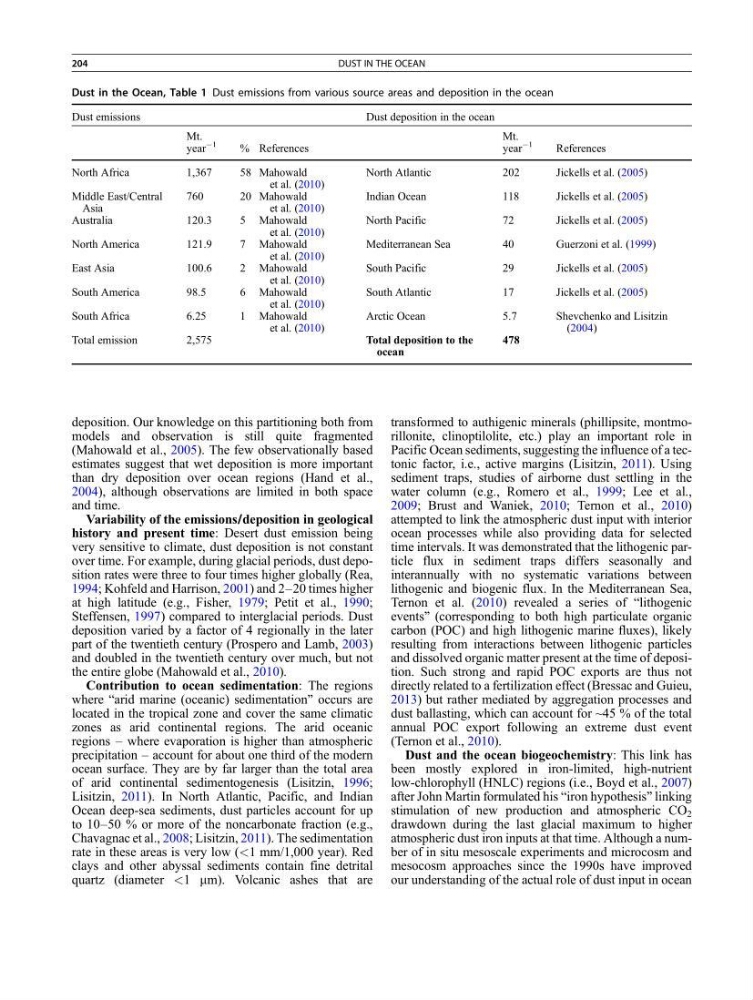
Dust in the Ocean, Table 1 Dust emissions from various source areas and deposition in the ocean
Dust emissions
Dust deposition in the ocean
Mt.
year
À1
% References
Mt.
year
À1
References
North Africa
1,367
58 Mahowald
et al. (2010)
North Atlantic
202
Jickells et al. (2005)
Middle East/Central
Asia
760
20 Mahowald
et al. (2010)
Indian Ocean
118
Jickells et al. (2005)
Australia
120.3
5 Mahowald
et al. (2010)
North Pacific
72
Jickells et al. (2005)
North America
121.9
7 Mahowald
et al. (2010)
Mediterranean Sea
40
Guerzoni et al. (1999)
East Asia
100.6
2 Mahowald
et al. (2010)
South Pacific
29
Jickells et al. (2005)
South America
98.5
6 Mahowald
et al. (2010)
South Atlantic
17
Jickells et al. (2005)
South Africa
6.25
1 Mahowald
et al. (2010)
Arctic Ocean
5.7
Shevchenko and Lisitzin
(2004)
Total emission
2,575
Total deposition to the
ocean
478
204
DUST IN THE OCEAN
models and observation is still quite fragmented
(Mahowald et al., 2005). The few observationally based
estimates suggest that wet deposition is more important
than dry deposition over ocean regions (Hand et al.,
2004), although observations are limited in both space
and time.
Variability of the emissions/deposition in geological
history and present time: Desert dust emission being
very sensitive to climate, dust deposition is not constant
over time. For example, during glacial periods, dust deposition rates were three to four times higher globally (Rea,
1994; Kohfeld and Harrison, 2001) and 2–20 times higher
at high latitude (e.g., Fisher, 1979; Petit et al., 1990;
Steffensen, 1997) compared to interglacial periods. Dust
deposition varied by a factor of 4 regionally in the later
part of the twentieth century (Prospero and Lamb, 2003)
and doubled in the twentieth century over much, but not
the entire globe (Mahowald et al., 2010).
Contribution to ocean sedimentation: The regions
where “arid marine (oceanic) sedimentation” occurs are
located in the tropical zone and cover the same climatic
zones as arid continental regions. The arid oceanic
regions – where evaporation is higher than atmospheric
precipitation – account for about one third of the modern
ocean surface. They are by far larger than the total area
of arid continental sedimentogenesis (Lisitzin, 1996;
Lisitzin, 2011). In North Atlantic, Pacific, and Indian
Ocean deep-sea sediments, dust particles account for up
to 10–50 % or more of the noncarbonate fraction (e.g.,
Chavagnac et al., 2008; Lisitzin, 2011). The sedimentation
rate in these areas is very low (<1 mm/1,000 year). Red
clays and other abyssal sediments contain fine detrital
quartz (diameter <1 mm). Volcanic ashes that are
transformed to authigenic minerals (phillipsite, montmorillonite, clinoptilolite, etc.) play an important role in
Pacific Ocean sediments, suggesting the influence of a tectonic factor, i.e., active margins (Lisitzin, 2011). Using
sediment traps, studies of airborne dust settling in the
water column (e.g., Romero et al., 1999; Lee et al.,
2009; Brust and Waniek, 2010; Ternon et al., 2010)
attempted to link the atmospheric dust input with interior
ocean processes while also providing data for selected
time intervals. It was demonstrated that the lithogenic particle flux in sediment traps differs seasonally and
interannually with no systematic variations between
lithogenic and biogenic flux. In the Mediterranean Sea,
Ternon et al. (2010) revealed a series of “lithogenic
events” (corresponding to both high particulate organic
carbon (POC) and high lithogenic marine fluxes), likely
resulting from interactions between lithogenic particles
and dissolved organic matter present at the time of deposition. Such strong and rapid POC exports are thus not
directly related to a fertilization effect (Bressac and Guieu,
2013) but rather mediated by aggregation processes and
dust ballasting, which can account for ~45 % of the total
annual POC export following an extreme dust event
(Ternon et al., 2010).
Dust and the ocean biogeochemistry: This link has
been mostly explored in iron-limited, high-nutrient
low-chlorophyll (HNLC) regions (i.e., Boyd et al., 2007)
after John Martin formulated his “iron hypothesis” linking
stimulation of new production and atmospheric CO 2
drawdown during the last glacial maximum to higher
atmospheric dust iron inputs at that time. Although a number of in situ mesoscale experiments and microcosm and
mesocosm approaches since the 1990s have improved
our understanding of the actual role of dust input in ocean
Dust in the Ocean, Table 1 Dust emissions from various source areas and deposition in the ocean
Dust emissions
Dust deposition in the ocean
Mt.
year
À1
% References
Mt.
year
À1
References
North Africa
1,367
58 Mahowald
et al. (2010)
North Atlantic
202
Jickells et al. (2005)
Middle East/Central
Asia
760
20 Mahowald
et al. (2010)
Indian Ocean
118
Jickells et al. (2005)
Australia
120.3
5 Mahowald
et al. (2010)
North Pacific
72
Jickells et al. (2005)
North America
121.9
7 Mahowald
et al. (2010)
Mediterranean Sea
40
Guerzoni et al. (1999)
East Asia
100.6
2 Mahowald
et al. (2010)
South Pacific
29
Jickells et al. (2005)
South America
98.5
6 Mahowald
et al. (2010)
South Atlantic
17
Jickells et al. (2005)
South Africa
6.25
1 Mahowald
et al. (2010)
Arctic Ocean
5.7
Shevchenko and Lisitzin
(2004)
Total emission
2,575
Total deposition to the
ocean
478
204
DUST IN THE OCEAN