

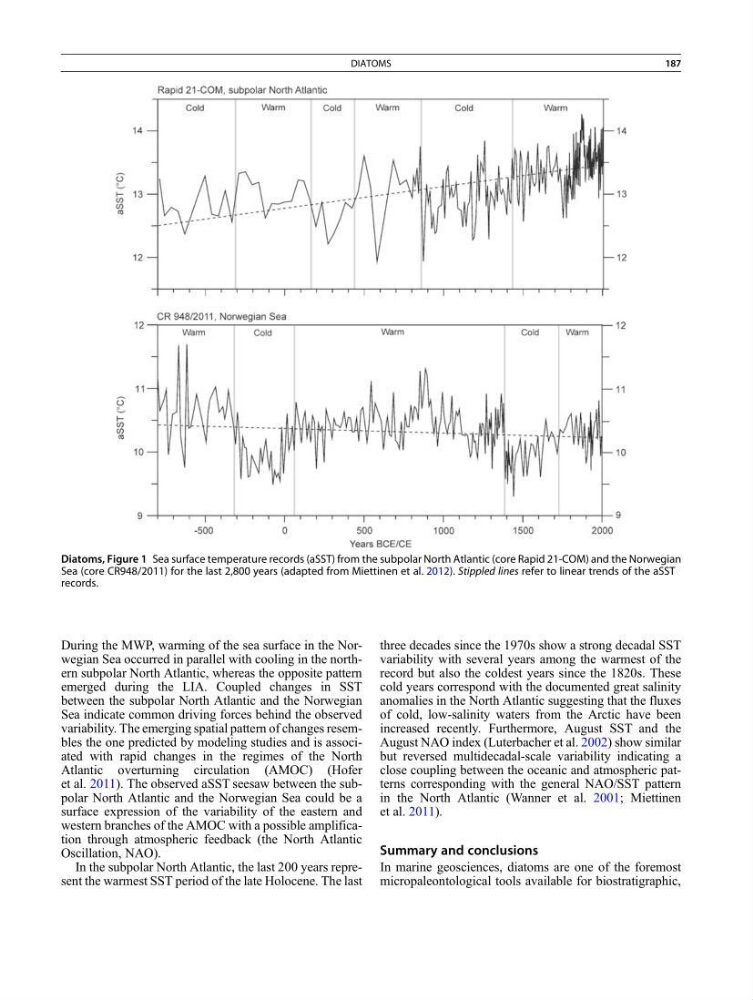
During the MWP, warming of the sea surface in the Norwegian Sea occurred in parallel with cooling in the northern subpolar North Atlantic, whereas the opposite pattern
emerged during the LIA. Coupled changes in SST
between the subpolar North Atlantic and the Norwegian
Sea indicate common driving forces behind the observed
variability. The emerging spatial pattern of changes resembles the one predicted by modeling studies and is associated with rapid changes in the regimes of the North
Atlantic overturning circulation (AMOC) (Hofer
et al. 2011). The observed aSST seesaw between the subpolar North Atlantic and the Norwegian Sea could be a
surface expression of the variability of the eastern and
western branches of the AMOC with a possible amplification through atmospheric feedback (the North Atlantic
Oscillation, NAO).
In the subpolar North Atlantic, the last 200 years represent the warmest SST period of the late Holocene. The last
three decades since the 1970s show a strong decadal SST
variability with several years among the warmest of the
record but also the coldest years since the 1820s. These
cold years correspond with the documented great salinity
anomalies in the North Atlantic suggesting that the fluxes
of cold, low-salinity waters from the Arctic have been
increased recently. Furthermore, August SST and the
August NAO index (Luterbacher et al. 2002) show similar
but reversed multidecadal-scale variability indicating a
close coupling between the oceanic and atmospheric patterns corresponding with the general NAO/SST pattern
in the North Atlantic (Wanner et al. 2001; Miettinen
et al. 2011).
Summary and conclusions
In marine geosciences, diatoms are one of the foremost
micropaleontological tools available for biostratigraphic,
Diatoms, Figure 1 Sea surface temperature records (aSST) from the subpolar North Atlantic (core Rapid 21-COM) and the Norwegian
Sea (core CR948/2011) for the last 2,800 years (adapted from Miettinen et al. 2012). Stippled lines refer to linear trends of the aSST
records.
DIATOMS
187
emerged during the LIA. Coupled changes in SST
between the subpolar North Atlantic and the Norwegian
Sea indicate common driving forces behind the observed
variability. The emerging spatial pattern of changes resembles the one predicted by modeling studies and is associated with rapid changes in the regimes of the North
Atlantic overturning circulation (AMOC) (Hofer
et al. 2011). The observed aSST seesaw between the subpolar North Atlantic and the Norwegian Sea could be a
surface expression of the variability of the eastern and
western branches of the AMOC with a possible amplification through atmospheric feedback (the North Atlantic
Oscillation, NAO).
In the subpolar North Atlantic, the last 200 years represent the warmest SST period of the late Holocene. The last
three decades since the 1970s show a strong decadal SST
variability with several years among the warmest of the
record but also the coldest years since the 1820s. These
cold years correspond with the documented great salinity
anomalies in the North Atlantic suggesting that the fluxes
of cold, low-salinity waters from the Arctic have been
increased recently. Furthermore, August SST and the
August NAO index (Luterbacher et al. 2002) show similar
but reversed multidecadal-scale variability indicating a
close coupling between the oceanic and atmospheric patterns corresponding with the general NAO/SST pattern
in the North Atlantic (Wanner et al. 2001; Miettinen
et al. 2011).
Summary and conclusions
In marine geosciences, diatoms are one of the foremost
micropaleontological tools available for biostratigraphic,
Diatoms, Figure 1 Sea surface temperature records (aSST) from the subpolar North Atlantic (core Rapid 21-COM) and the Norwegian
Sea (core CR948/2011) for the last 2,800 years (adapted from Miettinen et al. 2012). Stippled lines refer to linear trends of the aSST
records.
DIATOMS
187