

marine processes such as waves and longshore currents
(Fisher et al., 1969; Figure 6). The tidal regime of the
receiving basin was not considered in the formulation of
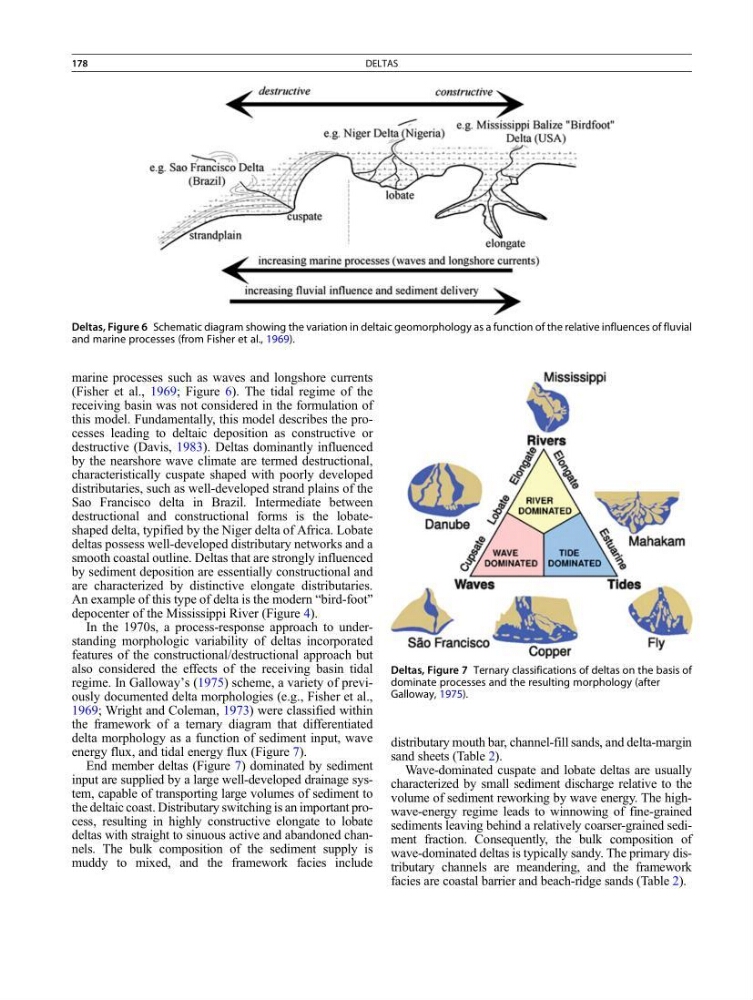
this model. Fundamentally, this model describes the processes leading to deltaic deposition as constructive or
destructive (Davis, 1983). Deltas dominantly influenced
by the nearshore wave climate are termed destructional,
characteristically cuspate shaped with poorly developed
distributaries, such as well-developed strand plains of the
Sao Francisco delta in Brazil. Intermediate between
destructional and constructional forms is the lobateshaped delta, typified by the Niger delta of Africa. Lobate
deltas possess well-developed distributary networks and a
smooth coastal outline. Deltas that are strongly influenced
by sediment deposition are essentially constructional and
are characterized by distinctive elongate distributaries.
An example of this type of delta is the modern “bird-foot”
depocenter of the Mississippi River (Figure 4).
In the 1970s, a process-response approach to understanding morphologic variability of deltas incorporated
features of the constructional/destructional approach but
also considered the effects of the receiving basin tidal
regime. In Galloway’s (1975) scheme, a variety of previously documented delta morphologies (e.g., Fisher et al.,
1969; Wright and Coleman, 1973) were classified within
the framework of a ternary diagram that differentiated
delta morphology as a function of sediment input, wave
energy flux, and tidal energy flux (Figure 7).
End member deltas (Figure 7) dominated by sediment
input are supplied by a large well-developed drainage system, capable of transporting large volumes of sediment to
the deltaic coast. Distributary switching is an important process, resulting in highly constructive elongate to lobate
deltas with straight to sinuous active and abandoned channels. The bulk composition of the sediment supply is
muddy to mixed, and the framework facies include
distributary mouth bar, channel-fill sands, and delta-margin
sand sheets (Table 2).
Wave-dominated cuspate and lobate deltas are usually
characterized by small sediment discharge relative to the
volume of sediment reworking by wave energy. The highwave-energy regime leads to winnowing of fine-grained
sediments leaving behind a relatively coarser-grained sediment fraction. Consequently, the bulk composition of
wave-dominated deltas is typically sandy. The primary distributary channels are meandering, and the framework
facies are coastal barrier and beach-ridge sands (Table 2).
Deltas, Figure 6 Schematic diagram showing the variation in deltaic geomorphology as a function of the relative influences of fluvial
and marine processes (from Fisher et al., 1969).
Deltas, Figure 7 Ternary classifications of deltas on the basis of
dominate processes and the resulting morphology (after
Galloway, 1975).
178
DELTAS
(Fisher et al., 1969; Figure 6). The tidal regime of the
receiving basin was not considered in the formulation of
this model. Fundamentally, this model describes the processes leading to deltaic deposition as constructive or
destructive (Davis, 1983). Deltas dominantly influenced
by the nearshore wave climate are termed destructional,
characteristically cuspate shaped with poorly developed
distributaries, such as well-developed strand plains of the
Sao Francisco delta in Brazil. Intermediate between
destructional and constructional forms is the lobateshaped delta, typified by the Niger delta of Africa. Lobate
deltas possess well-developed distributary networks and a
smooth coastal outline. Deltas that are strongly influenced
by sediment deposition are essentially constructional and
are characterized by distinctive elongate distributaries.
An example of this type of delta is the modern “bird-foot”
depocenter of the Mississippi River (Figure 4).
In the 1970s, a process-response approach to understanding morphologic variability of deltas incorporated
features of the constructional/destructional approach but
also considered the effects of the receiving basin tidal
regime. In Galloway’s (1975) scheme, a variety of previously documented delta morphologies (e.g., Fisher et al.,
1969; Wright and Coleman, 1973) were classified within
the framework of a ternary diagram that differentiated
delta morphology as a function of sediment input, wave
energy flux, and tidal energy flux (Figure 7).
End member deltas (Figure 7) dominated by sediment
input are supplied by a large well-developed drainage system, capable of transporting large volumes of sediment to
the deltaic coast. Distributary switching is an important process, resulting in highly constructive elongate to lobate
deltas with straight to sinuous active and abandoned channels. The bulk composition of the sediment supply is
muddy to mixed, and the framework facies include
distributary mouth bar, channel-fill sands, and delta-margin
sand sheets (Table 2).
Wave-dominated cuspate and lobate deltas are usually
characterized by small sediment discharge relative to the
volume of sediment reworking by wave energy. The highwave-energy regime leads to winnowing of fine-grained
sediments leaving behind a relatively coarser-grained sediment fraction. Consequently, the bulk composition of
wave-dominated deltas is typically sandy. The primary distributary channels are meandering, and the framework
facies are coastal barrier and beach-ridge sands (Table 2).
Deltas, Figure 6 Schematic diagram showing the variation in deltaic geomorphology as a function of the relative influences of fluvial
and marine processes (from Fisher et al., 1969).
Deltas, Figure 7 Ternary classifications of deltas on the basis of
dominate processes and the resulting morphology (after
Galloway, 1975).
178
DELTAS