

Bibliography
Archer, D. E., 1996. A data-driven model of the global calcite
lysocline. Global Biogeochemical Cycles, 10(3), 511–526.
Baker, E. T., and Urabe, T., 1996. Extensive distribution of hydrothermal plumes along the superfast spreading East Pacific Rise,
13
30
0
–18
40
0 S. Journal of Geophysical Research, Solid Earth,
101, 8685–8695.
Balistrieri, L., Brewer, P. G., and Murray, J. W., 1981. Scavenging
residence times of trace metals and surface chemistry of sinking
particles in the deep ocean. Deep Sea Research, 28A, 101–121.
CCD
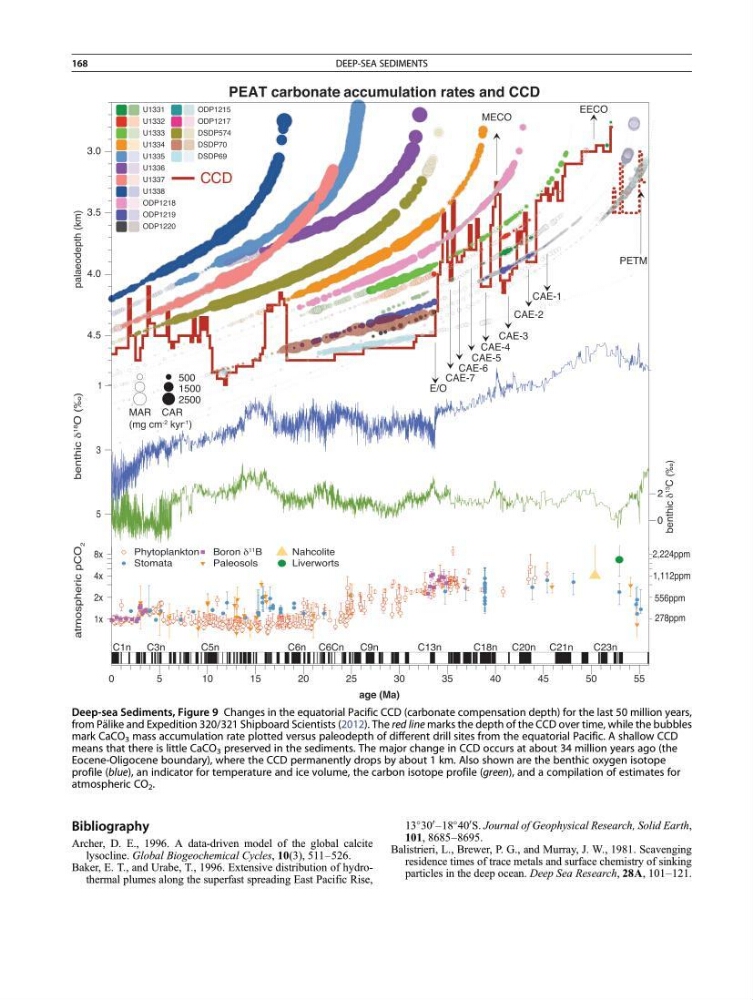
Deep-sea Sediments, Figure 9 Changes in the equatorial Pacific CCD (carbonate compensation depth) for the last 50 million years,
from Pa ¨like and Expedition 320/321 Shipboard Scientists (2012). The red line marks the depth of the CCD over time, while the bubbles
mark CaCO 3 mass accumulation rate plotted versus paleodepth of different drill sites from the equatorial Pacific. A shallow CCD
means that there is little CaCO 3 preserved in the sediments. The major change in CCD occurs at about 34 million years ago (the
Eocene-Oligocene boundary), where the CCD permanently drops by about 1 km. Also shown are the benthic oxygen isotope
profile (blue), an indicator for temperature and ice volume, the carbon isotope profile (green), and a compilation of estimates for
atmospheric CO 2 .
168
DEEP-SEA SEDIMENTS
Archer, D. E., 1996. A data-driven model of the global calcite
lysocline. Global Biogeochemical Cycles, 10(3), 511–526.
Baker, E. T., and Urabe, T., 1996. Extensive distribution of hydrothermal plumes along the superfast spreading East Pacific Rise,
13
30
0
–18
40
0 S. Journal of Geophysical Research, Solid Earth,
101, 8685–8695.
Balistrieri, L., Brewer, P. G., and Murray, J. W., 1981. Scavenging
residence times of trace metals and surface chemistry of sinking
particles in the deep ocean. Deep Sea Research, 28A, 101–121.
CCD
Deep-sea Sediments, Figure 9 Changes in the equatorial Pacific CCD (carbonate compensation depth) for the last 50 million years,
from Pa ¨like and Expedition 320/321 Shipboard Scientists (2012). The red line marks the depth of the CCD over time, while the bubbles
mark CaCO 3 mass accumulation rate plotted versus paleodepth of different drill sites from the equatorial Pacific. A shallow CCD
means that there is little CaCO 3 preserved in the sediments. The major change in CCD occurs at about 34 million years ago (the
Eocene-Oligocene boundary), where the CCD permanently drops by about 1 km. Also shown are the benthic oxygen isotope
profile (blue), an indicator for temperature and ice volume, the carbon isotope profile (green), and a compilation of estimates for
atmospheric CO 2 .
168
DEEP-SEA SEDIMENTS