

ocean crust has been less intensively studied than that in
subsurface sediments. Unlike sediments in which organic
carbon, derived from photosynthesis in the oceans, is the
major energy source for microbial life, inorganic processes in the ocean crusts likely provide the main energy
for the rock-hosted deep biosphere.
Prokaryotic cell abundances on seafloor-exposed
basalts are three to four orders of magnitude greater than
in overlying deep-sea water. Microbiological analyses of
basaltic lavas revealed that the basalt-hosted biosphere
harbor is a substantial community of phylogenetically
and physiologically diverse microorganisms. This community is dominated by Bacteria and comprises at least
16 different taxonomic groups, including all subdivisions
of the proteobacteria (Santelli et al., 2008). As energy
source for these microorganisms, the alteration of basalt,
in particular the oxidation of reduced iron and sulfur in
the basalt, has been suggested (Bach and Edwards,
2003). Evidence for this suggestion comes from textural
observations in altered glass of oceanic pillow basalts
(Fisk et al., 1998), the fact that iron-oxidizing bacteria
can live on basalt glass and increase basalt-weathering
rates (Edwards et al., 2004) and that microbial biomass
and community composition correlate with the age and
alteration state of seafloor basalts (Santelli et al., 2009).
As a competing hypothesis, iron- and manganeseoxidizing bacteria living as biofilms on basalt rock are
rather fed by material from hydrothermal venting than
by basalt-weathering processes explaining the formation
of iron-manganese crusts on basalt surfaces (Templeton
et al., 2009).
Support for microbial life in ocean crust came from the
microbial analyses of borehole fluids (reviewed in
Edwards et al., 2012). For example, ribosomal RNA gene
sequence data of 65
C fluids from a 300-m-deep borehole
indicated the presence of diverse Bacteria and Archaea,
including gene clones of varying degrees of relatedness
to known nitrate reducers (with ammonia production),
thermophilic sulfate reducers, and thermophilic fermentative heterotrophs, all consistent with the fluid chemistry
(Cowen et al., 2003).
Evidence for microbial carbon and sulfur cycling in
deeply buried ridge-flank basalts has been recently given
by the presence of functional genes of methane-cycling
and sulfate-reducing microorganisms, their successful cultivation, as well as signatures of carbon and sulfur stable
isotopes in the drilled basalt core. Hydrogen-producing
abiotic serpentinization reactions have been discussed to
be relevant for providing the energy for these microorganisms (Lever et al., 2013).
In the deepest gabbroic layer of ocean crust, a low
diversity of proteobacterial lineages was observed. These
were related to Bacteria from hydrocarbon-dominated
environments and to known hydrocarbon degraders.
Archaeal 16S rRNA genes were not detected; however,
the functional gene mcr of methanogens was detected as
well as functional genes coding for enzymes involved in
nitrate, sulfate, and metal reduction, carbon and nitrogen
fixation, and ammonium, methane, and toluene oxidation
(Mason et al., 2010). Since hydrocarbons were detected in
the same borehole, probably originating from abiotic
serpentinization reactions, the microbial community is
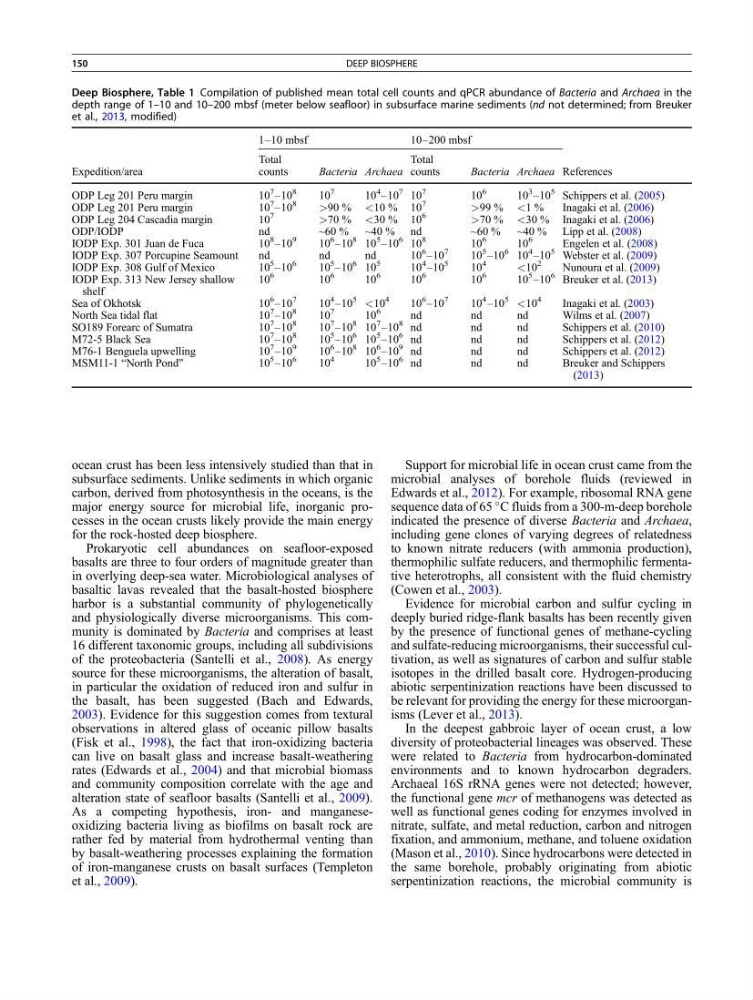
Deep Biosphere, Table 1 Compilation of published mean total cell counts and qPCR abundance of Bacteria and Archaea in the
depth range of 1–10 and 10–200 mbsf (meter below seafloor) in subsurface marine sediments (nd not determined; from Breuker
et al., 2013, modified)
Expedition/area
1–10 mbsf
10–200 mbsf
References
Total
counts
Bacteria Archaea
Total
counts
Bacteria Archaea
ODP Leg 201 Peru margin
10
7 –10
8
10
7
10
4
–10
7 10
7
10
6
10
3 –10
5 Schippers et al. (2005)
ODP Leg 201 Peru margin
10
7 –10
8
>90 % <10 % 10
7
>99 % <1 %
Inagaki et al. (2006)
ODP Leg 204 Cascadia margin
10
7
>70 % <30 % 10
6
>70 % <30 % Inagaki et al. (2006)
ODP/IODP
nd
~60 % ~40 % nd
~60 % ~40 % Lipp et al. (2008)
IODP Exp. 301 Juan de Fuca
10
8 –10
9
10
6 –10
8 10
5
–10
6 10
8
10
6
10
6
Engelen et al. (2008)
IODP Exp. 307 Porcupine Seamount
nd
nd
nd
10
6
–10
7
10
5
–10
6 10
4 –10
5 Webster et al. (2009)
IODP Exp. 308 Gulf of Mexico
10
5 –10
6
10
5 –10
6 10
5
10
4
–10
5
10
4
<10
2
Nunoura et al. (2009)
IODP Exp. 313 New Jersey shallow
shelf
10
6
10
6
10
6
10
6
10
6
10
5 –10
6 Breuker et al. (2013)
Sea of Okhotsk
10
6 –10
7
10
4 –10
5 <10
4
10
6
–10
7
10
4
–10
5 <10
4
Inagaki et al. (2003)
North Sea tidal flat
10
7 –10
8
10
7
10
6
nd
nd
nd
Wilms et al. (2007)
SO189 Forearc of Sumatra
10
7 –10
8
10
7 –10
8 10
7
–10
8 nd
nd
nd
Schippers et al. (2010)
M72-5 Black Sea
10
7 –10
8
10
5 –10
6 10
5
–10
6 nd
nd
nd
Schippers et al. (2012)
M76-1 Benguela upwelling
10
7 –10
9
10
6 –10
8 10
6
–10
9 nd
nd
nd
Schippers et al. (2012)
MSM11-1 “North Pond”
10
5 –10
6
10
4
10
5
–10
6 nd
nd
nd
Breuker and Schippers
(2013)
150
DEEP BIOSPHERE
subsurface sediments. Unlike sediments in which organic
carbon, derived from photosynthesis in the oceans, is the
major energy source for microbial life, inorganic processes in the ocean crusts likely provide the main energy
for the rock-hosted deep biosphere.
Prokaryotic cell abundances on seafloor-exposed
basalts are three to four orders of magnitude greater than
in overlying deep-sea water. Microbiological analyses of
basaltic lavas revealed that the basalt-hosted biosphere
harbor is a substantial community of phylogenetically
and physiologically diverse microorganisms. This community is dominated by Bacteria and comprises at least
16 different taxonomic groups, including all subdivisions
of the proteobacteria (Santelli et al., 2008). As energy
source for these microorganisms, the alteration of basalt,
in particular the oxidation of reduced iron and sulfur in
the basalt, has been suggested (Bach and Edwards,
2003). Evidence for this suggestion comes from textural
observations in altered glass of oceanic pillow basalts
(Fisk et al., 1998), the fact that iron-oxidizing bacteria
can live on basalt glass and increase basalt-weathering
rates (Edwards et al., 2004) and that microbial biomass
and community composition correlate with the age and
alteration state of seafloor basalts (Santelli et al., 2009).
As a competing hypothesis, iron- and manganeseoxidizing bacteria living as biofilms on basalt rock are
rather fed by material from hydrothermal venting than
by basalt-weathering processes explaining the formation
of iron-manganese crusts on basalt surfaces (Templeton
et al., 2009).
Support for microbial life in ocean crust came from the
microbial analyses of borehole fluids (reviewed in
Edwards et al., 2012). For example, ribosomal RNA gene
sequence data of 65
C fluids from a 300-m-deep borehole
indicated the presence of diverse Bacteria and Archaea,
including gene clones of varying degrees of relatedness
to known nitrate reducers (with ammonia production),
thermophilic sulfate reducers, and thermophilic fermentative heterotrophs, all consistent with the fluid chemistry
(Cowen et al., 2003).
Evidence for microbial carbon and sulfur cycling in
deeply buried ridge-flank basalts has been recently given
by the presence of functional genes of methane-cycling
and sulfate-reducing microorganisms, their successful cultivation, as well as signatures of carbon and sulfur stable
isotopes in the drilled basalt core. Hydrogen-producing
abiotic serpentinization reactions have been discussed to
be relevant for providing the energy for these microorganisms (Lever et al., 2013).
In the deepest gabbroic layer of ocean crust, a low
diversity of proteobacterial lineages was observed. These
were related to Bacteria from hydrocarbon-dominated
environments and to known hydrocarbon degraders.
Archaeal 16S rRNA genes were not detected; however,
the functional gene mcr of methanogens was detected as
well as functional genes coding for enzymes involved in
nitrate, sulfate, and metal reduction, carbon and nitrogen
fixation, and ammonium, methane, and toluene oxidation
(Mason et al., 2010). Since hydrocarbons were detected in
the same borehole, probably originating from abiotic
serpentinization reactions, the microbial community is
Deep Biosphere, Table 1 Compilation of published mean total cell counts and qPCR abundance of Bacteria and Archaea in the
depth range of 1–10 and 10–200 mbsf (meter below seafloor) in subsurface marine sediments (nd not determined; from Breuker
et al., 2013, modified)
Expedition/area
1–10 mbsf
10–200 mbsf
References
Total
counts
Bacteria Archaea
Total
counts
Bacteria Archaea
ODP Leg 201 Peru margin
10
7 –10
8
10
7
10
4
–10
7 10
7
10
6
10
3 –10
5 Schippers et al. (2005)
ODP Leg 201 Peru margin
10
7 –10
8
>90 % <10 % 10
7
>99 % <1 %
Inagaki et al. (2006)
ODP Leg 204 Cascadia margin
10
7
>70 % <30 % 10
6
>70 % <30 % Inagaki et al. (2006)
ODP/IODP
nd
~60 % ~40 % nd
~60 % ~40 % Lipp et al. (2008)
IODP Exp. 301 Juan de Fuca
10
8 –10
9
10
6 –10
8 10
5
–10
6 10
8
10
6
10
6
Engelen et al. (2008)
IODP Exp. 307 Porcupine Seamount
nd
nd
nd
10
6
–10
7
10
5
–10
6 10
4 –10
5 Webster et al. (2009)
IODP Exp. 308 Gulf of Mexico
10
5 –10
6
10
5 –10
6 10
5
10
4
–10
5
10
4
<10
2
Nunoura et al. (2009)
IODP Exp. 313 New Jersey shallow
shelf
10
6
10
6
10
6
10
6
10
6
10
5 –10
6 Breuker et al. (2013)
Sea of Okhotsk
10
6 –10
7
10
4 –10
5 <10
4
10
6
–10
7
10
4
–10
5 <10
4
Inagaki et al. (2003)
North Sea tidal flat
10
7 –10
8
10
7
10
6
nd
nd
nd
Wilms et al. (2007)
SO189 Forearc of Sumatra
10
7 –10
8
10
7 –10
8 10
7
–10
8 nd
nd
nd
Schippers et al. (2010)
M72-5 Black Sea
10
7 –10
8
10
5 –10
6 10
5
–10
6 nd
nd
nd
Schippers et al. (2012)
M76-1 Benguela upwelling
10
7 –10
9
10
6 –10
8 10
6
–10
9 nd
nd
nd
Schippers et al. (2012)
MSM11-1 “North Pond”
10
5 –10
6
10
4
10
5
–10
6 nd
nd
nd
Breuker and Schippers
(2013)
150
DEEP BIOSPHERE