

been isolated (Bale et al., 1997). Furthermore, a consortium of Archaea and sulfate-reducing bacteria catalyzes
anaerobic methane oxidation, an important process in
marine sediments regulating the sedimentary flux of methane to the ocean water column (Hoehler et al., 1994;
Boetius et al., 2000; Jørgensen and Boetius, 2007;
Milucka et al., 2012). In deeper sediments, where sulfate
becomes depleted, bacterial methanogenesis and
acetogenesis become quantitatively more important
(Parkes et al., 2000; Heuer et al., 2009; Lever et al.,
2010). Direct evidence for sulfate reduction and
methanogenic activity comes from radiotracer experiments performed on sediments from various ODP Legs
(Cragg et al., 1996; Parkes et al., 2000, 2005; Hoehler
and Jørgensen, 2013).
Organic-lean, oligotrophic, and oxic sediments, with
penetration of molecular oxygen to several meters, host
oxygen-respiring prokaryotes, which likely dominate
organic carbon oxidation (Røy et al., 2012; Ziebis et al.,
2012; Orcutt et al., 2013b). In such sediments radiolysis
of water may provide hydrogen, and thus an energy source
for autotrophic microorganisms independent of photosynthesis (Jørgensen and D’Hondt, 2006; D’Hondt et al.,
2009).
Microbial cells in deeply buried marine sediments
catabolize 10
4
–10
6
-fold more slowly than model organisms in nutrient-rich cultures, representing turnover biomass on timescales of centuries to millennia rather than
hours to days, and subsist with energy fluxes that are
1,000-fold lower than the typical culture-based estimates
of maintenance requirements (Hoehler and Jørgensen,
2013). Furthermore, it has been demonstrated that the
microbial communities and their activities change at sediment interfaces over geological times (Coolen et al., 2002;
Inagaki et al., 2003; Parkes et al., 2005; Schippers et al.,
2012). For example, bacterial populations in subseafloor
sediments from the Sea of Okhotsk, composed of pelagic
clays with several volcanic ash layers containing fine
pumice grains, were approximately two to ten times larger
in the ash layers than those in the clays (Inagaki et al.,
2003).
Microbial diversity and quantification in deep
subsurface sediments
The biomass of the deep subsurface biosphere comprises
the three domains of life Archaea, Bacteria, and Eukarya,
as well as spores and viruses (Schippers et al., 2005, 2012;
Edgcomb et al., 2011; Lomstein et al., 2012; Breuker
et al., 2013; Engelhardt et al., 2013; Orsi et al., 2013a;
Ciobanu et al., 2014). Total cell numbers alone do not provide information about the microbial diversity and the
physiology of the microorganisms that are critical to
understanding deep biosphere biogeochemical processes.
It is important to ask what types of microorganisms are
present and in what abundance and which of these microorganisms are truly active (i.e., not dormant) and participating in deep sedimentary geochemical processes. In
the early days of deep biosphere research, classical cultivation techniques were applied, while nowadays molecular techniques are more frequently used (see below).
Using classical cultivation techniques, i.e., the most
probable number (MPN) cultivation method, various
physiological types of microorganisms have been
enriched from deep sediments and their numbers determined (Cragg et al., 1990, 1996; Barnes et al., 1998;
Parkes et al., 2000, 2009; D’Hondt et al., 2004; Biddle
et al., 2005; Batzke et al., 2007). These types include aerobic ammonifiers, nitrate reducers, fermentative anaerobic
heterotrophs, sulfate reducers, methanogens, acetogens,
and anaerobic hexadecane oxidizers. MPN population
counts ranged from 0 to 10
5 cells/cm
3 and generally
decreased with increasing depth. Most of the prokaryotes
in natural environments do not grow on standard laboratory media since the complex conditions of the natural
habitat are difficult to reproduce. Thus, generally less than
0.6 % of the total cell numbers in deep sediments were
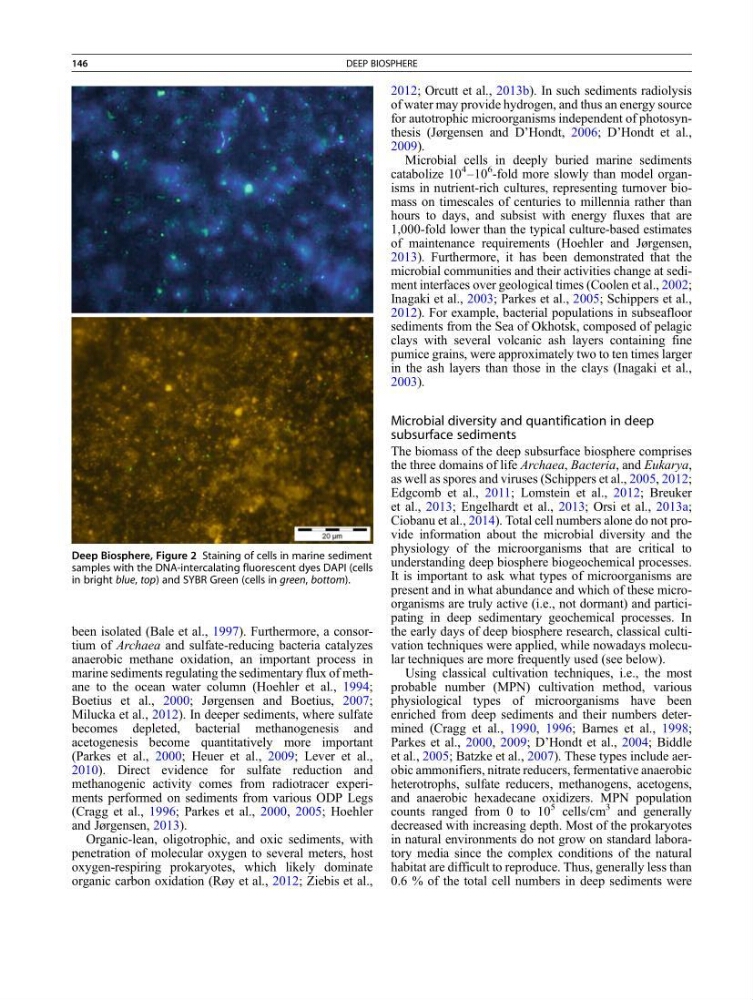
Deep Biosphere, Figure 2 Staining of cells in marine sediment
samples with the DNA-intercalating fluorescent dyes DAPI (cells
in bright blue, top) and SYBR Green (cells in green, bottom).
146
DEEP BIOSPHERE
anaerobic methane oxidation, an important process in
marine sediments regulating the sedimentary flux of methane to the ocean water column (Hoehler et al., 1994;
Boetius et al., 2000; Jørgensen and Boetius, 2007;
Milucka et al., 2012). In deeper sediments, where sulfate
becomes depleted, bacterial methanogenesis and
acetogenesis become quantitatively more important
(Parkes et al., 2000; Heuer et al., 2009; Lever et al.,
2010). Direct evidence for sulfate reduction and
methanogenic activity comes from radiotracer experiments performed on sediments from various ODP Legs
(Cragg et al., 1996; Parkes et al., 2000, 2005; Hoehler
and Jørgensen, 2013).
Organic-lean, oligotrophic, and oxic sediments, with
penetration of molecular oxygen to several meters, host
oxygen-respiring prokaryotes, which likely dominate
organic carbon oxidation (Røy et al., 2012; Ziebis et al.,
2012; Orcutt et al., 2013b). In such sediments radiolysis
of water may provide hydrogen, and thus an energy source
for autotrophic microorganisms independent of photosynthesis (Jørgensen and D’Hondt, 2006; D’Hondt et al.,
2009).
Microbial cells in deeply buried marine sediments
catabolize 10
4
–10
6
-fold more slowly than model organisms in nutrient-rich cultures, representing turnover biomass on timescales of centuries to millennia rather than
hours to days, and subsist with energy fluxes that are
1,000-fold lower than the typical culture-based estimates
of maintenance requirements (Hoehler and Jørgensen,
2013). Furthermore, it has been demonstrated that the
microbial communities and their activities change at sediment interfaces over geological times (Coolen et al., 2002;
Inagaki et al., 2003; Parkes et al., 2005; Schippers et al.,
2012). For example, bacterial populations in subseafloor
sediments from the Sea of Okhotsk, composed of pelagic
clays with several volcanic ash layers containing fine
pumice grains, were approximately two to ten times larger
in the ash layers than those in the clays (Inagaki et al.,
2003).
Microbial diversity and quantification in deep
subsurface sediments
The biomass of the deep subsurface biosphere comprises
the three domains of life Archaea, Bacteria, and Eukarya,
as well as spores and viruses (Schippers et al., 2005, 2012;
Edgcomb et al., 2011; Lomstein et al., 2012; Breuker
et al., 2013; Engelhardt et al., 2013; Orsi et al., 2013a;
Ciobanu et al., 2014). Total cell numbers alone do not provide information about the microbial diversity and the
physiology of the microorganisms that are critical to
understanding deep biosphere biogeochemical processes.
It is important to ask what types of microorganisms are
present and in what abundance and which of these microorganisms are truly active (i.e., not dormant) and participating in deep sedimentary geochemical processes. In
the early days of deep biosphere research, classical cultivation techniques were applied, while nowadays molecular techniques are more frequently used (see below).
Using classical cultivation techniques, i.e., the most
probable number (MPN) cultivation method, various
physiological types of microorganisms have been
enriched from deep sediments and their numbers determined (Cragg et al., 1990, 1996; Barnes et al., 1998;
Parkes et al., 2000, 2009; D’Hondt et al., 2004; Biddle
et al., 2005; Batzke et al., 2007). These types include aerobic ammonifiers, nitrate reducers, fermentative anaerobic
heterotrophs, sulfate reducers, methanogens, acetogens,
and anaerobic hexadecane oxidizers. MPN population
counts ranged from 0 to 10
5 cells/cm
3 and generally
decreased with increasing depth. Most of the prokaryotes
in natural environments do not grow on standard laboratory media since the complex conditions of the natural
habitat are difficult to reproduce. Thus, generally less than
0.6 % of the total cell numbers in deep sediments were
Deep Biosphere, Figure 2 Staining of cells in marine sediment
samples with the DNA-intercalating fluorescent dyes DAPI (cells
in bright blue, top) and SYBR Green (cells in green, bottom).
146
DEEP BIOSPHERE