

than estimates by Whitman et al. (1998). Therefore,
Kallmeyer et al. (2012) estimated the values for the global
biomass in marine sediments to be now 2.9 Â 10
29 cells,
corresponding to 4.1 petagram (Pg) C and ~0.6 % of
Earth’s total living biomass. The total microbial abundance in subseafloor sediments (2.9 Â 10
29 cells) is now
similar to the estimates for the total number of prokaryotes
in seawater (1.2 Â 10
29
) and in soil (2.6 Â 10
29
).
Kallmeyer et al. (2012) were able to count very low cell
numbers by using a protocol in which the cells were
counted after being detached from the sediment particles
which allowed a concentration of more cells on a filter
(Kallmeyer et al., 2008). For cell staining the brighter fluorescent dye SYBR Green was used instead of acridine
orange. SYBR Green is nowadays more frequently used
for total cell counting in sediments than any other dye
(Figure 2; Weinbauer et al., 1998; Engelen et al., 2008;
Morono et al., 2009; Schippers et al., 2010, 2012). Total
cell counts do not provide information about the viability
of the cells and their taxonomy. Using the cellular ribosomal RNA-targeting molecular technique catalyzed
reporter deposition-fluorescence in situ hybridization
(CARD-FISH or FISH), the first direct quantification of
living cells – defined by the presence of ribosomes –
was provided for deep sediment samples from the equatorial Pacific and the Peru margin (ODP Leg 201, Schippers
et al., 2005; Teske, 2005; Biddle et al., 2006). A striking
finding was that a large fraction of the subseafloor prokaryotes is alive, even in very old (16 Ma) and deep
(>400 mbsf) sediments (Schippers et al., 2005). However,
critical for a successful application of CARD-FISH or
FISH seems to be the cell permeabilization protocol
(Lloyd et al., 2013b).
Microbial activity and biogeochemistry in deep
subsurface sediments
Results of the ODP program demonstrated that
subseafloor microbial communities are active in biogeochemical cycling (e.g., Parkes et al., 2000). Within sediments and on rock surfaces, bacteria interact with
minerals, thus catalyzing dissolution, precipitation, and
other surface reactions that have been traditionally viewed
as abiotic (Parkes et al., 2007, 2011). Pore water data from
a large number of Deep Sea Drilling Project (DSDP) and
ODP sites (e.g., Whelan et al., 1986; Kastner et al.,
1990; Borowski et al., 1997; D’Hondt et al., 2004), in particular, decreases in sulfate and increases in methane, and
the presence of hydrogen sulfide has long been identified
by geochemists as manifestations of deep microbial activity. More recently, also stable sulfur isotope measurements
have shown to reflect the activity of deep biosphere
sulfate-reducing microbial communities (Wortmann
et al., 2001). Anaerobic processes, in particular sulfate,
Fe(III), and Mn(IV) reduction and methanogenesis, characterize subsurface marine sediments (D’Hondt et al.,
2004; Schippers et al., 2010). In continental margin sediments, bacterial sulfate reduction can be responsible for
50 % or more of the organic matter degradation
(Jørgensen, 1982; Ferdelman et al., 1999; Fossing et al.,
2000). Consequently, sulfate-reducing bacteria (SRB)
are among the most numerous microorganisms (Sahm
et al., 1999; Ravenschlag et al., 2000; Schippers et al.,
2010, 2012). From deep sediment layers in the Pacific
Ocean, sulfate-reducing bacteria (SRB) have been
enriched with different organic compounds at different
temperatures (Barnes et al., 1998), and a novel barophilic
sulfate-reducing bacterium, Desulfovibrio profundus, has
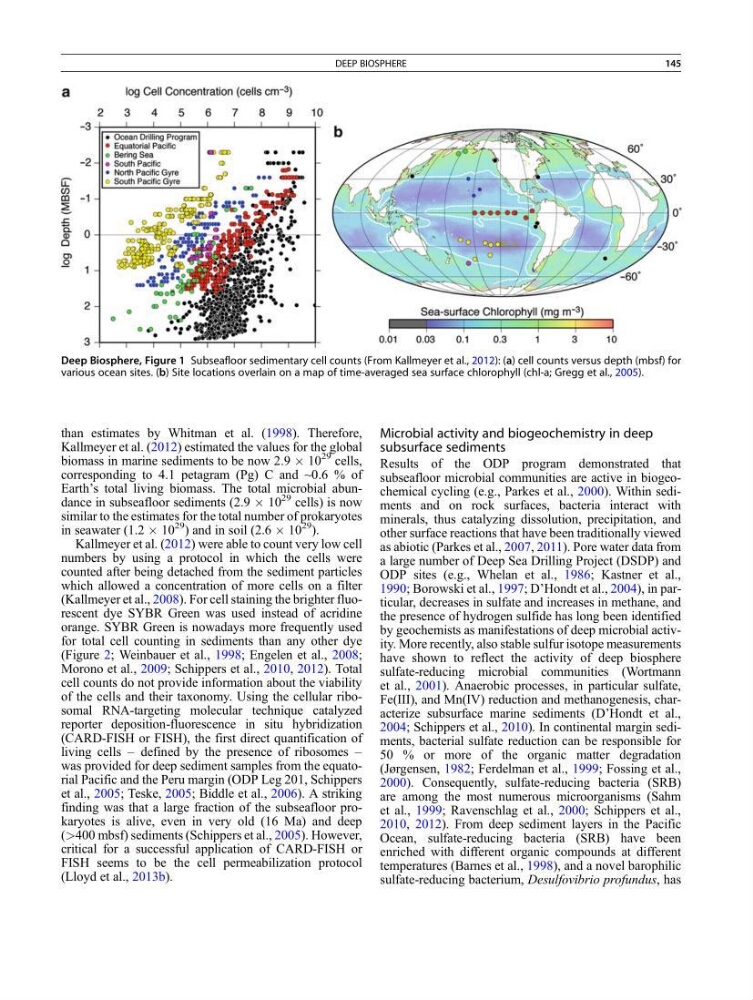
Deep Biosphere, Figure 1 Subseafloor sedimentary cell counts (From Kallmeyer et al., 2012): (a) cell counts versus depth (mbsf) for
various ocean sites. (b) Site locations overlain on a map of time-averaged sea surface chlorophyll (chl-a; Gregg et al., 2005).
DEEP BIOSPHERE
145
Kallmeyer et al. (2012) estimated the values for the global
biomass in marine sediments to be now 2.9 Â 10
29 cells,
corresponding to 4.1 petagram (Pg) C and ~0.6 % of
Earth’s total living biomass. The total microbial abundance in subseafloor sediments (2.9 Â 10
29 cells) is now
similar to the estimates for the total number of prokaryotes
in seawater (1.2 Â 10
29
) and in soil (2.6 Â 10
29
).
Kallmeyer et al. (2012) were able to count very low cell
numbers by using a protocol in which the cells were
counted after being detached from the sediment particles
which allowed a concentration of more cells on a filter
(Kallmeyer et al., 2008). For cell staining the brighter fluorescent dye SYBR Green was used instead of acridine
orange. SYBR Green is nowadays more frequently used
for total cell counting in sediments than any other dye
(Figure 2; Weinbauer et al., 1998; Engelen et al., 2008;
Morono et al., 2009; Schippers et al., 2010, 2012). Total
cell counts do not provide information about the viability
of the cells and their taxonomy. Using the cellular ribosomal RNA-targeting molecular technique catalyzed
reporter deposition-fluorescence in situ hybridization
(CARD-FISH or FISH), the first direct quantification of
living cells – defined by the presence of ribosomes –
was provided for deep sediment samples from the equatorial Pacific and the Peru margin (ODP Leg 201, Schippers
et al., 2005; Teske, 2005; Biddle et al., 2006). A striking
finding was that a large fraction of the subseafloor prokaryotes is alive, even in very old (16 Ma) and deep
(>400 mbsf) sediments (Schippers et al., 2005). However,
critical for a successful application of CARD-FISH or
FISH seems to be the cell permeabilization protocol
(Lloyd et al., 2013b).
Microbial activity and biogeochemistry in deep
subsurface sediments
Results of the ODP program demonstrated that
subseafloor microbial communities are active in biogeochemical cycling (e.g., Parkes et al., 2000). Within sediments and on rock surfaces, bacteria interact with
minerals, thus catalyzing dissolution, precipitation, and
other surface reactions that have been traditionally viewed
as abiotic (Parkes et al., 2007, 2011). Pore water data from
a large number of Deep Sea Drilling Project (DSDP) and
ODP sites (e.g., Whelan et al., 1986; Kastner et al.,
1990; Borowski et al., 1997; D’Hondt et al., 2004), in particular, decreases in sulfate and increases in methane, and
the presence of hydrogen sulfide has long been identified
by geochemists as manifestations of deep microbial activity. More recently, also stable sulfur isotope measurements
have shown to reflect the activity of deep biosphere
sulfate-reducing microbial communities (Wortmann
et al., 2001). Anaerobic processes, in particular sulfate,
Fe(III), and Mn(IV) reduction and methanogenesis, characterize subsurface marine sediments (D’Hondt et al.,
2004; Schippers et al., 2010). In continental margin sediments, bacterial sulfate reduction can be responsible for
50 % or more of the organic matter degradation
(Jørgensen, 1982; Ferdelman et al., 1999; Fossing et al.,
2000). Consequently, sulfate-reducing bacteria (SRB)
are among the most numerous microorganisms (Sahm
et al., 1999; Ravenschlag et al., 2000; Schippers et al.,
2010, 2012). From deep sediment layers in the Pacific
Ocean, sulfate-reducing bacteria (SRB) have been
enriched with different organic compounds at different
temperatures (Barnes et al., 1998), and a novel barophilic
sulfate-reducing bacterium, Desulfovibrio profundus, has
Deep Biosphere, Figure 1 Subseafloor sedimentary cell counts (From Kallmeyer et al., 2012): (a) cell counts versus depth (mbsf) for
various ocean sites. (b) Site locations overlain on a map of time-averaged sea surface chlorophyll (chl-a; Gregg et al., 2005).
DEEP BIOSPHERE
145