

Transport
Sediments in continental margins are hydrologically
active, but the processes that drive fluid flow vary
depending on the tectonic and geologic characteristics of
each site (Figure 1).
Convergent margins – The best-studied cold seeps to date
are located along margins where continental and oceanic
plates converge, such as those found landward of the subduction trenches that rim the Pacific Ocean. Cold seeps in these
settings were first reported in the early 1980s by LaVerne
Kulm and Erwin Suess along the Oregon-Washington coast
(Kulm et al., 1986). To date, cold seepage has been widely
studied from Alaska to southern Chile in the Eastern Pacific
margin, with similar level of research targeting seeps along
the western Pacific offshore Russia, Japan, and New Zealand
as well as the Mediterranean and Black Seas. Additional
seeps have been reported along convergent margins offshore
Makran, Indonesia, and Colombia (review in Suess, 2010).
Pore fluids in the sediments account for as much as
50–70 % of their volume, and these fluids are squeezed
out from the sediment by the lateral compression of plate
movement. As porosity decreases, the rate of
compaction-driven dewatering decreases, and thus water
contribution from intergranular and fracture porosity is
generally largest within the first $3–7 km of burial (see
review by Saffer and Tobin, 2011). With increasing burial,
water is released from hydrous minerals. Common in
these systems is the smectite to illite conversion, which
occurs at temperatures ranging from 60
C to 200
C
(Colten-Bradley, 1987). Fluid flow in convergent margins
appears to control seismogenic behavior, and the extensive research targeting the processes involved in fluid generation has revealed that at $ 10–40 km from the trench,
fluid sources from smectite and, to a lesser extent, opal
dehydration overtake those generated from compaction
(Saffer and Tobin, 2011). The excess water accumulates
in the pore space, where it creates overpressures that drive
flow toward the seafloor. Whether dewatering occurs by
compaction, dehydration, or a combination of these processes, water in convergent margins migrates from deep
horizons through high-permeability zones such as faults,
fractures, or coarse-grained sediment layers.
When methane accumulates as a gas, it can also generate
fractures in response to gas overpressures. Gas migration
through gas-induced hydrofracture networks or via structural (e.g., faults) and lithologic (e.g., sand horizons) pathways has been documented through acoustic imaging in
seismic profiles and by analyses of sediment cores collected
under in situ pressure (e.g., Tréhu et al., 2004; Torres
et al., 2011).
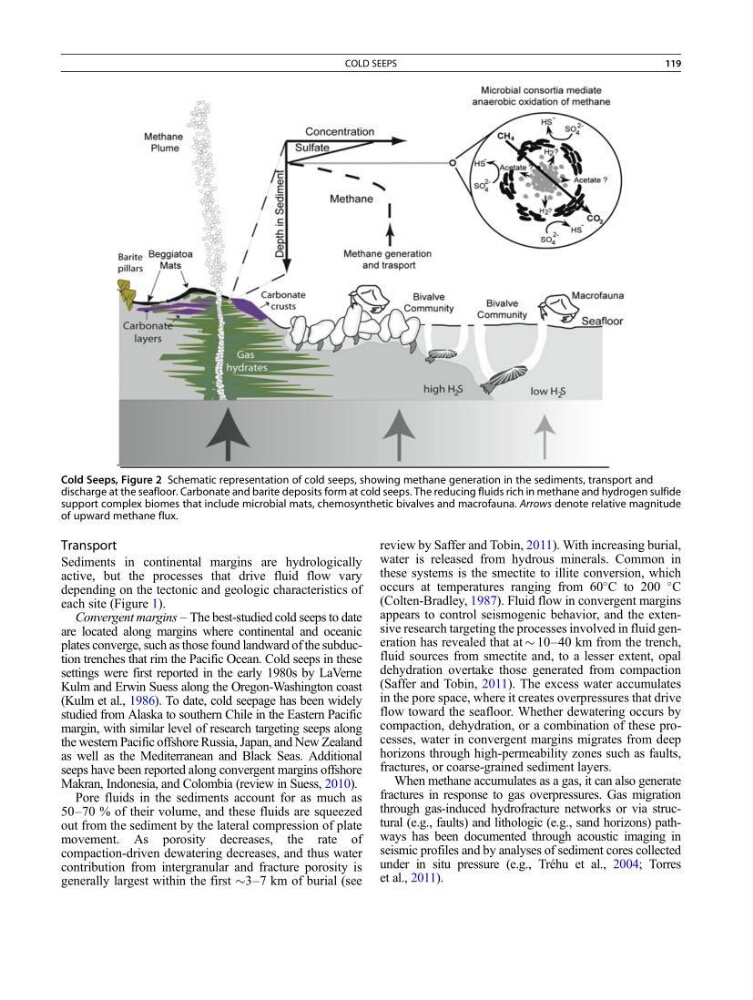
Cold Seeps, Figure 2 Schematic representation of cold seeps, showing methane generation in the sediments, transport and
discharge at the seafloor. Carbonate and barite deposits form at cold seeps. The reducing fluids rich in methane and hydrogen sulfide
support complex biomes that include microbial mats, chemosynthetic bivalves and macrofauna. Arrows denote relative magnitude
of upward methane flux.
COLD SEEPS
119
Sediments in continental margins are hydrologically
active, but the processes that drive fluid flow vary
depending on the tectonic and geologic characteristics of
each site (Figure 1).
Convergent margins – The best-studied cold seeps to date
are located along margins where continental and oceanic
plates converge, such as those found landward of the subduction trenches that rim the Pacific Ocean. Cold seeps in these
settings were first reported in the early 1980s by LaVerne
Kulm and Erwin Suess along the Oregon-Washington coast
(Kulm et al., 1986). To date, cold seepage has been widely
studied from Alaska to southern Chile in the Eastern Pacific
margin, with similar level of research targeting seeps along
the western Pacific offshore Russia, Japan, and New Zealand
as well as the Mediterranean and Black Seas. Additional
seeps have been reported along convergent margins offshore
Makran, Indonesia, and Colombia (review in Suess, 2010).
Pore fluids in the sediments account for as much as
50–70 % of their volume, and these fluids are squeezed
out from the sediment by the lateral compression of plate
movement. As porosity decreases, the rate of
compaction-driven dewatering decreases, and thus water
contribution from intergranular and fracture porosity is
generally largest within the first $3–7 km of burial (see
review by Saffer and Tobin, 2011). With increasing burial,
water is released from hydrous minerals. Common in
these systems is the smectite to illite conversion, which
occurs at temperatures ranging from 60
C to 200
C
(Colten-Bradley, 1987). Fluid flow in convergent margins
appears to control seismogenic behavior, and the extensive research targeting the processes involved in fluid generation has revealed that at $ 10–40 km from the trench,
fluid sources from smectite and, to a lesser extent, opal
dehydration overtake those generated from compaction
(Saffer and Tobin, 2011). The excess water accumulates
in the pore space, where it creates overpressures that drive
flow toward the seafloor. Whether dewatering occurs by
compaction, dehydration, or a combination of these processes, water in convergent margins migrates from deep
horizons through high-permeability zones such as faults,
fractures, or coarse-grained sediment layers.
When methane accumulates as a gas, it can also generate
fractures in response to gas overpressures. Gas migration
through gas-induced hydrofracture networks or via structural (e.g., faults) and lithologic (e.g., sand horizons) pathways has been documented through acoustic imaging in
seismic profiles and by analyses of sediment cores collected
under in situ pressure (e.g., Tréhu et al., 2004; Torres
et al., 2011).
Cold Seeps, Figure 2 Schematic representation of cold seeps, showing methane generation in the sediments, transport and
discharge at the seafloor. Carbonate and barite deposits form at cold seeps. The reducing fluids rich in methane and hydrogen sulfide
support complex biomes that include microbial mats, chemosynthetic bivalves and macrofauna. Arrows denote relative magnitude
of upward methane flux.
COLD SEEPS
119