

Definition
Cold seepage denotes the emission at the seafloor of deepsourced fluids enriched in methane and hydrogen sulfide,
which support a characteristic biome based on chemosynthetic organisms.
Basic process
Oxygen enters the ocean surface water through contact
with the atmosphere. From there, dissolved oxygen is
brought to greater depths by sinking and circulation of
water masses, so that in the majority of the deep oceans,
there is enough oxygen to support aerobic decomposition
of organic matter. Against this well-oxygenated hydrosphere, discrete locations on the seafloor experience localized discharge of highly reducing fluids from the
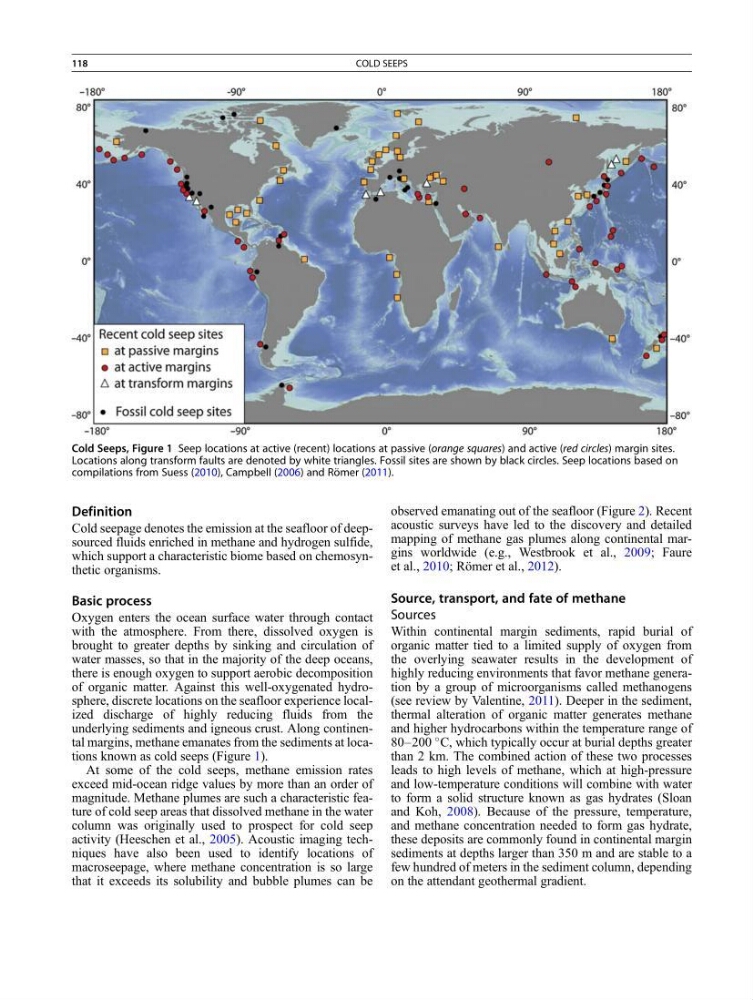
underlying sediments and igneous crust. Along continental margins, methane emanates from the sediments at locations known as cold seeps (Figure 1).
At some of the cold seeps, methane emission rates
exceed mid-ocean ridge values by more than an order of
magnitude. Methane plumes are such a characteristic feature of cold seep areas that dissolved methane in the water
column was originally used to prospect for cold seep
activity (Heeschen et al., 2005). Acoustic imaging techniques have also been used to identify locations of
macroseepage, where methane concentration is so large
that it exceeds its solubility and bubble plumes can be
observed emanating out of the seafloor (Figure 2). Recent
acoustic surveys have led to the discovery and detailed
mapping of methane gas plumes along continental margins worldwide (e.g., Westbrook et al., 2009; Faure
et al., 2010; Römer et al., 2012).
Source, transport, and fate of methane
Sources
Within continental margin sediments, rapid burial of
organic matter tied to a limited supply of oxygen from
the overlying seawater results in the development of
highly reducing environments that favor methane generation by a group of microorganisms called methanogens
(see review by Valentine, 2011). Deeper in the sediment,
thermal alteration of organic matter generates methane
and higher hydrocarbons within the temperature range of
80–200
C, which typically occur at burial depths greater
than 2 km. The combined action of these two processes
leads to high levels of methane, which at high-pressure
and low-temperature conditions will combine with water
to form a solid structure known as gas hydrates (Sloan
and Koh, 2008). Because of the pressure, temperature,
and methane concentration needed to form gas hydrate,
these deposits are commonly found in continental margin
sediments at depths larger than 350 m and are stable to a
few hundred of meters in the sediment column, depending
on the attendant geothermal gradient.
Cold Seeps, Figure 1 Seep locations at active (recent) locations at passive (orange squares) and active (red circles) margin sites.
Locations along transform faults are denoted by white triangles. Fossil sites are shown by black circles. Seep locations based on
compilations from Suess (2010), Campbell (2006) and Ro ¨ mer (2011).
118
COLD SEEPS
Cold seepage denotes the emission at the seafloor of deepsourced fluids enriched in methane and hydrogen sulfide,
which support a characteristic biome based on chemosynthetic organisms.
Basic process
Oxygen enters the ocean surface water through contact
with the atmosphere. From there, dissolved oxygen is
brought to greater depths by sinking and circulation of
water masses, so that in the majority of the deep oceans,
there is enough oxygen to support aerobic decomposition
of organic matter. Against this well-oxygenated hydrosphere, discrete locations on the seafloor experience localized discharge of highly reducing fluids from the
underlying sediments and igneous crust. Along continental margins, methane emanates from the sediments at locations known as cold seeps (Figure 1).
At some of the cold seeps, methane emission rates
exceed mid-ocean ridge values by more than an order of
magnitude. Methane plumes are such a characteristic feature of cold seep areas that dissolved methane in the water
column was originally used to prospect for cold seep
activity (Heeschen et al., 2005). Acoustic imaging techniques have also been used to identify locations of
macroseepage, where methane concentration is so large
that it exceeds its solubility and bubble plumes can be
observed emanating out of the seafloor (Figure 2). Recent
acoustic surveys have led to the discovery and detailed
mapping of methane gas plumes along continental margins worldwide (e.g., Westbrook et al., 2009; Faure
et al., 2010; Römer et al., 2012).
Source, transport, and fate of methane
Sources
Within continental margin sediments, rapid burial of
organic matter tied to a limited supply of oxygen from
the overlying seawater results in the development of
highly reducing environments that favor methane generation by a group of microorganisms called methanogens
(see review by Valentine, 2011). Deeper in the sediment,
thermal alteration of organic matter generates methane
and higher hydrocarbons within the temperature range of
80–200
C, which typically occur at burial depths greater
than 2 km. The combined action of these two processes
leads to high levels of methane, which at high-pressure
and low-temperature conditions will combine with water
to form a solid structure known as gas hydrates (Sloan
and Koh, 2008). Because of the pressure, temperature,
and methane concentration needed to form gas hydrate,
these deposits are commonly found in continental margin
sediments at depths larger than 350 m and are stable to a
few hundred of meters in the sediment column, depending
on the attendant geothermal gradient.
Cold Seeps, Figure 1 Seep locations at active (recent) locations at passive (orange squares) and active (red circles) margin sites.
Locations along transform faults are denoted by white triangles. Fossil sites are shown by black circles. Seep locations based on
compilations from Suess (2010), Campbell (2006) and Ro ¨ mer (2011).
118
COLD SEEPS