

The “AdvectionTerm” can be expressed as ÀU Á ∇C, and
“DiffusionTerm” by ∇ Á (D Á ∇C), where U and
D represent the velocity vector and diffusivity tensor,
respectively, and ∇ ¼ i
@ðÞ
@x þ j
@ðÞ
@y þ k
@ðÞ
@z , that is, the
Hamiltonian. The “Source-Sink” term deals with the
chemical reaction(s) that alters the element concentration
at molecular level. In the simulations with the 3D model,
usually the analytical solutions are not valid anymore;
however, the fine and heterogeneous structures of the
Bottom Sediments
hv
Atmosphere
Harvest
CO 2
CO 2
Bacteria
Flagellates
Ciliates
Viruses
Microbial Loop
Component
Phytoplankton
Zooplankton
Fish
Main Food Chain
Component
Element Cycles
(N, P, Si, Fe, ……)
Organic Matter
Marine Food-web
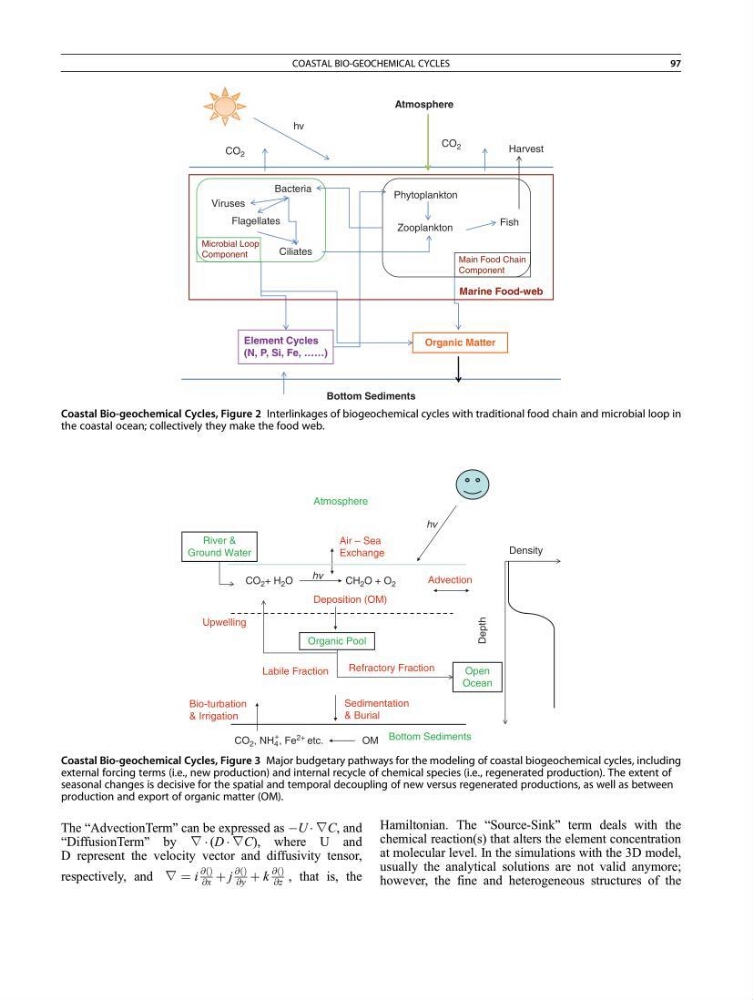
Coastal Bio-geochemical Cycles, Figure 2 Interlinkages of biogeochemical cycles with traditional food chain and microbial loop in
the coastal ocean; collectively they make the food web.
hv
Bottom Sediments
CO 2 + H 2 O
hv
CH 2 O + O 2
Atmosphere
Air – Sea
Exchange
Upwelling
Deposition (OM)
Sedimentation
& Burial
Bio-turbation
& Irrigation
Density
Depth
Advection
River &
Ground Water
Organic Pool
Open
Ocean
Refractory Fraction
Labile Fraction
OM
CO 2 , NH 4
+
, Fe
2+ etc.
Coastal Bio-geochemical Cycles, Figure 3 Major budgetary pathways for the modeling of coastal biogeochemical cycles, including
external forcing terms (i.e., new production) and internal recycle of chemical species (i.e., regenerated production). The extent of
seasonal changes is decisive for the spatial and temporal decoupling of new versus regenerated productions, as well as between
production and export of organic matter (OM).
COASTAL BIO-GEOCHEMICAL CYCLES
97
“DiffusionTerm” by ∇ Á (D Á ∇C), where U and
D represent the velocity vector and diffusivity tensor,
respectively, and ∇ ¼ i
@ðÞ
@x þ j
@ðÞ
@y þ k
@ðÞ
@z , that is, the
Hamiltonian. The “Source-Sink” term deals with the
chemical reaction(s) that alters the element concentration
at molecular level. In the simulations with the 3D model,
usually the analytical solutions are not valid anymore;
however, the fine and heterogeneous structures of the
Bottom Sediments
hv
Atmosphere
Harvest
CO 2
CO 2
Bacteria
Flagellates
Ciliates
Viruses
Microbial Loop
Component
Phytoplankton
Zooplankton
Fish
Main Food Chain
Component
Element Cycles
(N, P, Si, Fe, ……)
Organic Matter
Marine Food-web
Coastal Bio-geochemical Cycles, Figure 2 Interlinkages of biogeochemical cycles with traditional food chain and microbial loop in
the coastal ocean; collectively they make the food web.
hv
Bottom Sediments
CO 2 + H 2 O
hv
CH 2 O + O 2
Atmosphere
Air – Sea
Exchange
Upwelling
Deposition (OM)
Sedimentation
& Burial
Bio-turbation
& Irrigation
Density
Depth
Advection
River &
Ground Water
Organic Pool
Open
Ocean
Refractory Fraction
Labile Fraction
OM
CO 2 , NH 4
+
, Fe
2+ etc.
Coastal Bio-geochemical Cycles, Figure 3 Major budgetary pathways for the modeling of coastal biogeochemical cycles, including
external forcing terms (i.e., new production) and internal recycle of chemical species (i.e., regenerated production). The extent of
seasonal changes is decisive for the spatial and temporal decoupling of new versus regenerated productions, as well as between
production and export of organic matter (OM).
COASTAL BIO-GEOCHEMICAL CYCLES
97