

biogeochemical cycles in the ocean. Within the microbial
loop, organic matter is used by bacteria in the water column and pore waters to form new biomass that can be
grazed by Protozoa, including flagellates and ciliates,
which is then fed by zooplankton and linked to the higher
trophic levels of the food web. The microbial loop also
comprises pico-phytoplankton and autotrophic bacteria
(Azam and Malfatti, 2007). In the ocean, functioning of
the microbial loop is similar to a filtration system, by
selective use of readily decomposed molecules (i.e., labile
fraction) of organic matter, leaving the residual fraction
being more refractory in nature and thus not readily used
by organisms (Hopkinson and Vallino, 2005). The microbial loop in the coastal environment is also fueled with
organic matter from the terrestrial sources (e.g., river)
and from atmospheric wet (e.g., rainfall) and dry (i.e.,
aerosols and gases) depositions.
In Figure 2, the major biogenic functional groups that
link the biogeochemical cycles with the structure of food
web of ecosystems in the coastal ocean are summarized
as a conceptual model. Due to the diverse topography
and hydrographical forcing, the biogeochemical cycles
in shallow coastal seas exhibit considerably stronger spatial and temporal variations when compared to the open
ocean. For instance, coastal systems are exposed to tidal
forcing and constrained in semi-enclosed basins landward
from the coastline or connected to the open ocean through
channels/straits between islands, whereas systems
affected by the large rivers can extend seaward to the shelf
break and even beyond. Thus, horizontal and vertical gradients in hydrographic and chemical forcings induce that
biogeochemical cycles have a zonal nature. Briefly, the
coastal waters under influence from terrestrial influx can
suffer strongly from eutrophication, where photosynthesis
(p) can be exceeded by community respiration (r) (i.e.,
p À r < 0), and the ecosystem becomes heterotrophic with
occurrence of hypoxia and/or anoxia in near-bottom
waters; in the areas closer to the open ocean on the
other side, the environment becomes more oligotrophic
and the photosynthesis is higher than respiration (i.e.,
p Àr > 0), and the ecosystem turns to be autotrophic
(Bauer and Bianchi, 2011).
Biogeochemical modeling and budgets of the
coastal ocean
The quantitative description of coastal biogeochemical
cycles integrates our understandings of interactions of
chemical species between biotic and abiotic compartments
and the dynamic processes of biogeochemistry that regulate the transfer of elements from the sources to the sinks
including the fluxes across the boundaries between the
coastal ecosystems and adjacent marine and/or land provinces (Figure 3).
The early studies of biogeochemical budgets relied on
the application of a “box model,” owing to the limitation
of available data sets and the lack of the ability of mathematic calculations. In the box model, the system of interest
is considered well mixed and at the steady state, that is, the
concentration and fluxes of a given chemical species do
not change with time, and the principle of energy and/or
mass balances can be used to solve the problems; usually
the calculation of ordinary differential equation(s) is
incorporated.
In the more sophisticated studies, the equations that
describe the chemical reactions and/or biogeochemical
pathways (i.e., parameterization) are coupled with the
1D to 3D numerical models that simulate the hydrodynamic processes and sedimentary dynamics (e.g., transport of the total suspended matter). The output data can
be plotted against timescales, showing the variability in
spatial and temporal dimensions. In the numerical simulations, the change of concentration (C) for a volume of
water parcel at a given location can be described as
@C
@t
¼ AdvectionTerm
½
þDiffusionTerm ½
þ Source À Sink
½
Structure and Function Complexity
Oxidation State
NO 3
−
Organic N
NH 4
+
N 2 O
NO 2
−
N 2
Assimilation
Assimilation
Denitrification
Nitrification
Fixation
Dissimilatory Nitrate Reduction
Re-mineralization
Anammox
NO
−3
−2
−1
0
1
2
3
5
4
1b
Structure and Function Complexity
Oxidation State
CH 2 O
CO 2
CO 3
2−
HCO 3
−
CaCO 3
C n (H 2 O) m
CH 4
CO
C n H 2n+2
R-COOH
Methane Oxidation
Photosynthesis
Respiration
Fermentation
Bio-synthesis
Bio-degradation
Calcification vs Dissolution
−4
−3
−2
−1
0
1
2
4
3
1a
a
b
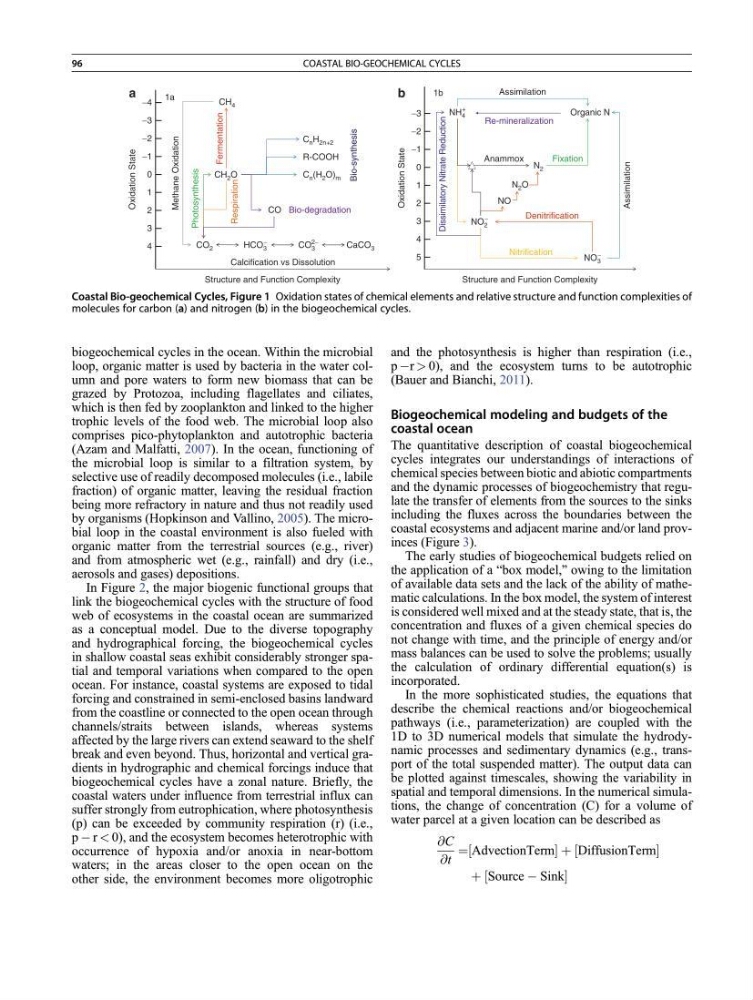
Coastal Bio-geochemical Cycles, Figure 1 Oxidation states of chemical elements and relative structure and function complexities of
molecules for carbon (a) and nitrogen (b) in the biogeochemical cycles.
96
COASTAL BIO-GEOCHEMICAL CYCLES
loop, organic matter is used by bacteria in the water column and pore waters to form new biomass that can be
grazed by Protozoa, including flagellates and ciliates,
which is then fed by zooplankton and linked to the higher
trophic levels of the food web. The microbial loop also
comprises pico-phytoplankton and autotrophic bacteria
(Azam and Malfatti, 2007). In the ocean, functioning of
the microbial loop is similar to a filtration system, by
selective use of readily decomposed molecules (i.e., labile
fraction) of organic matter, leaving the residual fraction
being more refractory in nature and thus not readily used
by organisms (Hopkinson and Vallino, 2005). The microbial loop in the coastal environment is also fueled with
organic matter from the terrestrial sources (e.g., river)
and from atmospheric wet (e.g., rainfall) and dry (i.e.,
aerosols and gases) depositions.
In Figure 2, the major biogenic functional groups that
link the biogeochemical cycles with the structure of food
web of ecosystems in the coastal ocean are summarized
as a conceptual model. Due to the diverse topography
and hydrographical forcing, the biogeochemical cycles
in shallow coastal seas exhibit considerably stronger spatial and temporal variations when compared to the open
ocean. For instance, coastal systems are exposed to tidal
forcing and constrained in semi-enclosed basins landward
from the coastline or connected to the open ocean through
channels/straits between islands, whereas systems
affected by the large rivers can extend seaward to the shelf
break and even beyond. Thus, horizontal and vertical gradients in hydrographic and chemical forcings induce that
biogeochemical cycles have a zonal nature. Briefly, the
coastal waters under influence from terrestrial influx can
suffer strongly from eutrophication, where photosynthesis
(p) can be exceeded by community respiration (r) (i.e.,
p À r < 0), and the ecosystem becomes heterotrophic with
occurrence of hypoxia and/or anoxia in near-bottom
waters; in the areas closer to the open ocean on the
other side, the environment becomes more oligotrophic
and the photosynthesis is higher than respiration (i.e.,
p Àr > 0), and the ecosystem turns to be autotrophic
(Bauer and Bianchi, 2011).
Biogeochemical modeling and budgets of the
coastal ocean
The quantitative description of coastal biogeochemical
cycles integrates our understandings of interactions of
chemical species between biotic and abiotic compartments
and the dynamic processes of biogeochemistry that regulate the transfer of elements from the sources to the sinks
including the fluxes across the boundaries between the
coastal ecosystems and adjacent marine and/or land provinces (Figure 3).
The early studies of biogeochemical budgets relied on
the application of a “box model,” owing to the limitation
of available data sets and the lack of the ability of mathematic calculations. In the box model, the system of interest
is considered well mixed and at the steady state, that is, the
concentration and fluxes of a given chemical species do
not change with time, and the principle of energy and/or
mass balances can be used to solve the problems; usually
the calculation of ordinary differential equation(s) is
incorporated.
In the more sophisticated studies, the equations that
describe the chemical reactions and/or biogeochemical
pathways (i.e., parameterization) are coupled with the
1D to 3D numerical models that simulate the hydrodynamic processes and sedimentary dynamics (e.g., transport of the total suspended matter). The output data can
be plotted against timescales, showing the variability in
spatial and temporal dimensions. In the numerical simulations, the change of concentration (C) for a volume of
water parcel at a given location can be described as
@C
@t
¼ AdvectionTerm
½
þDiffusionTerm ½
þ Source À Sink
½
Structure and Function Complexity
Oxidation State
NO 3
−
Organic N
NH 4
+
N 2 O
NO 2
−
N 2
Assimilation
Assimilation
Denitrification
Nitrification
Fixation
Dissimilatory Nitrate Reduction
Re-mineralization
Anammox
NO
−3
−2
−1
0
1
2
3
5
4
1b
Structure and Function Complexity
Oxidation State
CH 2 O
CO 2
CO 3
2−
HCO 3
−
CaCO 3
C n (H 2 O) m
CH 4
CO
C n H 2n+2
R-COOH
Methane Oxidation
Photosynthesis
Respiration
Fermentation
Bio-synthesis
Bio-degradation
Calcification vs Dissolution
−4
−3
−2
−1
0
1
2
4
3
1a
a
b
Coastal Bio-geochemical Cycles, Figure 1 Oxidation states of chemical elements and relative structure and function complexities of
molecules for carbon (a) and nitrogen (b) in the biogeochemical cycles.
96
COASTAL BIO-GEOCHEMICAL CYCLES