

Introduction
Our understanding of the ocean was built up along with
the ambition of navigation and exploration of marine
resources by human beings that started more than 2000
years ago. The coastal ocean, because of its proximity to
the land, is the marine environment that has been extensively explored by our human societies. For instance,
about 1,500 years ago, our ancestors from Asia started to
reclaim the coastal areas for salt production and for agriculture, and the early history of marine trade in the Middle
East can be tracked back to the epoch far before the tenth
century.
The modern knowledge of biogeochemical cycles
started to be established in the late nineteenth century in
Northern Europe where scientists began to determine the
chemical composition of seawaters from coastal and open
oceans. However, the process studies of the dynamics of
the biogeochemical cycles only began in the second half
of the twentieth century, benefiting from the technical
innovations in clean sample collection in seagoing observations and instrumental analysis in the laboratory, particularly when trace elements were of concern.
Besides, the rapid increase and change of human being
activities in the environment are a great challenge for the
study of biogeochemical cycles. For instance, the enormous
increase in agricultural production after the 1930s–1940s
by the application of chemically synthesized fertilizers has
considerably modified the seaward fluxes of some macronutrients (i.e., N and P), with a deterioration of adjacent
coastal environments, such as eutrophication and hypoxia.
More recently, the worldwide dam construction over the
watersheds has dramatically reduced the sediment loads to
the sea, and in some of the rivers, there has been a reduction
of flux of dissolved silicate that induces a change in the phytoplankton community structure (e.g., change in biomass
from diatoms to flagellates) with a profound impact on
the marine food web.
In this work, we briefly review the major aspects of the
coastal biogeochemical cycles and address a number of
key issues that affect the biogeochemistry of coastal ocean
and link to the health of marine ecosystems and sustainability of their exploitation.
External driving forces
Different from the open ocean, the ecosystems of the
coastal environment can be taken as overstressed, because
of the combined effects of climate change and anthropogenic perturbations. Although either natural forcing or
human being activity can be reasonably characterized with
state-of-art observational techniques and simulations, the
combined effect of these two categories of driving forces
is hardly predictable with our up-to-date knowledge and
existing data of ocean sciences. This can be exemplified
by the comparison with the interaction of different waves
in physics: the interaction of individual waves (e.g., in a
pond) is nonlinear mode and can produce a new wave spectrum with different period/frequency and amplification.
The natural driving force of the coastal ocean is related
to the global and climate changes, with a number of basinwide persistent processes and systematic trends, e.g.,
global warming, the sea-level rise, and ocean acidification, as well as by processes with relatively fast and
episodic characters with annual and interannual
variability, e.g., tropical cyclones and storms, and change
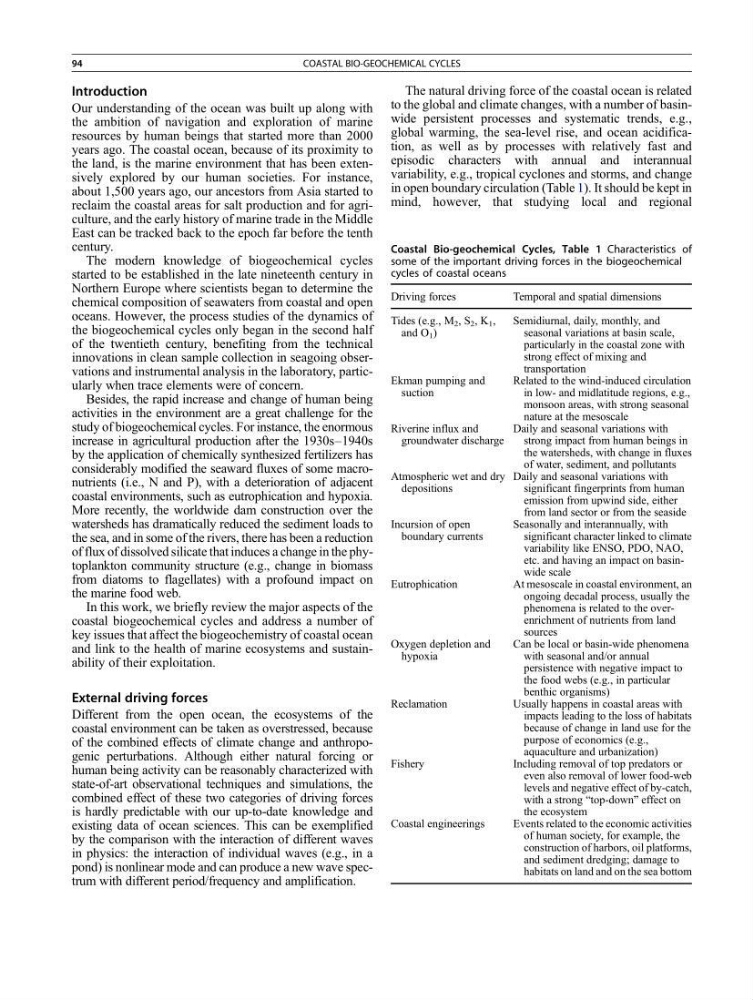
in open boundary circulation (Table 1). It should be kept in
mind, however, that studying local and regional
Coastal Bio-geochemical Cycles, Table 1 Characteristics of
some of the important driving forces in the biogeochemical
cycles of coastal oceans
Driving forces
Temporal and spatial dimensions
Tides (e.g., M 2 , S 2 , K 1 ,
and O 1 )
Semidiurnal, daily, monthly, and
seasonal variations at basin scale,
particularly in the coastal zone with
strong effect of mixing and
transportation
Ekman pumping and
suction
Related to the wind-induced circulation
in low- and midlatitude regions, e.g.,
monsoon areas, with strong seasonal
nature at the mesoscale
Riverine influx and
groundwater discharge
Daily and seasonal variations with
strong impact from human beings in
the watersheds, with change in fluxes
of water, sediment, and pollutants
Atmospheric wet and dry
depositions
Daily and seasonal variations with
significant fingerprints from human
emission from upwind side, either
from land sector or from the seaside
Incursion of open
boundary currents
Seasonally and interannually, with
significant character linked to climate
variability like ENSO, PDO, NAO,
etc. and having an impact on basinwide scale
Eutrophication
At mesoscale in coastal environment, an
ongoing decadal process, usually the
phenomena is related to the overenrichment of nutrients from land
sources
Oxygen depletion and
hypoxia
Can be local or basin-wide phenomena
with seasonal and/or annual
persistence with negative impact to
the food webs (e.g., in particular
benthic organisms)
Reclamation
Usually happens in coastal areas with
impacts leading to the loss of habitats
because of change in land use for the
purpose of economics (e.g.,
aquaculture and urbanization)
Fishery
Including removal of top predators or
even also removal of lower food-web
levels and negative effect of by-catch,
with a strong “top-down” effect on
the ecosystem
Coastal engineerings
Events related to the economic activities
of human society, for example, the
construction of harbors, oil platforms,
and sediment dredging; damage to
habitats on land and on the sea bottom
94
COASTAL BIO-GEOCHEMICAL CYCLES
Our understanding of the ocean was built up along with
the ambition of navigation and exploration of marine
resources by human beings that started more than 2000
years ago. The coastal ocean, because of its proximity to
the land, is the marine environment that has been extensively explored by our human societies. For instance,
about 1,500 years ago, our ancestors from Asia started to
reclaim the coastal areas for salt production and for agriculture, and the early history of marine trade in the Middle
East can be tracked back to the epoch far before the tenth
century.
The modern knowledge of biogeochemical cycles
started to be established in the late nineteenth century in
Northern Europe where scientists began to determine the
chemical composition of seawaters from coastal and open
oceans. However, the process studies of the dynamics of
the biogeochemical cycles only began in the second half
of the twentieth century, benefiting from the technical
innovations in clean sample collection in seagoing observations and instrumental analysis in the laboratory, particularly when trace elements were of concern.
Besides, the rapid increase and change of human being
activities in the environment are a great challenge for the
study of biogeochemical cycles. For instance, the enormous
increase in agricultural production after the 1930s–1940s
by the application of chemically synthesized fertilizers has
considerably modified the seaward fluxes of some macronutrients (i.e., N and P), with a deterioration of adjacent
coastal environments, such as eutrophication and hypoxia.
More recently, the worldwide dam construction over the
watersheds has dramatically reduced the sediment loads to
the sea, and in some of the rivers, there has been a reduction
of flux of dissolved silicate that induces a change in the phytoplankton community structure (e.g., change in biomass
from diatoms to flagellates) with a profound impact on
the marine food web.
In this work, we briefly review the major aspects of the
coastal biogeochemical cycles and address a number of
key issues that affect the biogeochemistry of coastal ocean
and link to the health of marine ecosystems and sustainability of their exploitation.
External driving forces
Different from the open ocean, the ecosystems of the
coastal environment can be taken as overstressed, because
of the combined effects of climate change and anthropogenic perturbations. Although either natural forcing or
human being activity can be reasonably characterized with
state-of-art observational techniques and simulations, the
combined effect of these two categories of driving forces
is hardly predictable with our up-to-date knowledge and
existing data of ocean sciences. This can be exemplified
by the comparison with the interaction of different waves
in physics: the interaction of individual waves (e.g., in a
pond) is nonlinear mode and can produce a new wave spectrum with different period/frequency and amplification.
The natural driving force of the coastal ocean is related
to the global and climate changes, with a number of basinwide persistent processes and systematic trends, e.g.,
global warming, the sea-level rise, and ocean acidification, as well as by processes with relatively fast and
episodic characters with annual and interannual
variability, e.g., tropical cyclones and storms, and change
in open boundary circulation (Table 1). It should be kept in
mind, however, that studying local and regional
Coastal Bio-geochemical Cycles, Table 1 Characteristics of
some of the important driving forces in the biogeochemical
cycles of coastal oceans
Driving forces
Temporal and spatial dimensions
Tides (e.g., M 2 , S 2 , K 1 ,
and O 1 )
Semidiurnal, daily, monthly, and
seasonal variations at basin scale,
particularly in the coastal zone with
strong effect of mixing and
transportation
Ekman pumping and
suction
Related to the wind-induced circulation
in low- and midlatitude regions, e.g.,
monsoon areas, with strong seasonal
nature at the mesoscale
Riverine influx and
groundwater discharge
Daily and seasonal variations with
strong impact from human beings in
the watersheds, with change in fluxes
of water, sediment, and pollutants
Atmospheric wet and dry
depositions
Daily and seasonal variations with
significant fingerprints from human
emission from upwind side, either
from land sector or from the seaside
Incursion of open
boundary currents
Seasonally and interannually, with
significant character linked to climate
variability like ENSO, PDO, NAO,
etc. and having an impact on basinwide scale
Eutrophication
At mesoscale in coastal environment, an
ongoing decadal process, usually the
phenomena is related to the overenrichment of nutrients from land
sources
Oxygen depletion and
hypoxia
Can be local or basin-wide phenomena
with seasonal and/or annual
persistence with negative impact to
the food webs (e.g., in particular
benthic organisms)
Reclamation
Usually happens in coastal areas with
impacts leading to the loss of habitats
because of change in land use for the
purpose of economics (e.g.,
aquaculture and urbanization)
Fishery
Including removal of top predators or
even also removal of lower food-web
levels and negative effect of by-catch,
with a strong “top-down” effect on
the ecosystem
Coastal engineerings
Events related to the economic activities
of human society, for example, the
construction of harbors, oil platforms,
and sediment dredging; damage to
habitats on land and on the sea bottom
94
COASTAL BIO-GEOCHEMICAL CYCLES