

in sea-level might eliminate most of the sediment production zone. This sedimentation pattern with sea-levelrelated sharp changes in sediment production is called
highstand shedding (e.g., Schlager et al., 1994). One could
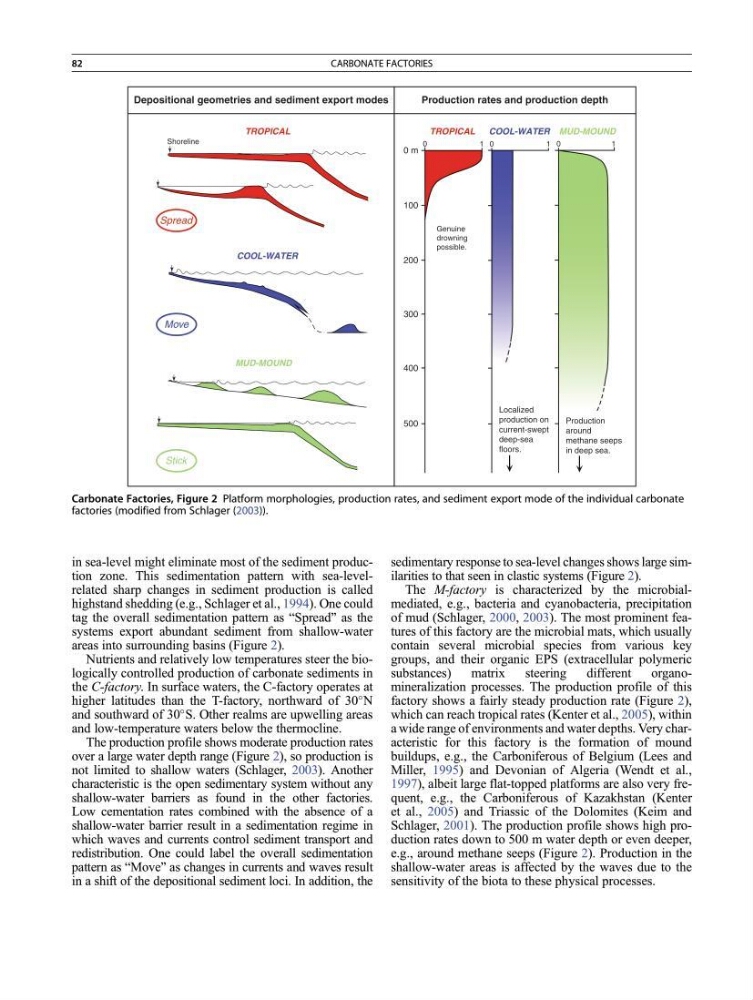
tag the overall sedimentation pattern as “Spread” as the
systems export abundant sediment from shallow-water
areas into surrounding basins (Figure 2).
Nutrients and relatively low temperatures steer the biologically controlled production of carbonate sediments in
the C-factory. In surface waters, the C-factory operates at
higher latitudes than the T-factory, northward of 30
N
and southward of 30
S. Other realms are upwelling areas
and low-temperature waters below the thermocline.
The production profile shows moderate production rates
over a large water depth range (Figure 2), so production is
not limited to shallow waters (Schlager, 2003). Another
characteristic is the open sedimentary system without any
shallow-water barriers as found in the other factories.
Low cementation rates combined with the absence of a
shallow-water barrier result in a sedimentation regime in
which waves and currents control sediment transport and
redistribution. One could label the overall sedimentation
pattern as “Move” as changes in currents and waves result
in a shift of the depositional sediment loci. In addition, the
sedimentary response to sea-level changes shows large similarities to that seen in clastic systems (Figure 2).
The M-factory is characterized by the microbialmediated, e.g., bacteria and cyanobacteria, precipitation
of mud (Schlager, 2000, 2003). The most prominent features of this factory are the microbial mats, which usually
contain several microbial species from various key
groups, and their organic EPS (extracellular polymeric
substances)
matrix
steering
different
organomineralization processes. The production profile of this
factory shows a fairly steady production rate (Figure 2),
which can reach tropical rates (Kenter et al., 2005), within
a wide range of environments and water depths. Very characteristic for this factory is the formation of mound
buildups, e.g., the Carboniferous of Belgium (Lees and
Miller, 1995) and Devonian of Algeria (Wendt et al.,
1997), albeit large flat-topped platforms are also very frequent, e.g., the Carboniferous of Kazakhstan (Kenter
et al., 2005) and Triassic of the Dolomites (Keim and
Schlager, 2001). The production profile shows high production rates down to 500 m water depth or even deeper,
e.g., around methane seeps (Figure 2). Production in the
shallow-water areas is affected by the waves due to the
sensitivity of the biota to these physical processes.
Shoreline
TROPICAL
COOL-WATER
MUD-MOUND
COOL-WATER
1
0
0
Localized
production on
current-swept
deep-sea
floors.
0 m
100
200
300
400
500
TROPICAL
1
Genuine
drowning
possible.
0
MUD-MOUND
1
Production
around
methane seeps
in deep sea.
Depositional geometries and sediment export modes
Production rates and production depth
Spread
Move
Stick
Carbonate Factories, Figure 2 Platform morphologies, production rates, and sediment export mode of the individual carbonate
factories (modified from Schlager (2003)).
82
CARBONATE FACTORIES
highstand shedding (e.g., Schlager et al., 1994). One could
tag the overall sedimentation pattern as “Spread” as the
systems export abundant sediment from shallow-water
areas into surrounding basins (Figure 2).
Nutrients and relatively low temperatures steer the biologically controlled production of carbonate sediments in
the C-factory. In surface waters, the C-factory operates at
higher latitudes than the T-factory, northward of 30
N
and southward of 30
S. Other realms are upwelling areas
and low-temperature waters below the thermocline.
The production profile shows moderate production rates
over a large water depth range (Figure 2), so production is
not limited to shallow waters (Schlager, 2003). Another
characteristic is the open sedimentary system without any
shallow-water barriers as found in the other factories.
Low cementation rates combined with the absence of a
shallow-water barrier result in a sedimentation regime in
which waves and currents control sediment transport and
redistribution. One could label the overall sedimentation
pattern as “Move” as changes in currents and waves result
in a shift of the depositional sediment loci. In addition, the
sedimentary response to sea-level changes shows large similarities to that seen in clastic systems (Figure 2).
The M-factory is characterized by the microbialmediated, e.g., bacteria and cyanobacteria, precipitation
of mud (Schlager, 2000, 2003). The most prominent features of this factory are the microbial mats, which usually
contain several microbial species from various key
groups, and their organic EPS (extracellular polymeric
substances)
matrix
steering
different
organomineralization processes. The production profile of this
factory shows a fairly steady production rate (Figure 2),
which can reach tropical rates (Kenter et al., 2005), within
a wide range of environments and water depths. Very characteristic for this factory is the formation of mound
buildups, e.g., the Carboniferous of Belgium (Lees and
Miller, 1995) and Devonian of Algeria (Wendt et al.,
1997), albeit large flat-topped platforms are also very frequent, e.g., the Carboniferous of Kazakhstan (Kenter
et al., 2005) and Triassic of the Dolomites (Keim and
Schlager, 2001). The production profile shows high production rates down to 500 m water depth or even deeper,
e.g., around methane seeps (Figure 2). Production in the
shallow-water areas is affected by the waves due to the
sensitivity of the biota to these physical processes.
Shoreline
TROPICAL
COOL-WATER
MUD-MOUND
COOL-WATER
1
0
0
Localized
production on
current-swept
deep-sea
floors.
0 m
100
200
300
400
500
TROPICAL
1
Genuine
drowning
possible.
0
MUD-MOUND
1
Production
around
methane seeps
in deep sea.
Depositional geometries and sediment export modes
Production rates and production depth
Spread
Move
Stick
Carbonate Factories, Figure 2 Platform morphologies, production rates, and sediment export mode of the individual carbonate
factories (modified from Schlager (2003)).
82
CARBONATE FACTORIES