

the Great Salt Lake (Stephens, 1990; Harris et al.,
2013). Porter et al. (1999) showed, for the Florida Keys
coral reef system, that elevated salinities could diminish the negative effects of elevated temperature and
conclude that temperature and salinity have opposing
effects on coral photosynthesis. In restricted environments, however, biotic diversity might be reduced
(Miocene, SE Spain; e.g., Braga and Martin, 1996).
The influence of the aforementioned factors on the
growth strategies of skeletal and microbial precipitation
and on the formation of non-skeletal particles differs for
each component. Various strategies will result in different
products at different times. Schlager (2000, 2003, 2005)
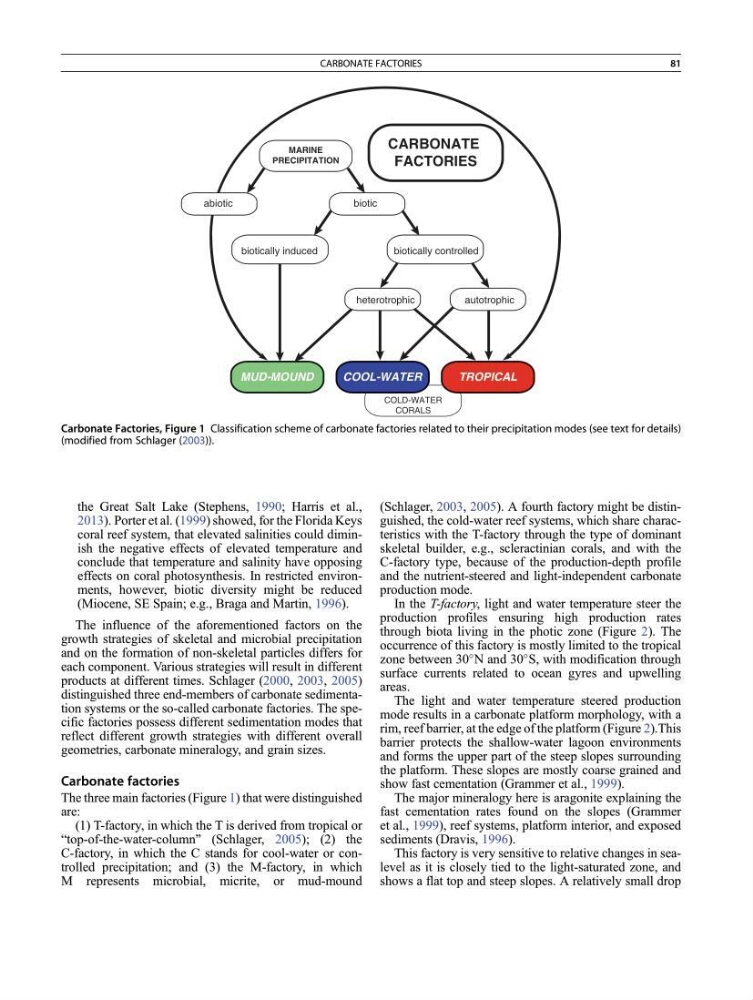
distinguished three end-members of carbonate sedimentation systems or the so-called carbonate factories. The specific factories possess different sedimentation modes that
reflect different growth strategies with different overall
geometries, carbonate mineralogy, and grain sizes.
Carbonate factories
The three main factories (Figure 1) that were distinguished
are:
(1) T-factory, in which the T is derived from tropical or
“top-of-the-water-column” (Schlager, 2005); (2) the
C-factory, in which the C stands for cool-water or controlled precipitation; and (3) the M-factory, in which
M represents microbial, micrite, or mud-mound
(Schlager, 2003, 2005). A fourth factory might be distinguished, the cold-water reef systems, which share characteristics with the T-factory through the type of dominant
skeletal builder, e.g., scleractinian corals, and with the
C-factory type, because of the production-depth profile
and the nutrient-steered and light-independent carbonate
production mode.
In the T-factory, light and water temperature steer the
production profiles ensuring high production rates
through biota living in the photic zone (Figure 2). The
occurrence of this factory is mostly limited to the tropical
zone between 30
N and 30
S, with modification through
surface currents related to ocean gyres and upwelling
areas.
The light and water temperature steered production
mode results in a carbonate platform morphology, with a
rim, reef barrier, at the edge of the platform (Figure 2).This
barrier protects the shallow-water lagoon environments
and forms the upper part of the steep slopes surrounding
the platform. These slopes are mostly coarse grained and
show fast cementation (Grammer et al., 1999).
The major mineralogy here is aragonite explaining the
fast cementation rates found on the slopes (Grammer
et al., 1999), reef systems, platform interior, and exposed
sediments (Dravis, 1996).
This factory is very sensitive to relative changes in sealevel as it is closely tied to the light-saturated zone, and
shows a flat top and steep slopes. A relatively small drop
CARBONATE
FACTORIES
abiotic
biotically induced
TROPICAL
biotically controlled
biotic
autotrophic
MUD-MOUND
COOL-WATER
MARINE
PRECIPITATION
COLD-WATER
CORALS
heterotrophic
Carbonate Factories, Figure 1 Classification scheme of carbonate factories related to their precipitation modes (see text for details)
(modified from Schlager (2003)).
CARBONATE FACTORIES
81
2013). Porter et al. (1999) showed, for the Florida Keys
coral reef system, that elevated salinities could diminish the negative effects of elevated temperature and
conclude that temperature and salinity have opposing
effects on coral photosynthesis. In restricted environments, however, biotic diversity might be reduced
(Miocene, SE Spain; e.g., Braga and Martin, 1996).
The influence of the aforementioned factors on the
growth strategies of skeletal and microbial precipitation
and on the formation of non-skeletal particles differs for
each component. Various strategies will result in different
products at different times. Schlager (2000, 2003, 2005)
distinguished three end-members of carbonate sedimentation systems or the so-called carbonate factories. The specific factories possess different sedimentation modes that
reflect different growth strategies with different overall
geometries, carbonate mineralogy, and grain sizes.
Carbonate factories
The three main factories (Figure 1) that were distinguished
are:
(1) T-factory, in which the T is derived from tropical or
“top-of-the-water-column” (Schlager, 2005); (2) the
C-factory, in which the C stands for cool-water or controlled precipitation; and (3) the M-factory, in which
M represents microbial, micrite, or mud-mound
(Schlager, 2003, 2005). A fourth factory might be distinguished, the cold-water reef systems, which share characteristics with the T-factory through the type of dominant
skeletal builder, e.g., scleractinian corals, and with the
C-factory type, because of the production-depth profile
and the nutrient-steered and light-independent carbonate
production mode.
In the T-factory, light and water temperature steer the
production profiles ensuring high production rates
through biota living in the photic zone (Figure 2). The
occurrence of this factory is mostly limited to the tropical
zone between 30
N and 30
S, with modification through
surface currents related to ocean gyres and upwelling
areas.
The light and water temperature steered production
mode results in a carbonate platform morphology, with a
rim, reef barrier, at the edge of the platform (Figure 2).This
barrier protects the shallow-water lagoon environments
and forms the upper part of the steep slopes surrounding
the platform. These slopes are mostly coarse grained and
show fast cementation (Grammer et al., 1999).
The major mineralogy here is aragonite explaining the
fast cementation rates found on the slopes (Grammer
et al., 1999), reef systems, platform interior, and exposed
sediments (Dravis, 1996).
This factory is very sensitive to relative changes in sealevel as it is closely tied to the light-saturated zone, and
shows a flat top and steep slopes. A relatively small drop
CARBONATE
FACTORIES
abiotic
biotically induced
TROPICAL
biotically controlled
biotic
autotrophic
MUD-MOUND
COOL-WATER
MARINE
PRECIPITATION
COLD-WATER
CORALS
heterotrophic
Carbonate Factories, Figure 1 Classification scheme of carbonate factories related to their precipitation modes (see text for details)
(modified from Schlager (2003)).
CARBONATE FACTORIES
81